Source: International Herald Tribune
ROME: Police in Rome said Tuesday they recovered dozens of looted artifacts, including a fresco believed to have been stripped from an ancient Roman villa.
Police were investigating 31 people who allegedly operated in Italy and France as part of a European art trafficking ring, a police statement said. No arrests had been made.
The remains of the fresco, which was stolen in the 1970s, are believed to belong to the 1st century A.D. villa of the Emperor Nero's wife Poppea in a site near Pompeii, police said in the statement.
The villa is in the area hit by the eruption in A.D. 79 of Mount Vesuvius, which killed thousands of people and buried Pompeii and neighboring towns in 6 meters (20 feet) of volcanic ash.
Also recovered were two 4th century B.C. vases from the southern region of Apulia and other pottery of Greek origin imported millennia ago by the Etruscan civilization in central Italy.
Italian police said the items turned up in collections in Switzerland, France and Spain and were recovered with the help of local authorities.
Calls to police for details were not answered.
During a raid on a house in Milan, police also seized 22 forgeries of paintings by artists including Renoir, Picasso, Modigliani, Monet and Degas, the statement said.
Wednesday, February 20, 2008


Monday, February 11, 2008
Tooth scan reveals Neanderthal mobility
Source: AP via Yahoo! News
By ELENA BECATOROS, Associated Press Writer Sat Feb 9, 2:21 AM ET
ATHENS, Greece - Analysis of a 40,000-year-old tooth found in southern Greece suggests Neanderthals were more mobile than once thought, paleontologists said Friday.
Analysis of the tooth — part of the first and only Neanderthal remains found in Greece — showed the ancient human had spent at least part of its life away from the area where it died.
"Neanderthal mobility is highly controversial," said paleoanthropologist Katerina Harvati at the Max Planck Institute for Evolutionary Anthropology in Leipzig, Germany.
Some experts believe Neanderthals roamed over very limited areas, but others say they must have been more mobile, particularly when hunting, Harvati said.
Until now, experts only had indirect evidence, including stone used in tools, Harvati said. "Our analysis is the first that brings evidence from a Neanderthal fossil itself," she said.
The findings by the Max Planck Institute team were published in the Journal of Archaeological Science.
The tooth was found in a seaside excavation in Greece's southern Peloponnese region in 2002.
The team analyzed tooth enamel for ratios of a strontium isotope, a naturally occurring metal found in food and water. Levels of the metal vary in different areas.
Eleni Panagopoulou of the Paleoanthropology-Speleology Department of Southern Greece said the tooth's levels of strontium showed that the Neanderthal grew up at least 12.5 miles from the discovery site.
"Our findings prove that ... their settlement networks were broader and more organized than we believed," Panagopoulou said.
Clive Finlayson, an expert on Neanderthals and director of the Gibraltar Museum, disagreed with the finding's significance.
"I would have been surprised if Neanderthals didn't move at least 20 kilometers (12.5 miles) in their lifetime, or even in a year ... We're talking about humans, not trees," Finlayson said.
By ELENA BECATOROS, Associated Press Writer Sat Feb 9, 2:21 AM ET
ATHENS, Greece - Analysis of a 40,000-year-old tooth found in southern Greece suggests Neanderthals were more mobile than once thought, paleontologists said Friday.
Analysis of the tooth — part of the first and only Neanderthal remains found in Greece — showed the ancient human had spent at least part of its life away from the area where it died.
"Neanderthal mobility is highly controversial," said paleoanthropologist Katerina Harvati at the Max Planck Institute for Evolutionary Anthropology in Leipzig, Germany.
Some experts believe Neanderthals roamed over very limited areas, but others say they must have been more mobile, particularly when hunting, Harvati said.
Until now, experts only had indirect evidence, including stone used in tools, Harvati said. "Our analysis is the first that brings evidence from a Neanderthal fossil itself," she said.
The findings by the Max Planck Institute team were published in the Journal of Archaeological Science.
The tooth was found in a seaside excavation in Greece's southern Peloponnese region in 2002.
The team analyzed tooth enamel for ratios of a strontium isotope, a naturally occurring metal found in food and water. Levels of the metal vary in different areas.
Eleni Panagopoulou of the Paleoanthropology-Speleology Department of Southern Greece said the tooth's levels of strontium showed that the Neanderthal grew up at least 12.5 miles from the discovery site.
"Our findings prove that ... their settlement networks were broader and more organized than we believed," Panagopoulou said.
Clive Finlayson, an expert on Neanderthals and director of the Gibraltar Museum, disagreed with the finding's significance.
"I would have been surprised if Neanderthals didn't move at least 20 kilometers (12.5 miles) in their lifetime, or even in a year ... We're talking about humans, not trees," Finlayson said.
Greece Returns Two Stolen Marble Statues to Albanian Museum
Source: Bloomberg.com
By Maria Petrakis
Feb. 7 (Bloomberg) -- Greece's government returned two ancient statues stolen from Albania almost two decades ago.
The headless marble statues, one dating back to the 2nd century B.C. and the other to the 2nd century A.D., were handed to Albanian Culture Minister Ylli Pango in Athens today. They were recovered by the Greek authorities in 1997 and identified as having been stolen from the Butrint archaeological site in 1991.
``Greece is implementing a coordinated policy on returning illegally gained antiquities,'' Culture Minister Mihalis Liapis said at a news conference in Athens today. The handover puts this ``policy in practice, in the hope that we will find imitators in other countries.''
Greece and countries including Italy and Egypt are increasingly demanding, and obtaining, the return of artifacts which they say were illegally acquired. Over the past two years, the J. Paul Getty Museum, the world's richest art institution, has agreed to return to Greece the four items claimed by the country, settling a decade-long dispute.
The two statues were identified in 2003 as having been stolen from the museum at Butrint in southern Albania, which borders Greece. The site of a Greek colony and a Roman city, Butrint is a UNESCO World Heritage site.
The handover was held at the New Acropolis Museum, which Greece is building to house antiquities from the 2,500-year-old Parthenon, including marbles in the British Museum which it hopes to get back.
To contact the reporter on this story: Maria Petrakis in Athens at mpetrakis@bloomberg.net
By Maria Petrakis
Feb. 7 (Bloomberg) -- Greece's government returned two ancient statues stolen from Albania almost two decades ago.
The headless marble statues, one dating back to the 2nd century B.C. and the other to the 2nd century A.D., were handed to Albanian Culture Minister Ylli Pango in Athens today. They were recovered by the Greek authorities in 1997 and identified as having been stolen from the Butrint archaeological site in 1991.
``Greece is implementing a coordinated policy on returning illegally gained antiquities,'' Culture Minister Mihalis Liapis said at a news conference in Athens today. The handover puts this ``policy in practice, in the hope that we will find imitators in other countries.''
Greece and countries including Italy and Egypt are increasingly demanding, and obtaining, the return of artifacts which they say were illegally acquired. Over the past two years, the J. Paul Getty Museum, the world's richest art institution, has agreed to return to Greece the four items claimed by the country, settling a decade-long dispute.
The two statues were identified in 2003 as having been stolen from the museum at Butrint in southern Albania, which borders Greece. The site of a Greek colony and a Roman city, Butrint is a UNESCO World Heritage site.
The handover was held at the New Acropolis Museum, which Greece is building to house antiquities from the 2,500-year-old Parthenon, including marbles in the British Museum which it hopes to get back.
To contact the reporter on this story: Maria Petrakis in Athens at mpetrakis@bloomberg.net
Friday, February 08, 2008
Oldest lighthouse at ancient Roman port
Source: The New Anatolian
Turkish archaeologists unearthed a 2000-year-old lighthouse at the ancient Roman port of Patara, near southern town of Kas, Antalya, discovering probably the oldest such structure that managed to remain intact.
The 12-meter-high lighthouse was built under the reign of Emperor Nero who ruled from 54 to 68, Professor Havva Iskan Isik, head of the excavation team reported.
"The oldest known lighthouse is the one in Alexandria but there is nothing left of it. So, the lighthouse at the Patara port is the oldest one that has remained intact," she said.
Isik said there might be a second lighthouse at the other edge of the port under a huge debris of soil, which she said was to be excavated at a later time.
Turkish archaeologists unearthed a 2000-year-old lighthouse at the ancient Roman port of Patara, near southern town of Kas, Antalya, discovering probably the oldest such structure that managed to remain intact.
The 12-meter-high lighthouse was built under the reign of Emperor Nero who ruled from 54 to 68, Professor Havva Iskan Isik, head of the excavation team reported.
"The oldest known lighthouse is the one in Alexandria but there is nothing left of it. So, the lighthouse at the Patara port is the oldest one that has remained intact," she said.
Isik said there might be a second lighthouse at the other edge of the port under a huge debris of soil, which she said was to be excavated at a later time.
Wednesday, February 06, 2008
Archeologist revises read of ancient seal inscription
Source: The Jerusalem Post
By ETGAR LEFKOVITS
A prominent Israeli archeologist said Monday that she has revised her reading of an inscription on an ancient seal uncovered in an archeological excavation in Jerusalem's City of David after various scholars around the world critiqued her original interpretation of the name on the seal.
The 2,500 year-old black stone seal was found last month amid stratified layers of debris in the excavation under way just outside the Old City walls near the Dung Gate, said archeologist Dr. Eilat Mazar, who is leading the dig.
Mazar had originally read the name on the seal as "Temech," and suggested that it belonged to the family of that name mentioned in the Book of Nehemiah.
But after the find was first reported in The Jerusalem Post, various epigraphers around the world said Mazar had erred by reading the inscription on the seal straight on (from right to left) rather than backwards (from left to right), as a result of the fact that a seal creates a mirror image when used to inscribe a piece of clay.
The critics, including the European scholar Peter van der Veen, as well as the epigrapher Ryan Byrne, co-director of the Tel Dan excavations, suggested in Internet blogs that the correct reading of the seal is actually "Shlomit," also a biblical name.
Mazar said Monday that she accepted the reading of "Shlomit" on the ancient seal, and added that she appreciated the scholarly research on the issue.
"We are involved in research, not in proving our own opinions," Mazar said.
She noted that the name Shlomit was known in the period from which the seal dated, and that other contemporary seals had been found that bore names of women who held official status in the administration.
It was not clear whether the name on the seal had any connection to the daughter of Zerubbabel, mentioned in 1 Chronicles 3:19, since the name was apparently common in the period.
The grandson of Judean King Jehoachin, Zerubbabel, led the first band of Jews who returned from the Babylonian captivity, and laid the foundation of the Second Temple in Jerusalem.
"What we can say for sure is that this woman was an important woman in the society," Mazar said.
The seal, which portrays a common and popular cultic scene, was bought in Babylon and dates to 538-445 BCE, Mazar said.
In contrast, Byrne suggested that a date in the late seventh or early sixth century was more probable, noting that scene was typical of the Iron Age Levant and that there was no reason to surmise the seal had been made in Babylon.
The 2.1 X 1.8 cm elliptical seal is engraved with two bearded priests standing on either side of an incense alter with their hands raised in a position of worship.
A crescent moon, the symbol of the chief Babylonian god Sin, appears on the top of the altar, Mazar said.
The fact that this cultic scene relates to a Babylonian god seemed not to have disturbed the Jews that used the seal, she added.
Mazar gained international prominence for her recent excavation that may have uncovered the biblical palace of King David.
The three-year-old east Jerusalem dig is being sponsored by the Shalem Center, a Jerusalem research institute, where Mazar serves as a senior fellow, and the City of David Foundation, which promotes Jewish settlement throughout east Jerusalem.
By ETGAR LEFKOVITS
A prominent Israeli archeologist said Monday that she has revised her reading of an inscription on an ancient seal uncovered in an archeological excavation in Jerusalem's City of David after various scholars around the world critiqued her original interpretation of the name on the seal.
The 2,500 year-old black stone seal was found last month amid stratified layers of debris in the excavation under way just outside the Old City walls near the Dung Gate, said archeologist Dr. Eilat Mazar, who is leading the dig.
Mazar had originally read the name on the seal as "Temech," and suggested that it belonged to the family of that name mentioned in the Book of Nehemiah.
But after the find was first reported in The Jerusalem Post, various epigraphers around the world said Mazar had erred by reading the inscription on the seal straight on (from right to left) rather than backwards (from left to right), as a result of the fact that a seal creates a mirror image when used to inscribe a piece of clay.
The critics, including the European scholar Peter van der Veen, as well as the epigrapher Ryan Byrne, co-director of the Tel Dan excavations, suggested in Internet blogs that the correct reading of the seal is actually "Shlomit," also a biblical name.
Mazar said Monday that she accepted the reading of "Shlomit" on the ancient seal, and added that she appreciated the scholarly research on the issue.
"We are involved in research, not in proving our own opinions," Mazar said.
She noted that the name Shlomit was known in the period from which the seal dated, and that other contemporary seals had been found that bore names of women who held official status in the administration.
It was not clear whether the name on the seal had any connection to the daughter of Zerubbabel, mentioned in 1 Chronicles 3:19, since the name was apparently common in the period.
The grandson of Judean King Jehoachin, Zerubbabel, led the first band of Jews who returned from the Babylonian captivity, and laid the foundation of the Second Temple in Jerusalem.
"What we can say for sure is that this woman was an important woman in the society," Mazar said.
The seal, which portrays a common and popular cultic scene, was bought in Babylon and dates to 538-445 BCE, Mazar said.
In contrast, Byrne suggested that a date in the late seventh or early sixth century was more probable, noting that scene was typical of the Iron Age Levant and that there was no reason to surmise the seal had been made in Babylon.
The 2.1 X 1.8 cm elliptical seal is engraved with two bearded priests standing on either side of an incense alter with their hands raised in a position of worship.
A crescent moon, the symbol of the chief Babylonian god Sin, appears on the top of the altar, Mazar said.
The fact that this cultic scene relates to a Babylonian god seemed not to have disturbed the Jews that used the seal, she added.
Mazar gained international prominence for her recent excavation that may have uncovered the biblical palace of King David.
The three-year-old east Jerusalem dig is being sponsored by the Shalem Center, a Jerusalem research institute, where Mazar serves as a senior fellow, and the City of David Foundation, which promotes Jewish settlement throughout east Jerusalem.
Friday, January 25, 2008
Wine-carrying ship dates back 2,300 years
Source: AP via msnbc
Vessel discovered on seabed off Cyprus is one of only a few such ships
NICOSIA, Cyprus - Marine archaeologists will begin work in June to uncover the sand-buried hull of a 2,300 year-old cargo ship thought to have been ferrying wine from the Aegean island of Chios before it sank off Cyprus' southern coast, researchers said Thursday.
The vessel, dating from the late Classical period (mid-fourth century B.C.) is one of only a few such ships to have been found so well-preserved, said University of Cyprus visiting marine archaeologist Stella Demesticha.
"The shipwreck looks very promising about shedding light on the nautical and economic history of the period in the east Mediterranean," Demesticha told the Associated Press on Thursday.
The wreck rests on the seabed at a depth of 144 feet some 1 1/2 miles off the island's southern coast.
Demesticha said the wreck was also unique because it lies at a depth that divers can easily reach, unlike similar discoveries found in deeper waters.
Unreleased underwater photographs that researchers took of the vessel on initial surveying dives in November show a jumble of dozens of amphorae — clay urns used in antiquity to carry liquids and solid foodstuffs — lying on the seabed in the shape of the ship.
Demesticha said researchers believe the ship's hull to be buried under tons of sand. The amphorae closely resemble others found to contain Chios wine, but may have been used to transport other goods in ancient sea trade.
The discovery could also provide more clues into Cyprus's role in maritime trade during the last phases of the Cypriot city-kingdoms, researchers said.
Vessel discovered on seabed off Cyprus is one of only a few such ships
NICOSIA, Cyprus - Marine archaeologists will begin work in June to uncover the sand-buried hull of a 2,300 year-old cargo ship thought to have been ferrying wine from the Aegean island of Chios before it sank off Cyprus' southern coast, researchers said Thursday.
The vessel, dating from the late Classical period (mid-fourth century B.C.) is one of only a few such ships to have been found so well-preserved, said University of Cyprus visiting marine archaeologist Stella Demesticha.
"The shipwreck looks very promising about shedding light on the nautical and economic history of the period in the east Mediterranean," Demesticha told the Associated Press on Thursday.
The wreck rests on the seabed at a depth of 144 feet some 1 1/2 miles off the island's southern coast.
Demesticha said the wreck was also unique because it lies at a depth that divers can easily reach, unlike similar discoveries found in deeper waters.
Unreleased underwater photographs that researchers took of the vessel on initial surveying dives in November show a jumble of dozens of amphorae — clay urns used in antiquity to carry liquids and solid foodstuffs — lying on the seabed in the shape of the ship.
Demesticha said researchers believe the ship's hull to be buried under tons of sand. The amphorae closely resemble others found to contain Chios wine, but may have been used to transport other goods in ancient sea trade.
The discovery could also provide more clues into Cyprus's role in maritime trade during the last phases of the Cypriot city-kingdoms, researchers said.
Worship Site Predates Zeus
Source: LiveScience
By Tuan C. Nguyen, LiveScience Staff Writer
Ancient pottery found at an altar used by ancient Greeks to worship Zeus was actually in use at least a millennium earlier, new archeological data suggest.
The pottery shards were discovered during an excavation last summer near the top of Mt. Lykaion in southern Greece.
The finding, which dates back to 3000 B.C., indicates that the tradition of divinity worship on the site is very ancient and may even pre-date the introduction of Zeus into the Greek world, said David Gilman Romano, a researcher at the University of Pennsylvania Museum of Archaeology and Anthropology and co-director of the excavation project.
"We don’t yet know how the altar was first used, and whether it was used in connection with natural phenomena such as wind, rain, light or earthquakes, possibly to worship some kind of divinity male or female or a personification representing forces of nature,” Romano said.
A rock crystal seal bearing an image of a bull, of probable Late Minoan times (1500 - 1400 B.C.), also was found on the altar, suggesting an early connection between the Minoan isle of Crete and Arcadia.
Early analysis on various bones recovered from the site has shown they belonged to animals, not humans. Ancient texts had mentioned human sacrifice being practiced at the altar of Zeus, but so far, no evidence of this has been found.
The mountaintop altar is known as one of the mythological birthplaces of Zeus. A meadow below the mountain featured a racetrack, stadium and buildings once used to host an athletic festival that rivaled the original Olympic games, held at nearby Olympia.
By Tuan C. Nguyen, LiveScience Staff Writer
Ancient pottery found at an altar used by ancient Greeks to worship Zeus was actually in use at least a millennium earlier, new archeological data suggest.
The pottery shards were discovered during an excavation last summer near the top of Mt. Lykaion in southern Greece.
The finding, which dates back to 3000 B.C., indicates that the tradition of divinity worship on the site is very ancient and may even pre-date the introduction of Zeus into the Greek world, said David Gilman Romano, a researcher at the University of Pennsylvania Museum of Archaeology and Anthropology and co-director of the excavation project.
"We don’t yet know how the altar was first used, and whether it was used in connection with natural phenomena such as wind, rain, light or earthquakes, possibly to worship some kind of divinity male or female or a personification representing forces of nature,” Romano said.
A rock crystal seal bearing an image of a bull, of probable Late Minoan times (1500 - 1400 B.C.), also was found on the altar, suggesting an early connection between the Minoan isle of Crete and Arcadia.
Early analysis on various bones recovered from the site has shown they belonged to animals, not humans. Ancient texts had mentioned human sacrifice being practiced at the altar of Zeus, but so far, no evidence of this has been found.
The mountaintop altar is known as one of the mythological birthplaces of Zeus. A meadow below the mountain featured a racetrack, stadium and buildings once used to host an athletic festival that rivaled the original Olympic games, held at nearby Olympia.
Saturday, January 12, 2008
Euphronios krater returning
Source: ekathimerini
Famous Greek vase spending its last days at NYC’s Metropolitan Museum
NEW YORK (AP) – An ancient Greek vase that has long been a highlight of New York City’s Metropolitan Museum of Art’s collection will be displayed there for the last time tomorrow before being returned to Italy, which maintains it was stolen from a site near Rome.
The museum and Italian authorities agreed nearly two years ago that the Euphronios krater would be back in Italy by January 15, 2008. In exchange, the Italian government is lending the Met other ancient treasures, including three ceramic pieces that are to go on view Wednesday.
“We expected one object, but got three very beautiful objects,” Met director Philippe de Montebello told The New York Times in an interview Thursday, as the museum announced the Euphronios krater’s final day on exhibit. It shows on what a firm footing our future collaborations with Italy will be.”
Dating to the 6th century BC, the Euphronios krater is a bowl for mixing wine and water, according to the museum. Painted with scenes related to Homer’s epic poems “The Iliad” and “The Odyssey,” it is regarded as one of the finest examples of its kind.
The museum bought the vessel for $1 million in 1972 from American art dealer Robert Hecht, on trial in Italy on charges of knowingly acquiring allegedly looted ancient artifacts. He denies wrongdoing. The Euphronios krater is to join an exhibition of masterpieces recovered through Italy’s campaign against illegal trafficking in antiquities. The show opened last month at Rome’s Quirinal Palace.
Famous Greek vase spending its last days at NYC’s Metropolitan Museum
NEW YORK (AP) – An ancient Greek vase that has long been a highlight of New York City’s Metropolitan Museum of Art’s collection will be displayed there for the last time tomorrow before being returned to Italy, which maintains it was stolen from a site near Rome.
The museum and Italian authorities agreed nearly two years ago that the Euphronios krater would be back in Italy by January 15, 2008. In exchange, the Italian government is lending the Met other ancient treasures, including three ceramic pieces that are to go on view Wednesday.
“We expected one object, but got three very beautiful objects,” Met director Philippe de Montebello told The New York Times in an interview Thursday, as the museum announced the Euphronios krater’s final day on exhibit. It shows on what a firm footing our future collaborations with Italy will be.”
Dating to the 6th century BC, the Euphronios krater is a bowl for mixing wine and water, according to the museum. Painted with scenes related to Homer’s epic poems “The Iliad” and “The Odyssey,” it is regarded as one of the finest examples of its kind.
The museum bought the vessel for $1 million in 1972 from American art dealer Robert Hecht, on trial in Italy on charges of knowingly acquiring allegedly looted ancient artifacts. He denies wrongdoing. The Euphronios krater is to join an exhibition of masterpieces recovered through Italy’s campaign against illegal trafficking in antiquities. The show opened last month at Rome’s Quirinal Palace.
Sunday, December 23, 2007


Friday, December 21, 2007
The Dig Cook
If you are looking for a cook for your next dig or survey, take a look at the website of Mrs Annie Evans The Dig Cook.
Annie has been cooking for fieldwork projects in the Mediterranean and the UK since 1998...and she even comes with references.
Annie has been cooking for fieldwork projects in the Mediterranean and the UK since 1998...and she even comes with references.
Thursday, December 20, 2007
Συνέδριο της UNESCO για τις επιστροφές αρχαιοτήτων τον Μάρτιο στην Ελλάδα
Source: in.gr
Διεθνές συνέδριο της UNESCO για τις επιστροφές αρχαιοτήτων θα διοργανωθεί το Μάρτιο στο Νέο Μουσείο της Ακρόπολης, ανακοίνωσε ο υπουργός Πολιτισμού Μιχάλης Λιάπης από τη Βουλή, λέγοντας ότι εντείνονται οι προσπάθειες για επιστροφή των κλεμμένων αρχαιοτήτων στην Ελλάδα. Ο κ. Λιάπης αναφέρθηκε επίσης στα σχέδια του υπουργείου Πολιτισμού για τη νέα χρονιά.
Το 2008 «είναι η χρονιά του Νέου Μουσείου της Ακρόπολης» δήλωσε ο Μιχάλης Λιάπης από τη Βουλή, όπου διεξάγεται η συζήτηση για τον προϋπολογισμό.
Όσον αφορά το υπόλοιπο έργο του υπουργείου Πολιτισμού ο κ. Λιάπης δήλωσε ότι ξεκινά ο σχεδιασμός της υπόγειας έκτασης του Αρχαιολογικού Μουσείου, ότι διοργανώνονται νέες εκθέσεις και ότι θα ολοκληρωθούν οι εργασίες στο Μέγαρο Τσίλερ του Εθνικού Θεάτρου, ώστε «η επόμενη χειμερινή θεατρική σεζόν να βρει τους ηθοποιούς του Εθνικού ξανά στην ιστορική τους βάση».
Δήλωσε επίσης ότι νέα κτήρια αποκτούν η Εθνική Βιβλιοθήκη και η Εθνική Λυρική Σκηνή, καθώς και ότι μέσα στις επόμενες ημέρες συστήνεται επιτροπή για τον εκσυγχρονισμό του νομοθετικού πλαισίου για τον κινηματογράφο, η οποία θα αποτελείται από σημαντικές, διεθνούς εμβέλειας προσωπικότητες του χώρου.
Ως πρώτη προτεραιότητα του υπουργείου Πολιτισμού ανέφερε ότι είναι η αποκατάσταση του φυσικού περιβάλλοντος στην Ολυμπία, με την αντιπλυμμηρική θωράκιση να έχει ολοκληρωθεί έως τις 15 Ιανουαρίου.
Υπενθυμίζεται ότι τη Δευτέρα ο πρωθυπουργός Κώστας Καραμανλής επισκεπτόμενος το Νέο Μουσείο της Ακρόπολης επανέλαβε το αίτημα για επιστροφή των Γλυπτών του Παρθενώνα στην Ελλάδα και πρόσθεσε ότι οι συνθήκες έχουν ωριμάσει και όλα τα επιχειρήματα κατά του ελληνικού αιτήματος έχουν καταρριφθεί.
Το Βρετανικό Μουσείο αρνήθηκε για ακόμα μια φορά να επιστρέψει τα Γλυπτά στην Ελλάδα, λέγοντας ότι αν και το Μουσείο είναι μεγάλο επίτευγμα δεν αλλάζει τη στάση του Μουσείου.
Διεθνές συνέδριο της UNESCO για τις επιστροφές αρχαιοτήτων θα διοργανωθεί το Μάρτιο στο Νέο Μουσείο της Ακρόπολης, ανακοίνωσε ο υπουργός Πολιτισμού Μιχάλης Λιάπης από τη Βουλή, λέγοντας ότι εντείνονται οι προσπάθειες για επιστροφή των κλεμμένων αρχαιοτήτων στην Ελλάδα. Ο κ. Λιάπης αναφέρθηκε επίσης στα σχέδια του υπουργείου Πολιτισμού για τη νέα χρονιά.
Το 2008 «είναι η χρονιά του Νέου Μουσείου της Ακρόπολης» δήλωσε ο Μιχάλης Λιάπης από τη Βουλή, όπου διεξάγεται η συζήτηση για τον προϋπολογισμό.
Όσον αφορά το υπόλοιπο έργο του υπουργείου Πολιτισμού ο κ. Λιάπης δήλωσε ότι ξεκινά ο σχεδιασμός της υπόγειας έκτασης του Αρχαιολογικού Μουσείου, ότι διοργανώνονται νέες εκθέσεις και ότι θα ολοκληρωθούν οι εργασίες στο Μέγαρο Τσίλερ του Εθνικού Θεάτρου, ώστε «η επόμενη χειμερινή θεατρική σεζόν να βρει τους ηθοποιούς του Εθνικού ξανά στην ιστορική τους βάση».
Δήλωσε επίσης ότι νέα κτήρια αποκτούν η Εθνική Βιβλιοθήκη και η Εθνική Λυρική Σκηνή, καθώς και ότι μέσα στις επόμενες ημέρες συστήνεται επιτροπή για τον εκσυγχρονισμό του νομοθετικού πλαισίου για τον κινηματογράφο, η οποία θα αποτελείται από σημαντικές, διεθνούς εμβέλειας προσωπικότητες του χώρου.
Ως πρώτη προτεραιότητα του υπουργείου Πολιτισμού ανέφερε ότι είναι η αποκατάσταση του φυσικού περιβάλλοντος στην Ολυμπία, με την αντιπλυμμηρική θωράκιση να έχει ολοκληρωθεί έως τις 15 Ιανουαρίου.
Υπενθυμίζεται ότι τη Δευτέρα ο πρωθυπουργός Κώστας Καραμανλής επισκεπτόμενος το Νέο Μουσείο της Ακρόπολης επανέλαβε το αίτημα για επιστροφή των Γλυπτών του Παρθενώνα στην Ελλάδα και πρόσθεσε ότι οι συνθήκες έχουν ωριμάσει και όλα τα επιχειρήματα κατά του ελληνικού αιτήματος έχουν καταρριφθεί.
Το Βρετανικό Μουσείο αρνήθηκε για ακόμα μια φορά να επιστρέψει τα Γλυπτά στην Ελλάδα, λέγοντας ότι αν και το Μουσείο είναι μεγάλο επίτευγμα δεν αλλάζει τη στάση του Μουσείου.
Tuesday, December 18, 2007
Early peak at Acropolis Museum
Source: ekathimerini
A section of the New Acropolis Museum will open to the public from Friday until Easter time to give people a first glimpse of the artifacts that will go on permanent display in the building, it was revealed yesterday.
The ground floor of the museum will be open for two hours every day over the next few months to allow visitors to see the antiquities that were discovered during the construction of the impressive building.
The news was made public during a visit by Prime Minister Costas Karamanlis, who renewed Greece’s call for the Parthenon Marbles to be returned from the British Museum in London.
“The construction and operation of the New Acropolis Museum destroys the final argument of those who refuse to satisfy a just demand,” said the premier.
“The conditions are now ripe to demand the return of the Parthenon Marbles to their rightful home. This can and must become a reality for this generation.”
Karamanlis’s call, however, was immediately rebuffed by the British Museum.
“The Acropolis Museum, although it is a great achievement, does not change the [British] museum’s position, because for us it has never been about the display of the sculptures in Athens,” spokeswoman Hannah Boulton told Agence France-Presse.
“The fundamental purpose of the British Museum is to present all world cultures, to enable all those who come here or see the collections on loan around the world to experience and compare the civilizations.”
A section of the New Acropolis Museum will open to the public from Friday until Easter time to give people a first glimpse of the artifacts that will go on permanent display in the building, it was revealed yesterday.
The ground floor of the museum will be open for two hours every day over the next few months to allow visitors to see the antiquities that were discovered during the construction of the impressive building.
The news was made public during a visit by Prime Minister Costas Karamanlis, who renewed Greece’s call for the Parthenon Marbles to be returned from the British Museum in London.
“The construction and operation of the New Acropolis Museum destroys the final argument of those who refuse to satisfy a just demand,” said the premier.
“The conditions are now ripe to demand the return of the Parthenon Marbles to their rightful home. This can and must become a reality for this generation.”
Karamanlis’s call, however, was immediately rebuffed by the British Museum.
“The Acropolis Museum, although it is a great achievement, does not change the [British] museum’s position, because for us it has never been about the display of the sculptures in Athens,” spokeswoman Hannah Boulton told Agence France-Presse.
“The fundamental purpose of the British Museum is to present all world cultures, to enable all those who come here or see the collections on loan around the world to experience and compare the civilizations.”
Funding for the establishment of the "Alexandria Center for Hellenistic Studies"
Source: Alexander S. Onassis Public Benefit Foundation
The President of the Alexander S. Onassis Foundation, Mr. Anthony S. Papadimitriou, the UNESCO Goodwill Ambassador and member of the Board of Directors of the Library of Alexandria Mrs. Marianna V. Vardinoyanni, and the Director of the Library of Alexandria Dr. Ismail Serageldin, held a common press conference announcing the establishment of the Center for Hellenistic Studies in the Library of Alexandria.
The initiative for the establishment of the Center belongs to the Alexander S. Onassis Public Benefit Foundation, the Vardinoyannis Foundation and the Library of Alexandria. The Onassis Foundation and the Vardinoyannis Foundation, have commonly decided to fund the Center, in the framework of their activities for the promotion of Greek culture abroad and for the promotion of the history of the Hellenistic era, during which the ancient library was created.
The center for Hellenistic Studies in the Library of Alexandria will be named "Alexandria Center for Helllenistic Studies" and will comprise academic departments for the study of History, Philosophy, Literature and the Arts. The Center will be housed in the Library of Alexandria, which is academically affiliated with the University of Alexandria and will grant diplomas and degrees at the Master and Ph. D. levels. The Library of Alexandria will provide the Center with the classrooms, lecture rooms and meeting rooms required for the needs of the Center and students will have free access to the Library premises for their research. All lessons will be conducted in the English language.
The Center will be managed by a Board of Directors comprising seven persons and chaired by the Director of the Library of Alexandria, and an Academic Council made up of eminent academic personalities specialized in the fields of the Center. The Council will be responsible to advise the Board with regard to the operation of the center, the designing of the academic curriculum, the setting of criteria for the selection of students, the selection of academic staff, the review and approval of the operational plans of the different departments, as well as the monitoring of the progress of students.
The President of the Alexander S. Onassis Foundation, Mr. Anthony S. Papadimitriou, the UNESCO Goodwill Ambassador and member of the Board of Directors of the Library of Alexandria Mrs. Marianna V. Vardinoyanni, and the Director of the Library of Alexandria Dr. Ismail Serageldin, held a common press conference announcing the establishment of the Center for Hellenistic Studies in the Library of Alexandria.
The initiative for the establishment of the Center belongs to the Alexander S. Onassis Public Benefit Foundation, the Vardinoyannis Foundation and the Library of Alexandria. The Onassis Foundation and the Vardinoyannis Foundation, have commonly decided to fund the Center, in the framework of their activities for the promotion of Greek culture abroad and for the promotion of the history of the Hellenistic era, during which the ancient library was created.
The center for Hellenistic Studies in the Library of Alexandria will be named "Alexandria Center for Helllenistic Studies" and will comprise academic departments for the study of History, Philosophy, Literature and the Arts. The Center will be housed in the Library of Alexandria, which is academically affiliated with the University of Alexandria and will grant diplomas and degrees at the Master and Ph. D. levels. The Library of Alexandria will provide the Center with the classrooms, lecture rooms and meeting rooms required for the needs of the Center and students will have free access to the Library premises for their research. All lessons will be conducted in the English language.
The Center will be managed by a Board of Directors comprising seven persons and chaired by the Director of the Library of Alexandria, and an Academic Council made up of eminent academic personalities specialized in the fields of the Center. The Council will be responsible to advise the Board with regard to the operation of the center, the designing of the academic curriculum, the setting of criteria for the selection of students, the selection of academic staff, the review and approval of the operational plans of the different departments, as well as the monitoring of the progress of students.
Ώριμο αίτημα η επιστροφή των Μαρμάρων, είπε ο πρωθυπουργός από το Μουσείο Ακρόπολης
Source: in.gr
Επίσκεψη στο Νέο Μουσείο της Ακρόπολης πραγματοποίησε το πρωί της Δευτέρας ο πρωθυπουργός. Ο κ. Καραμανλής συνοδευόμενος από τον υπουργό Πολιτισμού Μ.Λιάπη ενημερώθηκε για την πορεία της μεταφοράς των αρχαιοτήτων από τον Ιερό Βράχο και ξεναγήθηκε στους χώρους του μουσείου από τον πρόεδρο του ΟΑΝΜΑ, Δημήτρη Παντερμαλή και τον έφορο Ακροπόλεως Αλ.Μάντη.
Σε δηλώσεις του, αφού συνεχάρη όλους όσοι δούλεψαν για το δύσκολο εγχείρημα της μεταφοράς, ανέφερε πως μέχρι το τέλος Ιανουαρίου αναμένεται να έχει ολοκληρωθεί η φάση αυτή των εργασιών.
Ακολούθως έκανε αναφορά στο αίτημα επιστροφής των Μαρμάρων του Παρθενώνα, τονίζοντας ότι πλέον οι συνθήκες έχουν ωριμάσει και όλα τα επιχειρήματα κατά του ελληνικού αιτήματος έχουν καταρριφθεί.
«Το νέο Μουσείο της Ακρόπολης υπενθυμίζει κατ' εξοχήν, και μάλιστα με ηχηρό τρόπο, το χρέος της επανένωσης των Γλυπτών του Παρθενώνα, του κορυφαίου αυτού μνημείου της παγκόσμιας πολιτιστικής κληρονομιάς. Με την κατασκευή και λειτουργία του νέου Μουσείου Ακρόπολης καταρρίπτεται και το τελευταίο επιχείρημα εκείνων που αρνούνται την ικανοποίηση ενός δίκαιου αιτήματος» είπε.
Πρόσθεσε πως το αίτημα της επιστροφής, «το αίτημα που ο Κωνσταντίνος Καραμανλής όρισε μεταπολιτευτικά ως εθνικό στόχο και η αείμνηστη Μελίνα Μερκούρη, ως υπουργός Πολιτισμού, έκανε σκοπό ζωής και συνέβαλε καθοριστικά, ώστε να γίνει απαίτηση οικουμενική, μπορεί και πρέπει να γίνει πράξη στη γενιά μας».
Από την πλευρά του, το Βρετανικό Μουσείο, με αφορμή τις δηλώσεις του Έλληνα πρωθυπουργού, επανέλαβε την Δευτέρα την άρνησή του να επιστρέψει στην Ελλάδα τα Μάρμαρα του Παρθενώνα.
«Το Μουσείο της Ακρόπολης, αν και αποτελεί μια μεγάλη επιτυχία, δεν αλλάζει στο παραμικρό τη θέση του Βρετανικού Μουσείου» δήλωσε στο Γαλλικό Πρακτορείο η εκπρόσωπος του Μουσείου Χάνα Μπούλτον.
«Για μας το θέμα ουδέποτε αφορούσε τον τρόπο έκθεσης των Γλυπτών στην Αθήνα, αλλά αφορούσε πάντα το ιδεολογικό επιχείρημα που συνίσταται στο ότι το Βρετανικό Μουσείο εκθέτει έργα από όλους τους πολιτισμούς του κόσμου και ότι τα Γλυπτά του Παρθενώνα αποτελούν ένα πολύ σημαντικό τμήμα της συλλογής» πρόσθεσε.
* Από την Παρασκευή 21 Δεκεμβρίου και μέχρι το Πάσχα το ισόγειο του νέου Μουσείου Ακροπόλεως θα είναι ανοιχτό καθημερινά για ένα δίωρο. Την Παρασκευή θα ανοίξει τις πόρτες του για τους μικρούς και μεγάλους επισκέπτες του, που θα θαυμάσουν την έκθεση με παιδικά αντικείμενα της αρχαιότητας και ευρήματα από την ανασκαφή κάτω από το Μουσείο της Ακρόπολης.
Επίσκεψη στο Νέο Μουσείο της Ακρόπολης πραγματοποίησε το πρωί της Δευτέρας ο πρωθυπουργός. Ο κ. Καραμανλής συνοδευόμενος από τον υπουργό Πολιτισμού Μ.Λιάπη ενημερώθηκε για την πορεία της μεταφοράς των αρχαιοτήτων από τον Ιερό Βράχο και ξεναγήθηκε στους χώρους του μουσείου από τον πρόεδρο του ΟΑΝΜΑ, Δημήτρη Παντερμαλή και τον έφορο Ακροπόλεως Αλ.Μάντη.
Σε δηλώσεις του, αφού συνεχάρη όλους όσοι δούλεψαν για το δύσκολο εγχείρημα της μεταφοράς, ανέφερε πως μέχρι το τέλος Ιανουαρίου αναμένεται να έχει ολοκληρωθεί η φάση αυτή των εργασιών.
Ακολούθως έκανε αναφορά στο αίτημα επιστροφής των Μαρμάρων του Παρθενώνα, τονίζοντας ότι πλέον οι συνθήκες έχουν ωριμάσει και όλα τα επιχειρήματα κατά του ελληνικού αιτήματος έχουν καταρριφθεί.
«Το νέο Μουσείο της Ακρόπολης υπενθυμίζει κατ' εξοχήν, και μάλιστα με ηχηρό τρόπο, το χρέος της επανένωσης των Γλυπτών του Παρθενώνα, του κορυφαίου αυτού μνημείου της παγκόσμιας πολιτιστικής κληρονομιάς. Με την κατασκευή και λειτουργία του νέου Μουσείου Ακρόπολης καταρρίπτεται και το τελευταίο επιχείρημα εκείνων που αρνούνται την ικανοποίηση ενός δίκαιου αιτήματος» είπε.
Πρόσθεσε πως το αίτημα της επιστροφής, «το αίτημα που ο Κωνσταντίνος Καραμανλής όρισε μεταπολιτευτικά ως εθνικό στόχο και η αείμνηστη Μελίνα Μερκούρη, ως υπουργός Πολιτισμού, έκανε σκοπό ζωής και συνέβαλε καθοριστικά, ώστε να γίνει απαίτηση οικουμενική, μπορεί και πρέπει να γίνει πράξη στη γενιά μας».
Από την πλευρά του, το Βρετανικό Μουσείο, με αφορμή τις δηλώσεις του Έλληνα πρωθυπουργού, επανέλαβε την Δευτέρα την άρνησή του να επιστρέψει στην Ελλάδα τα Μάρμαρα του Παρθενώνα.
«Το Μουσείο της Ακρόπολης, αν και αποτελεί μια μεγάλη επιτυχία, δεν αλλάζει στο παραμικρό τη θέση του Βρετανικού Μουσείου» δήλωσε στο Γαλλικό Πρακτορείο η εκπρόσωπος του Μουσείου Χάνα Μπούλτον.
«Για μας το θέμα ουδέποτε αφορούσε τον τρόπο έκθεσης των Γλυπτών στην Αθήνα, αλλά αφορούσε πάντα το ιδεολογικό επιχείρημα που συνίσταται στο ότι το Βρετανικό Μουσείο εκθέτει έργα από όλους τους πολιτισμούς του κόσμου και ότι τα Γλυπτά του Παρθενώνα αποτελούν ένα πολύ σημαντικό τμήμα της συλλογής» πρόσθεσε.
* Από την Παρασκευή 21 Δεκεμβρίου και μέχρι το Πάσχα το ισόγειο του νέου Μουσείου Ακροπόλεως θα είναι ανοιχτό καθημερινά για ένα δίωρο. Την Παρασκευή θα ανοίξει τις πόρτες του για τους μικρούς και μεγάλους επισκέπτες του, που θα θαυμάσουν την έκθεση με παιδικά αντικείμενα της αρχαιότητας και ευρήματα από την ανασκαφή κάτω από το Μουσείο της Ακρόπολης.
Friday, December 14, 2007
Excavations in the East Jordan Land
Source: AlphaGalileo
This year Thomas Pola, professor for theology at TU Dortmund, and his team have continued the excavations in the East Jordan Land. With their findings on the mountain Tall adh-Dhahab (West) in the Jabbok Valley the archeologists could substantiate one assumption: everything points to the fact that the building remains from the Hellenistic and Roman era, found in 2006, were part of a yet unknown monumental building of Herod the Great (73-4 BC).
This assumption is based on the floors of one of the discovered peristyle yards (yards enclosed by continuous columns) which the archeologists were able to excavate. Prof. Pola sees the parallels with the architecture of Herod’s West Jordan Alexandreion as prove that there also was a monumental building of Herod the Great on the plateau of the mountain Tall adh-Dhahab. That would mean that in addition to his reign over the West Jordan Land, the Jewish king had a security system with which he could have controlled the ancient long-distance traffic in the middle Jordan Valley and the access ways to the plateau of the East Jordan Land.
Above that, the team of Prof. Pola for the first time discovered a layer from the late Bronze Age or the Early Iron Age on a natural terrace directly underneath the plateau. The ruins of a tower from the city wall at least show three building phases. “On the level of the oldest building phase we took samples from a burnt layer. A C14-analysis carried out by Prof. Manfred Bayer (Physics at TU Dortmund) showed that the charcoal originates from the time 1300 to 1000 BC. At this location we will continue to work in 2008.”
Finally Prof. Pola’s team discovered the purpose of the monumental military facility half way up the mountain: it is a casemate wall. It is supposed to have been finished in Roman times. This is yet another argument for the identification of the mountain with the stronghold Amathous mentioned in the ancient world. The historian Josephus (37 to 100 AD) described Amathous as the biggest stronghold in the East Jordan Land.
Even reworking the campaign 2006 revealed a sensation: the carve-drawings which had been discovered by Dr. Batereau-Neumann, a sponsor of the project, at that time, were dated to the ninth or tenth century by the internationally renowned specialist for Middle East iconography, Prof. Othmar Keel (Universität Freiburg). According to him the two pictures, the head of a lioness and the fragment of a cultural scene, belong together. The sensation: they point to the existence of a temple on the mountain plateau in the New-Assyrian time.
The project is sponsored by Technische Universität Dortmund and the Gesellschaft der Freunde der TU Dortmund. For the time from the end of July until the end of August Prof. Pola is again looking for sponsors of the project as fellow travelers. “They can join the team or just enjoy the beautiful landscape”, says Prof. Pola. The requested 3,000€ include flight, transport, food and simple accommodation.
This year Thomas Pola, professor for theology at TU Dortmund, and his team have continued the excavations in the East Jordan Land. With their findings on the mountain Tall adh-Dhahab (West) in the Jabbok Valley the archeologists could substantiate one assumption: everything points to the fact that the building remains from the Hellenistic and Roman era, found in 2006, were part of a yet unknown monumental building of Herod the Great (73-4 BC).
This assumption is based on the floors of one of the discovered peristyle yards (yards enclosed by continuous columns) which the archeologists were able to excavate. Prof. Pola sees the parallels with the architecture of Herod’s West Jordan Alexandreion as prove that there also was a monumental building of Herod the Great on the plateau of the mountain Tall adh-Dhahab. That would mean that in addition to his reign over the West Jordan Land, the Jewish king had a security system with which he could have controlled the ancient long-distance traffic in the middle Jordan Valley and the access ways to the plateau of the East Jordan Land.
Above that, the team of Prof. Pola for the first time discovered a layer from the late Bronze Age or the Early Iron Age on a natural terrace directly underneath the plateau. The ruins of a tower from the city wall at least show three building phases. “On the level of the oldest building phase we took samples from a burnt layer. A C14-analysis carried out by Prof. Manfred Bayer (Physics at TU Dortmund) showed that the charcoal originates from the time 1300 to 1000 BC. At this location we will continue to work in 2008.”
Finally Prof. Pola’s team discovered the purpose of the monumental military facility half way up the mountain: it is a casemate wall. It is supposed to have been finished in Roman times. This is yet another argument for the identification of the mountain with the stronghold Amathous mentioned in the ancient world. The historian Josephus (37 to 100 AD) described Amathous as the biggest stronghold in the East Jordan Land.
Even reworking the campaign 2006 revealed a sensation: the carve-drawings which had been discovered by Dr. Batereau-Neumann, a sponsor of the project, at that time, were dated to the ninth or tenth century by the internationally renowned specialist for Middle East iconography, Prof. Othmar Keel (Universität Freiburg). According to him the two pictures, the head of a lioness and the fragment of a cultural scene, belong together. The sensation: they point to the existence of a temple on the mountain plateau in the New-Assyrian time.
The project is sponsored by Technische Universität Dortmund and the Gesellschaft der Freunde der TU Dortmund. For the time from the end of July until the end of August Prof. Pola is again looking for sponsors of the project as fellow travelers. “They can join the team or just enjoy the beautiful landscape”, says Prof. Pola. The requested 3,000€ include flight, transport, food and simple accommodation.
Tuesday, December 11, 2007
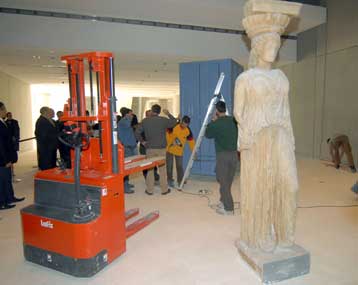
Στο Νέο Μουσείο της Ακρόπολης μεταφέρθηκε η πρώτη από τις πέντε Καρυάτιδες
Source: in.gr
Πραγματοποιήθηκε το Σάββατο η εναέρια μεταφορά της πρώτης από τις πέντε Καρυάτιδες στο νέο Μουσείο της Ακρόπολης. Η όμορφη κόρη τοποθετήθηκε στο πρώτο επίπεδο του Μουσείου σε εσωτερικό «μπαλκόνι».
Η επιχείρηση έγινε με το σύστημα των τριών γερανών, από το παλιό Μουσείο της Ακρόπολης στον Ιερό Βράχο, στο θέατρο του Διονύσου και από εκεί στο Νέο Μουσείο.
Η όμορφη κόρη αποχαιρέτησε τον Ιερό Βράχο μετά από 2.500 χρόνια. Το ίδιο θα γίνει τις επόμενες ημέρες και με τις υπόλοιπες Καρυάτιδες, εκτός από μία -όπως υπενθύμισε και ο υπουργός Πολιτισμού Μ.Λιάπης-, αυτή που βρίσκεται στο Βρετανικό Μουσείο του Λονδίνου.
Υπενθυμίζεται ότι η μεταφορά των γλυπτών από το παλαίο στο Νέο Μουσείο ξεκίνησε τον Οκτώβριο. Τα κιβώτια μεταφοράς είναι μεταλλικά με ξύλινους σκελετούς στο εσωτερικό και αφρώδες υλικό, προκειμένου να μην υπάρξουν ζημιές.
Για πιο ευαίσθητα αντικείμενα χρησιμοποιούνται άλλα κιβώτια με ενισχυμένη προστασία. Συνολικά θα χρησιμοποιηθούν έξι ειδών κιβώτια για τα 154 γλυπτά που θα μεταφερθούν με τους γερανούς.
Το συνολικό βάρος των 246 γλυπτών που θα μεταφερθούν στο νέο Μουσείο φτάνει τους 113 τόνους ενώ άλλους 184 τόνους ζυγίζουν χιλιάδες άλλα αντικείμενα, πολλά από τα οποία βρίσκονται στις αποθήκες του παλιού Μουσείου.
Inner sanctum of first Roman emperor to go on show
Source: Reuters
ROME, Dec 10 (Reuters Life!) - Four frescoed rooms in the eastern wing of the house of Augustus, where he lived before becoming Rome's first emperor, will open to the public for the first time next year after three decades of restorations.
Italian archaeologists said on Monday the rooms dated from around 30 B.C. and had been buried -- which may explain why some of the paintings are so well preserved -- after Augustus moved to another residence on a higher level of the Palatine Hill.
The tiny rooms, first discovered in the late 1970s, are mostly painted in vivid red, blue and ochre. They include a cubicle on an upper floor known as the "studiolo", or small studio, where Augustus was thought to withdraw for privacy.
The decorations on the walls and vaulted ceilings were found almost intact in some parts of the building, while in others they had to be pieced back together from a myriad of fragments.
"The level of preservation of the frescoes and the colors is extraordinary," said Rome's Mayor Walter Veltroni during a presentation of the rooms to journalists.
"It bears witness to the wonders of a city which is like a box of hidden treasures," he said.
The rooms will open to the public on March 2 together with the house of Livia, Augustus' wife, but visitors will only be allowed to enter in small groups to avoid damaging the delicate frescoes.
Excavations on the Palatine in recent decades have turned up a steady stream of precious archaeological finds, but preserving the ruins of ancient Rome is costly.
Culture Minister Francesco Rutelli said some 12 million euros ($17.59 million) would be devoted to the conservation of the site, an amount that some experts say is a third of what is needed every year.
(Reporting by Silvia Aloisi, editing by Paul Casciato)
ROME, Dec 10 (Reuters Life!) - Four frescoed rooms in the eastern wing of the house of Augustus, where he lived before becoming Rome's first emperor, will open to the public for the first time next year after three decades of restorations.
Italian archaeologists said on Monday the rooms dated from around 30 B.C. and had been buried -- which may explain why some of the paintings are so well preserved -- after Augustus moved to another residence on a higher level of the Palatine Hill.
The tiny rooms, first discovered in the late 1970s, are mostly painted in vivid red, blue and ochre. They include a cubicle on an upper floor known as the "studiolo", or small studio, where Augustus was thought to withdraw for privacy.
The decorations on the walls and vaulted ceilings were found almost intact in some parts of the building, while in others they had to be pieced back together from a myriad of fragments.
"The level of preservation of the frescoes and the colors is extraordinary," said Rome's Mayor Walter Veltroni during a presentation of the rooms to journalists.
"It bears witness to the wonders of a city which is like a box of hidden treasures," he said.
The rooms will open to the public on March 2 together with the house of Livia, Augustus' wife, but visitors will only be allowed to enter in small groups to avoid damaging the delicate frescoes.
Excavations on the Palatine in recent decades have turned up a steady stream of precious archaeological finds, but preserving the ruins of ancient Rome is costly.
Culture Minister Francesco Rutelli said some 12 million euros ($17.59 million) would be devoted to the conservation of the site, an amount that some experts say is a third of what is needed every year.
(Reporting by Silvia Aloisi, editing by Paul Casciato)
Friday, December 07, 2007
Glue used by the Romans has stuck around for 2,000 years
Source: The Independent
By Tony Paterson in Berlin
Published: 06 December 2007
German archaeologists claim to have found traces of a glue they say was made by the Romans more than 2,000 years ago and used to mount silver laurel leaves on legionnaires' battle helmets.
Researchers at the Rhineland historical museum in Bonn said they had found remnants of the glue on a legionnaire's iron helmet unearthed near the town of Xanten. It had lain on what was once the bed of the Rhine for at least 1,500 years.
Frank Willer, the museum's chief restorer, said researchers came across the glue by surprise while removing a tiny sample of metal from the helmet with a fine saw. The heat from the tool caused silver laurel leaves decorating the helmet to peel off leaving thread-like traces of the glue behind.
"It is a sensational find and a complete stroke of luck that we were still able to find traces of the substance on the helmet after 2,000 years," Mr Willer said.
The museum's team of archaeologists maintains that, as the helmet lay on the river-bed for so long, its glue was not exposed to the destructive effects of the atmosphere and therefore did not lose its adhesive power.
Mr Willer said that other Roman remains, including ancient battle masks, kept by the museum bore traces of silver decorations and had probably been glued in the same way. Their condition has deteriorated too far to find evidence of glue.
Analysis shows that the Roman glue was made of bitumen, beef tallow and pitch. But researchers said they had failed so far to recreate the adhesive and that sawdust, soot or sand might have to be added to complete the process.
"When we finally manage to remake the superglue, it will easily compete with its modern equivalents," Mr Willer said. "After all, which of today's glues stick for 2,000 years?"
By Tony Paterson in Berlin
Published: 06 December 2007
German archaeologists claim to have found traces of a glue they say was made by the Romans more than 2,000 years ago and used to mount silver laurel leaves on legionnaires' battle helmets.
Researchers at the Rhineland historical museum in Bonn said they had found remnants of the glue on a legionnaire's iron helmet unearthed near the town of Xanten. It had lain on what was once the bed of the Rhine for at least 1,500 years.
Frank Willer, the museum's chief restorer, said researchers came across the glue by surprise while removing a tiny sample of metal from the helmet with a fine saw. The heat from the tool caused silver laurel leaves decorating the helmet to peel off leaving thread-like traces of the glue behind.
"It is a sensational find and a complete stroke of luck that we were still able to find traces of the substance on the helmet after 2,000 years," Mr Willer said.
The museum's team of archaeologists maintains that, as the helmet lay on the river-bed for so long, its glue was not exposed to the destructive effects of the atmosphere and therefore did not lose its adhesive power.
Mr Willer said that other Roman remains, including ancient battle masks, kept by the museum bore traces of silver decorations and had probably been glued in the same way. Their condition has deteriorated too far to find evidence of glue.
Analysis shows that the Roman glue was made of bitumen, beef tallow and pitch. But researchers said they had failed so far to recreate the adhesive and that sawdust, soot or sand might have to be added to complete the process.
"When we finally manage to remake the superglue, it will easily compete with its modern equivalents," Mr Willer said. "After all, which of today's glues stick for 2,000 years?"
Thursday, December 06, 2007
Archaeologists find 2,000 year-old palace in east Jerusalem
Source: Yahoo! News
JERUSALEM (AFP) - Israeli archaeologists said on Wednesday they have unearthed a palace complex dating back to the first century AD in an Arab neighbourhood just outside the walls of Jerusalem's Old City.
Archaeologists discovered a structure that is "relatively big in size and subdivided into main halls," said Doron Ben-Ami, the project director, adding that coins on site dated the structure to the time of the Jews' Second Temple.
Ben-Ami said more work was necessary but that there was a "high probability" that the structure was a palace built by Queen Helena, a wealthy Iraqi aristocrat who converted to Judaism and moved to Jerusalem around 40 AD.
The structure was destroyed 30 years later, when Roman troops violently suppressing a Jewish revolt razed much of Jerusalem to the ground, including the Second Temple of which only the Western Wall remains today, he said.
The excavation is being carried out in a car park just opposite the City of David, the site of Jerusalem in ancient times and now an outdoor archaeological museum in the densely populated Palestinian suburb of Silwan.
The suburb is part of Arab east Jerusalem, which Israel occupied in the 1967 Middle East war and annexed soon thereafter, a move not recognised by the international community.
Palestinians, who see east Jerusalem as the capital of their future state, have long accused Israel of confiscating land in the Arab suburbs and of using archaeological projects to bolster Jewish claims to the area.
The site includes remains from the Islamic and Byzantine eras as well, including a large Byzantine structure built atop the ruins of the palace that incorporated some of the debris left behind from its destruction.
JERUSALEM (AFP) - Israeli archaeologists said on Wednesday they have unearthed a palace complex dating back to the first century AD in an Arab neighbourhood just outside the walls of Jerusalem's Old City.
Archaeologists discovered a structure that is "relatively big in size and subdivided into main halls," said Doron Ben-Ami, the project director, adding that coins on site dated the structure to the time of the Jews' Second Temple.
Ben-Ami said more work was necessary but that there was a "high probability" that the structure was a palace built by Queen Helena, a wealthy Iraqi aristocrat who converted to Judaism and moved to Jerusalem around 40 AD.
The structure was destroyed 30 years later, when Roman troops violently suppressing a Jewish revolt razed much of Jerusalem to the ground, including the Second Temple of which only the Western Wall remains today, he said.
The excavation is being carried out in a car park just opposite the City of David, the site of Jerusalem in ancient times and now an outdoor archaeological museum in the densely populated Palestinian suburb of Silwan.
The suburb is part of Arab east Jerusalem, which Israel occupied in the 1967 Middle East war and annexed soon thereafter, a move not recognised by the international community.
Palestinians, who see east Jerusalem as the capital of their future state, have long accused Israel of confiscating land in the Arab suburbs and of using archaeological projects to bolster Jewish claims to the area.
The site includes remains from the Islamic and Byzantine eras as well, including a large Byzantine structure built atop the ruins of the palace that incorporated some of the debris left behind from its destruction.
Tuesday, December 04, 2007
Remains of 4,000-year-old dam found in Upper Egypt
Source: Xinhua News Agency
CAIRO, Dec. 2 (Xinhua) -- Remains of an ancient dam dating back some 4,000 years have been discovered in Upper Egypt, local English daily The Egyptian Gazette reported Sunday.
Secretary-General of the Egyptian Supreme Council of Antiquities Zahi Hawass said Saturday that the ancient dam was found a few meters away from the Karnak Temple in Luxor, some 500 km south of Cairo.
The finding was made by an Egyptian-French archaeological team, which has been working in Luxor since March, Hawass was quoted as saying at a press conference.
"The 230-meter long dam was built during the age of the Middle Kingdom (of ancient Egypt) to protect the temple from the Nile flood," said Hawass.
The Egyptian archaeology supremo stressed the importance of the finding, saying it proved that the ancient Egyptians were good at building dams.
The discover will also revive interest in the ancient Egyptian city, which was believed by some archaeologists that nothing of great importance would be found again, said the report.
The team had also unearthed the relics of a Roman bath built in the first century AD and a clay jar containing 316 coins from different historical periods, said Hawass.
CAIRO, Dec. 2 (Xinhua) -- Remains of an ancient dam dating back some 4,000 years have been discovered in Upper Egypt, local English daily The Egyptian Gazette reported Sunday.
Secretary-General of the Egyptian Supreme Council of Antiquities Zahi Hawass said Saturday that the ancient dam was found a few meters away from the Karnak Temple in Luxor, some 500 km south of Cairo.
The finding was made by an Egyptian-French archaeological team, which has been working in Luxor since March, Hawass was quoted as saying at a press conference.
"The 230-meter long dam was built during the age of the Middle Kingdom (of ancient Egypt) to protect the temple from the Nile flood," said Hawass.
The Egyptian archaeology supremo stressed the importance of the finding, saying it proved that the ancient Egyptians were good at building dams.
The discover will also revive interest in the ancient Egyptian city, which was believed by some archaeologists that nothing of great importance would be found again, said the report.
The team had also unearthed the relics of a Roman bath built in the first century AD and a clay jar containing 316 coins from different historical periods, said Hawass.
Subscribe to:
Posts (Atom)