Tuesday, October 17, 2006

The Aegean from Bronze Age to Iron Age

Finally, Oliver Dickinson's new book is out! I've been waiting for it since my PhD years!! :-)


This textbook is an up-to-date synthesis of the period between the collapse of the Bronze Age civilization in the thirteenth and twelfth centuries BC, right up to the rise of the Greek civilization in the eight century BC.


Table of Contents


Introduction
1. Terminology and Chronology
2. The Collapse of the Bronze Age Civilization
3. The Postpalatial Period
4. The Structure and Economy of Communities
5. Crafts
6. Burial Customs
7. Trade, Exchange, and Foreign Contacts
8. Religion
9. Conclusions

Oxford Journal of Archaeology 25.4 (2006): 317-433

The November issue of the OJA has just appeared.

317 MOUSTERIAN MUSICIANSHIP? THE CASE OF THE DIVJE BABE I BONE
IAIN MORLEY

355 THE DATE AND SEQUENCE OF USE OF NEOLITHIC FUNERARY MONUMENTS: NEW AMS DATING EVIDENCE FROM THE COTSWOLD-SEVERN REGION
MARTIN SMITH, MEGAN BRICKLEY

357 MORTUARY DISPLAY AND CULTURAL CONTACT: A CEMETERY AT KASTRI ON THASOS
SARA OWEN

371 OFFSHORE FINDS FROM THE BRONZE AGE IN NORTH-WESTERN EUROPE: THE SHIPWRECK SCENARIO REVISITED
ALICE V.M. SAMSON

389 LATE BRONZE AND IRON AGE LAKE SETTLEMENT IN SCOTLAND AND IRELAND: THE DEVELOPMENT OF THE 'CRANNOG' IN THE NORTH AND WEST
GRAEME CAVERS

413 THE 'PERSEUS DANCE' VASE REVISITED
ALAN HUGHES

Odyssey in the Caribbean


Homer’s ‘Odyssey’ transports poet to Caribbean waters
Derek Walcott on ‘Omeros’ and poetic parallels

Poet, playwright and 1992 Nobel laureate in literature Derek Walcott met journalists during a news conference in Athens yesterday. Walcott will deliver a lecture tonight at the Athens Concert Hall and receive an honorary doctorate tomorrow from Athens University. (Photo: PhotoView)


By Vivienne Nilan - Kathimerini English Edition

“At some point while I was reading ‘The Odyssey,’ where Odysseus has been shipwrecked and washed up on the rocks and is trying to save himself, I realized that this could be a Caribbean story,” poet Derek Walcott told the press at a luncheon yesterday in Athens.

The poet, playwright and 1992 Nobel laureate in literature is in town to deliver a lecture tonight for the Megaron Plus series at the Athens Concert Hall (see What’s On) and receive an honorary doctorate from Athens University tomorrow.

He was explaining, no doubt for the umpteenth time, what led him to write his epic poem “Omeros.”

“When I began to write ‘Omeros,’ I said don’t do this, because it will lead to these sorts of questions,” he joked.

But the close parallels he observed between the civilizations of the Aegean and the Caribbean, with their stories of ships and fishermen, is a powerful theme threading through his work.

He loved the “freshness, gustiness, wind, sea, light, waves and action” that he found in Homer. “The one image that Homer has given to the world is that of a sail, a ship leaving and coming back,” he said.

Walcott’s own work is steeped in images of the sea and of the lives and dreams that grow on it and around it. Some poems hark back overtly to Homer, as in “Archipelagoes,” from “Map of the New World”:

At the end of this sentence, rain will begin. / At the rain’s edge, a sail. // Slowly the sail will lose sight of the islands; / into a mist will go the belief in harbors / of an entire race. // The ten-years war is finished. Helen’s hair a gray cloud. / Troy, a white ashpit / by the drizzling sea. // The drizzle tightens like the strings of a harp. / A man with clouded eyes picks up the rain / and plucks the first line of the Odyssey./

Elsewhere, as in this excerpt “Adios, Carenage” from “The Schooner Flight,” the tale is still timeless but the scene and the language are redolent of the Caribbean:

In idle August, while the sea soft, / and leaves of brown islands stick to the rim / of this Caribbean, I blow out the light / by the dreamless face of Maria Concepcion / to ship as a seaman on the schooner ‘Flight,’ / Out in the yard turning gray in the dawn. / I stood like a stone and nothing else move / but the cold sea rippling like galvanize / and the nail holes of stars in the sky roof // till a wind start to interfere with the trees.

Walcott’s artful incorporation of the vernacular among the multiple registers in his verse was a challenge for his Greek translators. Katerina Anghelaki-Rooke and Stefanos Papadopoulos, who have done a marvelous job of translating his poems into Greek for Kastaniotis publishers. Anghelaki-Rooke and Papadopoulos worked on Walcott’s poems together for three months. They chose not to employ an equivalent for the Caribbean element, said Anghelaki-Rooke, because it would have been impossible to convey the flavor by means of some Greek dialect.

Choosing which poems to translate was a tough task, she said, with a strict limit on the size of the book. But one of the criteria, wisely, was to select poems that would work in Greek.

One hopes that the next edition of the volume will get some more meticulous proofreading to weed out solecisms like dual spellings of the author’s and one translator’s names.

Asked about the burden of the poetic past, Walcott sympathized with Greek writers: “It must be tough to be a Greek poet, having to deal with the weight of all that stuff,” he said. “Any young Greek poet who lifts a pen is lifting a column.”

Monday, October 16, 2006

Sites to get electronic ticket system


Source: ekathimerini

Photo: KAS wants to keep out ticket dodgers.

Electronic ticket machines at the nation’s archaeological sites are on their way in.

Following the approval of the Central Archaeological Council (KAS), the machines will be installed at 17 archaeological sites and 12 museums across the country.

Many other works must be completed before the system can be comprehensively implemented. For instance, booths must be constructed to house the machines and staff must be trained, among other things.

So for now, the system will be applied on an experimental basis as of next summer in Lindos, the National Archaeological Museum and at Delphi. The museums and sites selected (based on the number of visitors) are the Acropolis, the Ancient Agora, the Roman Forum, Hadrian’s Library, the Kerameikos Cemetery, Ancient Olympia, the National Archaeological and the Byzantine museums in Athens, the ancient cities of Knossos and Phaestos on Crete, as well as the museums of Iraklion and Hania, Mycenae, Epidaurus and Delphi, Thessaloniki’s Museum of Byzantine Culture and Archaeological Museum, Lindos and the Great Magician’s Palace in Rhodes, the Asclepeion in Kos and Santorini’s Akrotiri and the Museum of Prehistoric Thera.

KAS leaders said the machines are also intended to keep out those visitors who want to enter without purchasing tickets.

Sunday, October 15, 2006

More cool excavation websites

Argilos: an Archaeological Site of Northern Greece

The Azoria Project

The Kenchreai Cemetery Project

The Kouphovouno Project

Mitrou Archaeological Project

Sikyon Survey Project

Saturn's Moons May Be Creating New Rings

Nothing to do with archaeology but I just couldn't help it! I found the following image very beautiful...


NASA Finds Saturn's Moons May Be Creating New Rings
October 11, 2006
(Source: NASA/JPL)

In Saturn's Shadow (Color-exagerated view)
Imaging scientists have noticed color variations across the diffuse rings that imply active processes sort the particles in the ring according to their sizes.

See the labeled version and the original version.
Cassini scientists are on the trail of the missing moons of Saturn. A recent observation by the spacecraft leads them to believe that they will find the moons near newly discovered rings around the planet.

During an unprecedented opportunity, with the sun poised behind Saturn, Cassini scientists discovered two new rings and confirmed the presence of two others. The new rings are associated with one or more small moons and share their orbits with the moons, while scientists suspect a moon is lurking near a third ring.
READ FULL STORY

Saturday, October 14, 2006

Athens during the Roman Period

International Archaeological Symposium
"Athens during the Roman Period: Recent Discoveries, New Evidence"

Athens, Benaki Museum – Pireos Street Annexe
19/10/2006 - 21/10/2006

The conference will explore the private and public life in Roman Athens through the presentation of unpublished material and recent excavations by specialists from Greece and abroad.

Its objective is to give a comprehensive description of the art and architecture, the everyday life and the inner city culture of the period between the 1st century B.C. and the 4th century A.D. The changes in the urban structure of Roman Athens, as well as the progress in sculpture, pottery and miniature art reveal how the Greek “legacy” is visually reconstructed under Roman rule, and to what extent this has been influenced by Roman notions.

The three-day colloquium introduces the most important finds of the Roman period that have been excavated in Athens in recent years. It offers classical archaeologists and students a unique opportunity to learn about the latest major discoveries, and to meet and converse with the excavators.

Organisational Committee: Dr. Alkistis Choremi, Prof. Angelos Delivorrias, Nicoletta Divari-Valakou, Dr. Paraskevi Vasilopoulou, Dr. Stavros Vlizos.

Scientific Committee: Prof. John Mck. Camp, Dr. Alkistis Choremi, Prof. Angelos Delivorrias, Nicoletta Divari-Valakou, Prof. Wolf-Dietrich Niemeier, Dr. Stavros Vlizos.

Conference Programme

Contact:
Dr. Stavros Vlizos, Benaki Museum, St. Koumbari 1, GR-10674 Athens, Greece, Tel. +30.210.3671091, Fax. +30.210.3671063, Email vlizos@benaki.gr

Organization:
Benaki Museum, 1st Ephorate of Prehistoric and Classical Antiquities, 3rd Ephorate of Prehistoric and Classical Antiquities, American School of Classical Studies at Athens – Agora Excavations, German Archaeological Institute at Athens

Friday, October 13, 2006

More on Ithaca quest


Drill hole begins Homeric quest

By Jonathan Amos
Science reporter, BBC News

A UK-led team is challenging cherished ideas on Greek mythology by proposing an alternative site for Ithaca.

The island was said to be the home of Odysseus, whose 10-year journey back from the Trojan War is chronicled in Homer's epic poem the Odyssey.

Most people think the modern-day Ionian island of Ithaki is the location.

But geologists are this week sinking a borehole on nearby Kefalonia in an attempt to test whether its western peninsula of Paliki is the real site.

The scientists hope to find evidence that the peninsula once stood proud, separated from Kefalonia by a narrow, navigable marine channel. It is only in the last 2,500-3,000 years - and after Homer's time - that the channel has been filled in, the team contends.

"We can't prove the story of the Odyssey is true, but we can test whether Homer got his geography right," said Edinburgh University geologist Professor John Underhill, who is supervising the drilling operation. READ FULL STORY

Thursday, October 12, 2006

Free archaeology journal issues: Part III

Mediterranean Historical Review 20.2 (2005)

Stanford Journal of Archaeology I (2002)

Stanford Journal of Archaeology II (2003)

Studia Humaniora Tartuensia (all issues)

Web Journal on Cultural Patrimony 1 (2006)

Ancient Roman Technology


Ancient Roman Technology is an electronic handbook of ancient Roman technology. It was created by, and is maintained by, students and faculty of the University of North Carolina at Chapel Hill. Its goal is to provide a comprehensive guide to Roman technology, with various levels of information.

Clearly a must-see for those interested in ancient technology!

Wednesday, October 11, 2006

Human figures, wild animal reliefs unearthed in 11,000-year-old Gobeklitepe tumulus

Source:Turkish Daily News

A team of archaeologists working at the Gobeklitepe tumulus in the southeastern city of Sanl?urfa came across human figures without heads as well as reliefs of scorpions, snakes and wild birds on obelisks belonging to the Neolithic period, the head of the team announced on Monday.

Speaking at a press conference at the ancient city, excavation team leader Klaus Schmidt of the German Archeological Institute in Berlin stated that Gobeklitepe was an 11,000-year-old site of worship established by the hunter-gatherer people of the time.

"During this year's excavations we came across human figures without heads, and we discovered a human figure for the first time since we started working here 12 years ago. This is a remarkable development. Remains give us important clues regarding the future of the excavations," Schmidt said.

He said excavations in Gobeklitepe brought to light the monumental architecture and the advanced symbolic world of the hunter groups that existed prior to the period of transition to production.

Schmidt said they also discovered the remains of nearly 20 round or elliptical structures 30 meters in diameter in the area.

According to Schmidt, the animal figures on the obelisks unearthed this year in Gobeklitepe have different characteristics. "Animal figures drawn by the people of the Neolithic era may represent the 'watchman' of the period," said Schmidt, adding that similar human figures were previously encountered in the ancient tumulus of Catalhoyuk, which is 2,000 years younger than Gobeklitepe.

Tuesday, October 10, 2006

Greek police seize some 450 antiquities, arrest Athens man

Source: The Associated Press via International Herald Tribune

ATHENS, Greece Police in Athens have arrested a Greek man suspected of illegally possessing some 450 ancient and late mediaeval artifacts, authorities said on Tuesday.

The suspect, identified as an 81-year-old former mine owner, was arrested during a raid on his Athens home on Monday, police said.

Officers confiscated the collection, which dated from as early as prehistoric times and was the most important seized in Greece in recent months.

Police said the artifacts included two marble heads — of a youth and a young woman — 147 silver and copper coins, jewelry, metal and pottery figurines, some 50 vases, bronze arrowheads and axes, a bronze dagger and spearhead, as well as 21 religious icons.

Police did not provide precise dating for the seized artifacts.

Under Greece's strict protection laws, it is illegal to own, buy, sell or excavate antiquities without a special permit. Any items found accidentally must be handed over to authorities.

Burnt City Broke the Record in Archeological Findings

Source: Cultural Heritage News Agency


Having discovered and documented 130 archeological sites, archeologists of the Cultural Heritage Center of Burnt City have broken a historic record.

Tehran, 10 October 2006 (CHN Foreign Desk) -- With discovering and documenting some 130 historical sites including satellite villages in the archeological site of Burnt City within only 6 months, archeologists of the Cultural Heritage Center of Burnt City have surpassed all the previous records in identifying and registering archeological sites in Iran.

“Discovery and registration of 130 historical sites within 6 months of archeological excavations in Burnt City indicates that almost every day one discovery has been made and announced to be registered in the list of Iran’s National Heritage, something which is absolutely unprecedented in the history of archeological excavations in Iran and should be registered as a successful record for Iran’s Cultural Heritage and Tourism Organization (ICHTO),” said Alireza Khosravi, head of Cultural Heritage Center of Burnt City.

Khosravi also announced that experts are currently working on preparing a map on which distribution of archeological sites in Sistan Plain is pinned down as well as a digital map from the area.

According to Khosravi, this project aims to highlight the tourism potentials of the region through identifying and documenting the historical sites that exist in the area. It also intends to introduce the unique archeological features of the Sistan Plain and the rich civilization and cultural values of Burnt City, southeast Iran, and to reveal some unknown aspects of this historical site.

Prior to this, some 137 historical hills had been identified by this Center in the vicinity of Burnt City historical site. Archeologists believed that most probably these hills were settled by the Burnt City inhabitants during the ancient times. The discovered historical sites are located 6-8 kilometers from the Burnt City and some cultural evidence such as broken clays similar to those discovered in Burnt City have been unearthed in these hills.

Located 57 kilometers from the city of Zabol in Sistan va Baluchestan province, southeast Iran, the Burnt City covers an area of 150 hectares and was one of the world’s largest cities at the dawn of the urban era. It was built around 3200 BC and was destroyed some time around 2100 BC. The city had four stages of civilization and was burnt down three times, which is why it is called Burnt City (Shahr-e Sukhteh in Persian).

Toward the end of the second millennium BC, Burnt City came to a cultural standstill; and archeological evidence shows that this ancient civilization of the eastern plateau of Iran somehow vanished from the face of the earth at the beginning of the first millennium BC.

According to Khosravi, archeologists are determined to trace the settlement area of human beings during the latest periods of settlement in Burnt City which coincided with the dawn of civilization in eastern half of the Iranian Plateau. Comparing and studying the discovered cultural evidence such as earthenware remains scattered in the region in different areas from the basin of Hirmand River to the satellite villages as well as identifying the location of the settlement areas in other parts of Sistan Plain where life existed at a time Burnt City was still alive and discovering the process of development of the art of pottery-making in Sistan Plain and finding the trend of civilization in the region are the other objectives behind this year’s archeological excavations in the vicinity of Burnt City.

Although 9 seasons of archeological excavations have been carried out on the Burnt City so far, there are still many questions remained unanswered about the ethnicity and language of its inhabitants. Moreover, archeologists have not yet figured out what happened to the people of the region and where they migrated to after they abandoned their city.

Excavation on the Burnt City was initiated in 1967 when Professor Maurizzio Tosi, Italian archeologists and his colleagues joined Iranian archeologists. Later, in 1988-89, excavations were resumed by Dr. Sajjadi under the auspices of Iran’s Cultural Heritage and Tourism Organization. The outcome of the research has been published in 170 books and papers so far in Persian, English, Italian, Japanese, German, and Spanish languages.

According to excavations and researches, the Burnt City has come to be known as one of the most important proofs for the independence of the eastern part of Iran from Mesopotamia. Based on the discovered historical relics such as rope, basket, cloth, wooden objects, fingernail and hair, weaving equipment such as hooks, shoe lace, human and animal statuettes seldom unearthed in other archeological sites so far, archeologists have concluded that Burnt City was the most significant center of settlement and in fact the whole region’s social, economic, political and cultural center during the 3rd and 2nd millennia BC.

One of the prominent ancient relics found in the Burnt City is a skull that anthropologists believe might have been the first evidence of brain surgeries in prehistoric Iran. The skull was found in a mass grave in 1978 during excavations by the Italian team, lead by Maurizzio Tosi.

Results of 10 years of excavations in the historical site of Burnt City are to be published in a book in which major archeological findings in this historical site will be documented.


Soudabeh Sadigh
foreigndesk@chn.ir

Ancient Giant Camels

Source: The Associated Press

Bones of ancient giant camel found

DAMASCUS, Syria (AP) -- The bones of a giant camel dating back 100,000 years have been unearthed in the Syrian desert, a government newspaper reported over the weekend.

The bones were discovered by a joint Syrian-Swiss archaeological team at the site of al-Hemel in the Palmyra region about 155 miles northeast of Damascus, the state-run Tishrin daily reported Saturday.

The discovery revealed that the Syrian desert "is the first origin of the camel," Bassam Jammous, director general of the Antiquities and Museum Department in Syria, told the newspaper.

He said the animal would have been some 13 feet tall - double the size of the modern-day camel - and "poses a revolution in the world of archaeological discoveries."

Officials with the Swiss archaeology team could not immediately be reached for comment Sunday.

The discovery of the bones was first reported in 2005.

Sunday, October 08, 2006

Star Trek and Mythology

Star Trek tests technological frontier

Judy Skatssoon
ABC Science Online

Star Trek heralded real developments in science and drew on the great classical myths, an Australian researcher says.

Dr Djoymi Baker, a self-confessed Trekkie from the University of Melbourne, watched more than 700 episodes of the cult TV series as part of her PhD.

Baker, an expert in media and popular culture, says scientists often dismiss science fiction for getting it wrong.

But she says it can foreshadow or even influence developments in science, adding that more members of the public watch science fiction than "science factual".

"Because it's gone on for so many decades [Star Trek has] had a big impact on what people think about space and what might be possible in the future," she says.

"A lot of NASA astronauts cite it as their inspiration; scientists have cited it as their inspiration for new technology."

For example, NASA's first shuttle of 1977 was named Enterprise after a campaign by Star Trek fans.

The Star Trek influence can also be seen in new 'spray on' drug delivery technologies, the computer chip and even the flip-top mobile phone and automatic doors, she says.

And after the catchphrase "beam me up Scotty", scientists have started to experiment with dematerialising and rematerialising helium, and 'cloning' laser beams.

"They can't beam you up yet but they're starting to do experiments along those lines," Baker says.

While Star Trek described life in the future, it also had what is now regarded as a quaint pre-Copernican tendency to place humans at the centre of the universe, she says.

Back to the future

Baker says Star Trek still holds a huge fascination even as space authorities like NASA fight for funds, recognition and good publicity.

"Scientists often don't like science fiction because it can get it wrong, but on the other hand it can be very inspirational," she says.

"NASA might be struggling [but] on the other hand we have science fiction which says we can achieve great things in space, not only in terms of exploration but in terms of what sort of race we want to be, and that's quite a powerful message."

Baker says Star Trek not only looks forward to the technological future, but harks back to the heroic past of ancient myths like Homer's Odyssey.

Not only do mythical figures like the Amazons, the god Apollo or the sirens of Homeric lore appear in space, but Star Trek contains the sweeping themes of intrepid adventure and bold exploration that lie at the heart of classical mythology.

"Mythology is a bit of a recurring theme in science fiction television shows," Baker says.

"Just as you might have met strange creatures in an ancient myth, instead you find strange creatures in outer space."

Shows like Star Trek were also an indirect offshoot from the great cinematic "sword and sandal" epics of the 1950s and 60s, she says.

"Mostly TV was constrained by much tighter budgets so it just couldn't do those types of spectacles," she says.

"So myth goes into other genres and one of the genres ... is science fiction.

"Instead of going into the ancient past, you fast forward into the future."

Thursday, October 05, 2006

Getty talks

Source: ekathimerini

Greece has begun a new round of talks in Athens with representatives of Los Angeles’s J. Paul Getty Museum about the possibility of returning two ancient Greek treasures, the Culture Ministry said late on Tuesday.

Greece says the gold wreath from 400 BC and a 6th century BC marble statue were illegally excavated and smuggled out of the country. Getty officials are examining the documentation, which Greece believes supports this claim. Two other antiquities from the Getty Museum were returned to Greece last month.

Oldest profession helps boost Greek national output by 25 per cent

The right-wing Greek government managed once again to make Greece the laughing stock of the world. On September 29, the Financial Times published an article entitled "Oldest profession helps boost Greek national output by 25 per cent" referring to the inclusion of black-economy (including prostitution) money to the Gross Domestic Product.

Although the actual amount related to illegal activities accounts only for 0.7% of the 25% upward revision of the GDP, it's quite obvious that there is something seriously wrong with the "big brains" of the Greek Ministry of Economy and Finance.

Talking about prostitution, I would like to say a thing about its role in ancient Athens where the legendary lawmaker Solon is credited with legalising prostitution by having created state brothels with regulated prices. However, what Solon really did (mainly in order to curb abuses of the Drakonian adultery laws), was to introduce a law which stated that if a man is caught with a woman who practices some form of prostitution, either organized or free-lance, he cannot be accused of adultery (Dem. 59.67). As Kapparis (2003, 3) states "by doing so Solon perhaps unintentionally legalized and defined prostitution."

Reference: K. Kapparis, “Women and Family in Athenian Law,” in Adriaan Lanni, ed., “Athenian Law in its Democratic Context” (Center for Hellenic Studies On-line Discussion Series). Republished in C.W. Blackwell, ed., D?mos: Classical Athenian Democracy (A. Mahoney and R. Scaife, edd., The Stoa: a consortium for electronic publication in the humanities [www.stoa.org]) edition of March 22, 2003.

Wednesday, October 04, 2006

Bathed in controversy

The world's oldest known thermal spa is at the centre of a conflict between Turkey's drive for modernity and the protection of its heritage, writes Helena Smith

Helena Smith in Allianoi, Turkey
Wednesday October 4, 2006

The Guardian

The floodwaters have not arrived yet but the Yortanli dam is ready. As his team of tireless diggers ignores the sizzling Anatolian heat to uncover the secrets of Allianoi, Dr Ahmet Yaras had the look of a condemned commander about him.

It would, he said, be death by drowning for the world's oldest known thermal spa. "And still," he exclaimed, his eyes scouring the wooded hillocks of the ancient settlement, "there is so much to find."

Days after Turkey's government gave its blessing to the construction of the controversial Ilisu dam in the south-east of the country, archaeologists in western Allianoi have accelerated efforts to salvage a 1,800-year-old health centre that is arguably the most impressive and best preserved on the continent of Europe.

Not since excavations began in 1998 has the quest to unearth the mysteries of the complex been so fraught with the knowledge that time is running out. The Yortanli project was completed last November and only pressure from both inside and outside Turkey has kept the floodgates closed.

Laying the foundation stone for the Ilisu plant - a project that campaigners claim will wreak "cultural mass destruction" on the historic site of Hasankeyf while displacing thousands of Kurds - the Turkish prime minister, Recep Tayyip Erdogan, summed up the dilemma thus: "On the one hand, you have the increasing demand for energy and a bright future for Turkey; on the other history, culture and an inheritance that belongs to all humanity. We have to find a solution. We have to make peace between the two sides."
FULL STORY

Archaeologists find 11-millennium-old building in Syria

Source: Yahoo! News

DAMASCUS (AFP) - Archaeologists said they have discovered an 11-millennium-old building with on the banks of the Euphrates River in northern
Syria.

"A remarkable discovery has just been uncovered of a large circular building dating back to 8,800 BC near (the locality of) Ja'de," the head of the French archaeologal team that made the find told AFP.

The building, much larger than normal houses, "had a collective use, probably for all of the village or a group," Eric Coqueugniot said.

"A part of this community building takes the shape of the head of a bull and retains painted decorations, the oldest known in the Middle East," he said.

"The multi-coloured geometrical paintings" that decorate the building would be displayed at the museum of Aleppo, in northern Syria, he added.

"Many hunting weapons, domestic tools ... were discovered at this level. The majority of these tools are made of flint and very few are of obsidian (volcanic stone)," he said.

Coqueugniot heads the team of the National Centre for Scientific Research (CNRS), France's largest scientific establishment, which has led the excavation work at the site for the past 15 years.

Monday, October 02, 2006

Free issues of archaeology journals: Part II

Journal of Archaeological Science 33.1 (2006)

Mediterranean Archaeology and Archaeometry (all issues)

Oxford Journal of Archaeology 25.1 (2006)

World Archaeology 37.4 (2005)

Battle of Salamis Monument

Source: Eleutherotypia


A monument to commemorate the fallen soldiers of the Battle of Salamis was erected in the area of the original burial mound last Friday.

The bronze sculpture was made by the Greek sculptor Achilles Basileiou and it was officially presented to the public on the anniversary of the famous naval battle on September 29.

Saturday, September 30, 2006

Stolen artifacts...

Source: ekathimerini

PAVLOS MAKRIDIS/ANA


Police display some of the stolen artifacts that were recovered by authorities in Thessaloniki yesterday. Officers arrested two brothers on suspicion of trying to illegally sell the small collection of excavated antiquities. A raid on the suspects’ homes turned up 16 clay pots dating from the 7th century BC to medieval times and six ancient coins that had been carefully hidden in storage areas, police said. It was unclear whether the ancient artifacts, considered to be in excellent condition, had been dug up by the suspects. The suspects were identified as Greeks, aged 53 and 51.

Thursday, September 28, 2006

Boston's MFA returns 13 disputed artifacts to Italy

Source: Boston News

By Ariel David, Associated Press Writer | September 28, 2006

ROME --Boston's Museum of Fine Arts has returned 13 disputed ancient artifacts to Italy, including a statue and a bas relief believed to have decorated Hadrian's Villa near Rome, as part of a deal with the Italian government.

The pieces, including 11 vases in the ancient Greek style from central and southern Italy, were displayed for journalists Thursday at the Italian Culture Ministry before a signing ceremony in Rome.

In July, officials said the museum and Italy had reached a tentative deal for the return of the antiquities, which Italian authorities contend were stolen and later sold to the institution.

Culture Minister Francesco Rutelli and museum director Malcolm Rogers were scheduled Thursday to sign the final agreement, which also deals with loans of other Italian treasures.

Italy has been aggressively trying to recover archaeological treasures through agreements like this one, as well as through criminal prosecution.

In one case, Marion True, a former curator for the J. Paul Getty Museum is on trial in Rome, along with American art dealer Robert Hecht for alleged trafficking in illegal artifacts. Both have denied wrongdoing.

Lawyers for the Italian government have been negotiating with Getty officials toward reaching a deal similar to the Boston museum accord.

Earlier this year, New York's Metropolitan Museum of Art agreed to return 21 artifacts that were looted from Italy in exchange for loans of other treasures.

A law dating to the days of dictator Benito Mussolini's regime requires any antiquities found in Italy to be turned over to the state.

Tracing Greek language from age of Linear B


By Vivienne Nilan - Kathimerini English Edition

Geoffrey Horrocks, author of the noted book on the history of Greek.


Geoffrey Horrocks, professor of Comparative Philology at Cambridge, has written widely in his field, but is probably best known for his monumental work “Greek: A History of the Language and its Speakers,” published by Longman Linguistics Library in 1997.

Now the Greek publisher Hestia has brought the book out in a Greek translation by Melita Stavrou and Maria Tzevelekou, who also provide a helpful introduction, setting the work in context, evaluating Horrock’s contribution and explaining their translation methodology.

Horrocks is visiting Athens this week and he spoke to Kathimerini English Edition yesterday ahead of the launch of the Greek edition of his book at the Benaki Museum.

We asked what attracted him to the study of Greek. “From an early age I was always interested in languages,” he responded. “I heard people speaking foreign languages and wondered what they were saying to each other about the world.”

“The key moment was at the age of 13, when I had to choose between German and Greek at school,” Horrocks said. “It was completely arbitrary, almost like tossing a coin. I chose Greek mainly because the alphabet looked intriguing. Then I found I really liked it.”

Horrocks went on to study Ancient Greek at university. His acquaintance with the modern language began after travels and the desire to communicate with the people he met. Since then his research has taken him into every aspect of the language, from the epic tradition and Ancient Greek dialectology to the syntax of Modern Greek.

As a historical linguist, Horrocks sees the big picture as well as the details. For instance, he views the fraught language question, which long bedeviled Greece and even led to bloodshed between rival supporters of demotic and katharevousa or purist Greek in the early 19th century, as the continuation of an age-old gap between the written and the spoken language.

The standoff between the opposing views grew more intense in the 19th century, he explains, because the Greek state was being recreated and decisions had to be made about which resources, including language, were to be used.

Judicious blend

In recent years, much of the fire has gone out of that debate and users of the language now feel free to exploit its entire range.

“The language is a huge resource and we’ve now got what people were advocating way back,” he said, referring to a judicious blend of the language’s rich resources.

Does he see the classical past as a burden or a source of enrichment for Greek?

“Sometimes it is both,” he said. “But Greece has achieved so much since 1850 and done so well in difficult circumstances that it should take pride in what it is is today.”

He doesn’t see it as a problem that younger Greeks do not want Ancient Greek to be compulsory in schools.

“The language has liberated itself from the political and ideological burdens of the past,” he said. “On the other hand, I’ve seen serious journalism and academic discourse making use of elements of katharevousa.”

Covering as it does the history and structure of Greek through all its stages from Linear B to classical, Koine, medieval and Modern Greek, “Greek: A History of the Language and its Speakers” has become a standard work of reference. How did he decide what to include and what not to include in it?

“There was no clear plan from the beginning,” he said. “The book evolved. As a historical linguist I wanted to explore under what circumstances a written language develops and the effect that has on the spoken language. I left out what was not related to that central development.”

Lingua franca

Does he see English becoming a lingua franca in the way that Greek once was?

“It already is, in some ways,” he said. “Such languages need an empire with resources to promote them and we do live in a kind of American empire where English has a special status. People will learn English if it helps them to get ahead. It already is a globalized language, but it won’t be forever.”

There is no reason for Greeks to see the burgeoning influence of English as a threat to their own language, Horrocks says. “Change is change; it isn’t necessarily either progress or decay,” he said. “Language changes according to the needs and circumstances of the people who use it.”

Borrowed words from English should not arouse concern. After all, as he pointed out, English is a classic example of a language that has absorbed words from everywhere and not lost its vigor.

Hestia have done local scholars and other readers a valuable service in making his account of the development of Greek since the second millenium BC available in Greek.

Wednesday, September 27, 2006

Was There Really a Trojan War?

If you want to find out, and you happen to be in Greece next month, you are invited to attend the lecture organised by the Athens - Greece Society of the Archaeological Institute of America.

Speaker: Dr. Oliver Dickinson (Reader Emeritus, Durham University)
Date: Monday, October 9, 7.30pm
Venue: The Danish Institute at Athens, Herefondos 14, Plaka, Athens

Tuesday, September 26, 2006

8,400-year old settlement unearthed in Izmir's (Smyrna's) Ulucak tumulus

Source: Turkish Daily News

A team of archaeologists working at the Ulucak tumulus, located in Izmir's Kemalpasa district, have unearthed a Neolithic settlement area dating back some 8,400 years, an archaeologist announced last week.

Archaeologist Fulya Dedeoglu of Ege University told the Dogan News Agency that excavations had been under way in the area since 1995.


She said they believed their latest discovery could be the oldest settlement dating from the Neolithic period unearthed to date and added that further excavations on the lower levels could reveal even older remains.

Workshops, storage facilities and furnaces are among the most significant structures unearthed in the tumulus, estimated to date back to 6,400 B.C., said Dedeoglu, adding that mother goddess figures and pieces of ceramics were also discovered.

Dedeoglu said they were lucky that they did not encounter water while excavating the area. In most of the excavation areas in the Aegean region, underground water covers the area and hinders excavations. We were lucky that it didn't happen here, she explained.

The Odyssey in Linear B

This is an all-time favourite of mine, although I don't believe that the Homeric epics were ever written in Linear B. Still, this is a very interesting and stimulating task undertaken by Dr E. Pantos.


The Odyssey in Linear B

Monday, September 25, 2006

9,500-year-old decorated skulls found in Syria

Source: Yahoo! News

DAMASCUS (AFP) - Archaeologists said they had uncovered decorated human skulls dating back as long as 9,500 years ago from a burial site near the Syrian capital Damascus.

"The human skulls date back between 9,500 and 9,000 years ago, (on which) lifelike faces were modelled with clay earth ... then coloured to accentuate the features," said Danielle Stordeur, head of the joint French-Syrian archaeological mission behind the discovery.

Located at a burial site near a prehistoric village, the five skulls were found earlier this month in a pit resting against one another, underneath the remains of an infant, said Stordeur.

The French archaeologist described as "extraordinary" the find at the Neolithic site of Tell Aswad, at Jaidet al-Khass village, 35 kilometres (22 miles) from Damascus.

The discovery was not the first of its kind in the Middle East, but "the realism of two of these skulls is striking," stressed Stordeur, in charge of the excavation along with Bassam Jamous, the chief of antiquities of Syria's National Museum.

"They surprise by the regularity and the smoothness of their features," Stordeur said of the skulls.

"The eyes are shown as closed, underlined by black bitumen. The nose is straight and fine, with a pinched base to portray the nostrils.

"The mouth is reduced to a slit," said Stordeur, of the Asian research house of the National Centre for Scientific Research (CNRS), France's largest scientific establishment.

The decorated skulls were devoted "only to important individuals, chosen according to social or religious criteria," she added.

Visually impaired to experience art

Source: ekathimerini

On October 8, visitors to the National Archaeological Museum will enjoy a performance featuring fairy tales and myths about Eros, as well as being able to touch an original sculpture of the god of love.


For the first time ever, Greece’s largest museum, the National Archaeological Museum, will participate in an event celebrated every October by museums and art centers worldwide - Art Beyond Sight Awareness Month. The event, an initiative of the New York-based international organization Art for the Blind (AEB), is dedicated to blind or visually impaired people who are usually excluded from appreciating works of art in museums.

Benefits of art

With specially adapted programs and educational materials, a visit to a museum and contact with art in general can be very fruitful for visually impaired people. Such contact can help them to create mental images and lead to the development of linguistic and other skills. It can cultivate a critical mind, boost self-confidence and can also provide learning opportunities in a stimulating environment.

Therefore, on October 8, the National Archaeological Museum will host a performance by the Paramythosendouko group between 11 a.m. and noon. The group, which consists of narrator Niki Kapari and musicians Yiannis Pseimadas and Evi Mazi, will narrate fairy tales and myths about Eros, the naughty son of the ancient goddess Aphrodite, for visually impaired primary schoolchildren.

After the performance, the children will have an opportunity to touch one of the museum’s original sculptures of the young Eros sleeping and then make up their own story about the character.

National Archaeological Museum, 44 Patission Street. Admission is free of charge and reservations can be made by calling 210.821.7724, 210.821.7717.

Saturday, September 23, 2006

Santorini celebrates book featuring its ancient past

Source: ekathimerini


Photo: Iris Tzachili’s new book on the history of excavations on the island of Santorini will be launched tomorrow evening in Oia.

HELBI

The book “The Beginnings of the Prehistoric Aegean: Excavations on Thera and Therasia in the 19th Century” by archeologist Iris Tzachili is to be launched by the Community of Oia on Santorini tomorrow afternoon. The book launch will be held against a backdrop of the famous Oia sunset, at the Aghios Georgios Festival House in Oia with a galaxy of speakers headed by Professor Christos Doumas, director of excavations at Akrotiri, Thera, since 1975; Claire Palyvou, an associate professor of architecture at Thessaloniki University, and, naturally, the author, who is an associate professor of history and archeology at Crete University. The coordinator is Manolis Lignos, an author and the publisher of the Theran News. The publication was subsidized by Kathimerini SA and the launch is being organized by the Oia Community Development Corporation. On Sunday, September 24, Santorini will be at its best, with Oia’s whitewashed houses spilling down the rocky slope facing the caldera. The tourist hordes have thinned; the popular island is slipping back into the quiet season in its authentic, pure Aegean beauty. This weekend was chosen by the Oia community and its president Dimitris Halaris for the presentation of a book that honors archaeological research and its pioneers, a book that is a scientific study of the early history of archaeology in Thera’s network of islands that began in the 19th century. The book is a collection of information about this research, aimed at presenting a picture of Theran society during the Bronze Age. The link with the past and the search through reports left by past researchers was undertaken by Tzachili at the urging of Professor Doumas, who has written the preface to the book, in which he congratulates the author and expresses his thanks. Doumas also notes the vote of thanks that the archaeology community owes to the Therans, as well as to Aristides and Themistocles Alafouzos. This book, accessible not only to the archaeologist, researcher and scholar but to the layperson with an interest in the history of archaeological research in Thera and Therasia as well, fills once and for all what was a gap in the archaeology of the Aegean.

Friday, September 22, 2006

Red floor unearthed in Persepolis treasury

Source: IranMania

LONDON, September 21 (IranMania) - A red floor which dates back to the reign of Darius the Great was recently unearthed in the treasury of Persepolis, the Persian service of CHN reported.

Archaeologists working on Persepolis were not informed about the floor, which was discovered while gardeners worked on the green area over top of one section of the treasury.

“At present, the area of the floor measures five meters square. It is original and dates back to Darius the Great,” curator of the Persepolis site-specific museum Mohammad-Taqi Ataii said.

According to Ataii, the discovery confirms the view of German archaeologist Erich Frederich Schmidt about the dimensions of the treasury at the time of Darius I. Schmidt excavated Persepolis in the mid 1930s.

Archaeological studies show that the Achaemenid’s revenues increased during the reign of Xerxes I, son of Darius, so he expanded the treasury area, which was located on the eastern side of Persepolis and also allocated a part of the area for his harem.

“U.S. archaeologist Ernest Hertzfeld converted the women’s quarter into a site-specific museum and an office for managing the site. Consequently, the floor remained buried and now it has been dug out from under the grass,” explained Ataii, who is also an archaeologist.

Hertzfeld had previously unearthed pillars of the women’s quarters of the Xerxes Palace and established the museum in 1931.

Located near Shiraz in Fars Province, Persepolis was registered on UNESCO’s World Heritage List in 1979.

Three centuries of Greek costumes as seen by travelers

Source: ekathimerini

Prints from the the John D. Koilalous collection at the Benaki Museum

A. KOROXENIDIS

If it were not for the drawings that traveling painters to Greece produced from the 16th to the beginning of the 20th century, what local people dressed like, especially in the earlier period, would have remained largely unknown. In many cases, the initial drawings were later made into engravings, lithographs or etchings that were either presented on their own or printed in books or albums which were commissioned by private clients or publishing houses.

A large selection of this important documentary material is presented in “The Greek Costume, Printed Sources of the 16th - 19th century from the J.D. Koilalous Collection” at Benaki Museum in Kolonaki. Curated by Fani-Maria Tsigakou, the exhibition has been organized on the occasion of the donation that the collector J.D. Koilalous made to the Benaki of more than 500 printed images of Greek costumes.

The images are presented according to the region from where the costumes depicted originate. Displayed one after the other, like the open pages of a book, they afford valuable information about clothing as attributes of social class, profession, gender and taste.

However, those depictions should not be taken as exact documentations of Greek costume for, in varying degrees, they reflect the projections that western travelers made on what they saw. As the exhibition’s curator said, researchers should not rely on any one image as a source of information but make comparative studies to appraise the objectivity of an image and arrive at a a solid conclusion. Factors such as who the painter was, his skills as a painter and whether he actually visited a region or painted based on secondary images are important.

Many of the images reflect the rising interest in folklore that began in the 18th century. Others derive from the trend of orientalism. Many diplomats that were posted in the Orient, for example, bought local costumes and posed with them for their portraits. Several images in the Benaki exhibition are based on those portraits.

Most prints depict single figures but there is also a selection that documents banquets and festivities, although most prints are portraits of a single person.

The Benaki has printed a comprehensive, bilingual catalogue of the J.D. Koilalous exhibition.

“The Greek Costume” at the Benaki Museum (1 Koumbari, Kolonaki, tel 210.367.1000) to November 12.

Thursday, September 21, 2006

Ancient Hittite dam inaugurated after 32 centuries

Source: Turkish Daily News

ANKARA - Turkish Daily News

A Hittite-era dam located in the central Anatolian province of ?orum and believed to be one of the oldest in the world to have survived to date has been restored and is once again serving as a source of irrigation for local residents.

The dam, located at the Alacah?y?k archaeological site, was built by the Hittites in 1240 B.C. The dam's inauguration was marked with a ceremony over the weekend attended by Professor Aykut ??naro?lu, who heads the team excavating Alacah?y?k, Ankara University Rector Professor Nusret Aras, Emin Sazak, director of the construction firm sponsoring the excavations and archaeologists working in the area.

??naro?lu said excavations in the area, launched in 1936 at the order of Mustafa Kemal Atat?rk, had revealed the dam in a swampy area.The dam was found to be functional, prompting further excavation in its vicinity.

The dam was ordered by Hittite King Tudhaliya IV in the name of goddess Hepat, according to ancient Hittite tablets, he said. After a drought Anatolia suffered in 1200 B.C., Tudhaliya IV imported wheat from Egypt so that his subjects would not suffer a famine. Following this, the king ordered numerous dams to be built in central Anatolia, in 1240 B.C. All but one of them became dysfunctional over time. The one in Alacah?y?k has survived because the water source is located inside the dam's reservoir, he explained.

??naro?lu said the construction technique used in building the dam was similar to those of today but that the stone blocks forming the dam were joined with clay instead of cement.

The Hittites used the dam to provide both irrigation and tap water, said ??naro?lu, adding: In ancient times, tap water from this dam was collected in a separate pool, and after filtering, the water was carried to the city center two kilometers away. Canals built based on the water's flow astonished us.

Capable of holding approximately 15,000 cubic meters of water, the dam is now being used by locals for irrigation. An ancient dam is re-inaugurated 3,240 years after it was built. It is now serving the 2,300 residents of Alacah?y?k village as an irrigation source," ??naro?lu said. He noted that the width of the reservoir would become clear after excavation was complete.

The base of a statue of Hepat as well as a golden necklace decorated with rubies were also unearthed during the excavations.

Following the ceremony guitarist Ahmet Kanneci and clarinetist Ekrem ?ztan performed a recital in front of the Hittite temple in Alacah?y?k, where the oldest known guitar relief is found.

Tuesday, September 19, 2006

The harbour of Knossos was found

The Greek daily Eleutherotypia reports the discovery of the harbour of Knossos at the location of Katsambas in Heraklion.

The excavations by the Greek archaeologist Antonis Vasilakis brought to light structures of very large dimensions which have been identified as shipsheads. In particular, six parallel walls were unearthed (1m thick each), exhibiting a North-South orientation which in effect created six parallel, rectangular areas divided in two wings.

Five of those areas have a width of 6m each, a length of 21-23m (the visible part) and they are divided into two wings. The internal space of each shipshed is estimated to be 150 sq. m.

Among the various artefacts reported are a rectangular stone-built hearth (with several cooking and other vessels in situ), numerous sherds from other storage and cooking vessels, clay weights, bone and bronze pins as well as large quantities of obsidian and steatite.

Vasilakis considers exceptionally important the discovery of a large quantity of severely burnt lead objects collected from the destruction level (tools connected to the manufacture and maintenance of ships?)

The shipsheds are dated to ca. 1300 BCE, although there is evidence for use in earlier periods too. FULL STORY (in Greek)

Saturday, September 16, 2006

The Argo sails again


Spiegel (in German) and in.gr (in Greek) are reporting on the reconstruction of Argo, Jason's legendary ship, that is about to be launched. After sea trials, the reconstructors plan to make a journey across the Aegean and through the Black Sea to Georgia, thus replicating the journey of the Argo from Volos (traditionally identified as ancient Iolkos) to Colchis.

Modern medicine reveals secrets of a middle-class mummy

Source: Telegraph

By Paul Stokes

Modern medical advances are being used to unlock the secrets of a middle class Egyptian woman who lived and died 3,000 years ago.

The mummified remains of Bakt Hor Nekht, encased in a linen and plaster inner coffin, were bought at a local market and brought to Britain in 1820. Now a full Computerised Tomography (CT) scan at Newcastle General Hospital is yielding a wealth of information.

Bakt Hor Nekht was 5ft tall and had a full set of teeth, including wisdom teeth, and no signs of arthritis or bone disease, which suggests she was between 21 and 35 when she died. A substance found on her teeth may have been painted on as a cosmetic exercise after her face was damaged during embalming.

Gill Scott, an Egyptologist at the Hancock Museum, Newcastle upon Tyne, said: "It was very important, when the soul was separated from the body, for it to recognise the face after death."

The non-invasive scans also revealed jewellery created from a variety of materials positioned across the body. One amulet, the symbol of resurrection in the form of the winged scarab, is on the top of her chest and another to the left side of the stomach over the embalming incision areas.

False eyes, possibly made from alabaster or shells, were placed over her eyelids and were thought to provide the dead with vision in the afterlife. Miss Scott, a member of York University's mummy research group, said: "We think she was probably the equivalent of today's middle class because she was buried in a tomb and her cartonnage [layers of fibre or papyrus] is quite elaborate and the outer coffin of sycamore wasn't cheap."

Bakt Hor Nekht was found in a tomb at Gourneh in Thebes (now Luxor) and dates from around the 21st to the 22nd dynasties of ancient Egypt. The mummy will be moved to the Segedunum Roman Fort, the last outpost of Hadrian's Wall, at the end of the month as part of the new Land of the Pharaohs exhibition. It will also form part of the £26 million Great North Museum project which is due to open in 2009.

Friday, September 15, 2006

Reclaimed antiquities being sent home

Source: ekathimerini

As more missing artifacts come back to Greece, a change in international attitudes raises hopes for the return of the Parthenon Marbles

By Iota Sykka

The recent return of antiquities from the J. Paul Getty Museum to their countries of origin has helped bring about a change in attitudes worldwide regarding the repatriation of antiquities. Top museums, which only a few years back had signed firm declarations that they were not going to part with their disputed antiquities, provoked mainly by Greece’s claim for the Parthenon Marbles from the British Museum, seem to have changed their stance. The New York Metropolitan Museum has reached a deal with the Italians to return the priceless Euphronius Krater and the Morgantina treasure while the Getty Institute has emerged a little the worse for wear after its curator went on trial in Italy for illicit trading in antiquities.

The current trend is in Greece’s favor, which, unlike in the past, has proved ready to exploit it. The country started action under former culture minister Petros Tatoulis, and has been continued by the current minister, Giorgos Voulgarakis, who, after a decade-long fruitless campaign via diplomatic channels, has achieved the return of antiquities from the Getty Museum. Two of the four antiquities, a 6th century BC votive relief from the island of Thassos depicting a god and worshippers and a carved stele have already been repatriated. The impressive gold wreath and marble statue are next in line and negotiations have started with the museum’s director, Michael Brandt.

Culture Minister Voulgarakis recently flew with the prime minister’s airplane to Heidelberg to receive a fragment of a foot belonging to a leaf bearer from Block VIII of the Parthenon frieze’s north section (depicting a procession of chiton- and cape-clad flute and guitar players). The fragment, which was going to be sold as a souvenir, is square and has the word “Parthenon” engraved on it. It belonged to the university collection and was purchased in Athens by an unknown individual in 1871. The repatriation, in which Heidelberg Professor Angelos Chaniotis took part, is a highly symbolic gesture and a trump card that will assist Greek demands for the return of the Parthenon Marbles from the British Museum.

Also:
Ministry focuses on repatriating treasures from around the world

A successful summer for returns

The quest for the stolen artifacts often involves help of embassies

Thursday, September 14, 2006

Neanderthal's last stand

Source: Nature

Cave in Gibraltar may be most recent home of extinct species.

David Brill

Gibraltar may have been the last refuge of the Neanderthals, according to the results of a six-year archaeological dig.

The findings, which show that Neanderthals lived alongside modern humans for thousands of years, bring fresh evidence to the debate on what happened to our evolutionary cousins, and whether modern humans drove them to extinction.

Clive Finlayson from the Gibraltar Museum and his colleagues found Neanderthal artefacts in a site called Gorham's Cave. The dig there has so far unearthed 103 items, including spear-points, knives and scraping devices, bearing the marks of Neanderthal craftsmanship. Radiocarbon dating suggests that most of the objects are about 28,000 years old, with the youngest being 24,000 years old.

Data from nearby sites show that modern humans were present 32,000 years ago, so the two seem to have overlapped for millennia.

But dating such material is tricky, notes Paul Mellars, an archaeologist at the University of Cambridge, UK. "Radiocarbon dates can easily be too young because of contamination," he says. "Just a tiny amount can take several thousand years off the age."

He adds that a large number of the artefacts in Gorham's Cave date from 30,000-31,000 years ago, which he thinks may be more representative of the samples. That wouldn't make it the youngest Neanderthal site.

Pockets of survival

Finlayson suggests that the area's mountains could have sheltered the Neanderthals. "It lends itself to little valley populations, rather than the sweeping approach of one population and the disappearance of another," he says.

Signs of Neanderthal technology were first discovered close to the outside of Gorham's Cave in the 1950s, but that deeper excavations only began in 1997. These latest findings, published online in Nature1 this week, are the results of work done between 1999 and 2005.

This site appears to have been ideal for Neanderthals. "They had a whole range of resources," says Finlayson. "In spite of cooling in other parts of Europe there were typical Mediterranean plants there — wild olives and so on. They were also clearly eating a lot of marine material such as mussels. And we have some pretty good indications that they were de-fleshing marine mammals such as seals," he says.

Neanderthals' stronghold was Europe, although they also lived in parts of Asia. Previous work has suggested that when Homo sapiens swept up from Africa some 40,000 years ago, the newcomers displaced Neanderthals from Central and Western Europe within 5,000 years2.

Gorham's Cave should provide an opportunity to understand how the transition from Neanderthals to modern humans took place. "This does suggest that in some parts of Europe they were well enough adapted to hang on, even if modern humans were in the vicinity," says palaeontologist Chris Stringer of the Natural History Museum in London, another author on the report. "How much they contacted each other remains unclear," he adds.

References

1. Finlayson C., et al. Nature, advanced online publication doi : 10.1038/nature05195 (2006).
2. Mellers P., et al. Nature, 439. 931 - 935 (2006).

Wednesday, September 13, 2006

Just what did the ancients eat?

Source: ekathimerini

This and other culinary questions answered by 34 museums around the country in three-day event


The various exhibitions taking place will also focus on the utensils and other gadgets used by the ancients.


IOTA SYKKA

A series of exhibitions that took place last year, called “Culture at the Table” and which addressed the culinary history and eating habits of the ancients, was a resounding success. Hundreds of visitors flocked to the museums that participated in the celebrations for European Days of Cultural Heritage, intrigued to learn how much the average household spent in antiquity on foodstuffs, what people ate, recipes and other secrets from various regions.

This year, a similar string of exhibitions will take place on the same theme at 34 museums around the country. Starting on September 22 and running for just two to three days, the Department of State Archaeological Museums and Associations of the Directorate for Museums, Exhibitions and Educational Programs have organized exhibitions and performances, as well as gastronomic events, offering a plethora of information on what ancient and Byzantine Greeks ate and drank, what utensils they used, how they organized seating arrangements and other such details.

How much did chickpeas cost in AD 301? The Epigraphical Museum aims at answering this and other questions in its series of events on September 22.

At the National Archaeological Museum, the program is aimed at primary school children and centers on drinking vessels and the “food of the gods.” There will also be storytelling of ancient myths.

The Numismatic Museum is where those who are fascinated by finance should go, as its displays will detail developments in the cost of food from antiquity to the present, while at the Ancient Agora and the Stoa of Attalos, the menu looks at the culinary habits of Athenians in Classical antiquity.

The Kaisariani Monastery will be offering information on eating habits during Byzantine times, the Jewish History Museum will be offering visitors a taste of Greek-Jewish cuisine, with free samples, and the Museum of Greek Folk Art looks at the herbs and spices that give each recipe is special flavors.

How many different flavors can there be in a feast? The question is answered by the Greek Children’s Museum. In Piraeus, the Nautical Museum does what it knows best and looks at the maritime trade of foodstuffs throughout Greece.

Up north, in Veria, the Byzantine Museum is putting together a three-day event titled “Memories of Taste,” with lectures by recipe guru Evi Voutsina on bread making and vintner Yiannis Boutaris on wine. During the same period, in Thessaloniki, the Museum of Byzantine Culture invites the audience to a photography exhibition on the theme of food and also has a special event lined up for children. The Archaeological Museum of Thessaloniki looks at the relationship between food and communication in a new exhibition on the habits and practices of eating.

In Volos, there will be a different twist on the theme, with the Athanassakeio Foundation zooming in on the eating habits of athletes in antiquity. In Amfissa, the theme is art at the table, while in Mycenae it is hardly surprising that they will be looking at the culinary habits of the Mycenaean civilization (this exhibition will run from September 23 to the end of the year). Something similar is being done in Olympia, where the local museum has chosen the “Olympic Games’ Closing Ceremony Dinner at the Prytaneion” as its theme.

In Kardamili, in the southern Peloponnese, the exhibitions showcase the lean diet of the people of Mani, while in Sigri, on the island of Lesvos, visitors will learn everything there is to know about the produce of the land over the ages.

Nefertiti Was an Aging Beauty


Rossella Lorenzi, Discovery News

Sept. 5, 2006 — Nefertiti, one of the ancient world's legendary beauties, may have had wrinkles and bags under her eyes, according to a new investigation into the famous bust bearing her likeness.

Since its discovery in 1912 at Tel-El-Amarna in what used to be the workshop of the sculptor Thutmose, the 3,300-year-old painted limestone bust has become an international symbol of beauty.

Showing a woman with a long neck, elegantly arched brows, high cheekbones, a slender nose and an enigmatic smile played about red lips, the bust has established Nefertiti as one of the most beautiful faces of antiquity.


FULL STORY

Monday, September 11, 2006

Nabonidus Archaeological Data Management Software

Nabonidus is a web application designed for Archaeological Excavation data storage, sharing, manipulation and analysis. According to its creators, Nabonidus aims to revolutionize the way archaeologists collect, analyze and interpret excavation data. More specifically it offers:

Simple data collection
-- all excavation data can be stored simply and easily in the Nabonidus database which can be accessed at anytime from anywhere in the world with an internet connection.

Complete data privacy
-- all data is stored securely and excavations can mark their data as public or private as they see fit.

Immediate results
-- Nabonidus gives meaningful statistical feedback immediately upon entering data for your dig.

Cross excavation analysis
-- Nabonidus' powerful search engine allows easy cross excavation analysis.

Simple dig configuration
-- Nabonidus allows you total control over what data your excavation needs to record and how private or public you would like that data to be.

And best of all...It's free!
-- Nabonidus is free to any excavation run by a University, charitable or not-for-profit organisation. Commercial excavations will need to pay the a yearly subscription fee. Please go the Register page to sign up. You can be adding contextual data to your excavation within 5 minutes.

Friday, September 08, 2006

Free issues of archaeology journals

Aegaeum 22 (2001)
POTNIA. Deities and Religion in the Aegean Bronze Age. Proceedings of the 8th International Aegean Conference G?teborg, G?teborg University, 12-15 April 2000. Edited by Robert Laffineur and Robin H?gg.

Aegaeum 18 (1998)
The Aegean and the Orient in the Second Millennium, Proceedings of the 50th Anniversary Symposium, University of Cincinnati, 18-20 April 1997. E.H. CLINE and D. HARRIS-CLINE, eds.

Archaeological Dialogues 12.1 (2005)

International Journal of Nautical Archaeology 35.1 (2006)

Cambridge Archaeological Journal 16.1 (2006)

Greece to loan Minoan antiquities to British Museum

Source: Middle East Times

AFP

September 8, 2006

ATHENS -- Greece has agreed to loan London's British Museum a collection of priceless Minoan-era antiquities for an exhibition to be held by 2009, the Greek culture ministry has said.

Among antiquities on display will be the renowned bull-leaping frescoes from the Minoan palace of Knossos, Crete, a 3,700-year-old site excavated by British archaeologist Arthur Evans in the early 20th century.

The loan will be possible because of ongoing restoration works on Crete's Heraklion Museum, where the antiquities are currently housed, a culture ministry official said Friday.

Greek daily Eleftherotypia Friday reported that the loan "aims to reopen talks for the return of the Parthenon Marbles," a collection of sculpted friezes depicting gods, men and monsters shipped to Britain in the early 19th century on orders from Lord Elgin, British ambassador to the Ottoman Empire.

The Greeks have for 20 years demanded their return, complaining that the works - masterpieces executed at the height of the Greek classical period 2,500 years ago - were illegally removed and are part of their national heritage.

The restitution to Athens this week of a Parthenon marble statue fragment from Germany's Heidelberg University has rekindled Greece's determination to secure all the missing parts of the temple, which was badly damaged in a 17th century Venetian siege.

According to the Greek culture ministry, pieces of the 5th-century B.C. temple are currently found in London, Paris, Vienna, Rome, Palermo, Copenhagen, Munich, and Wuerzburg.

Named after the mythical king Minos, master of the fearsome Minotaur, the Minoan civilization flourished during the Bronze Age, covering a period from 2700 to 1200 before the common era.

Climate change rocked cradles of civilization

Source: EurekAlert!

Severe climate change was the primary driver in the development of civilisation, according to new research by the University of East Anglia.

The early civilisations of Egypt, Mesopotamia, South Asia, China and northern South America were founded between 6000 and 4000 years ago when global climate changes, driven by natural fluctuations in the Earth's orbit, caused a weakening of monsoon systems resulting in increasingly arid conditions. These first large urban, state-level societies emerged because diminishing resources forced previously transient people into close proximity in areas where water, pasture and productive land was still available.

In a presentation to the BA Festival of Science on September 7, Dr. Nick Brooks will challenge existing views of how and why civilisation arose. He will argue that the earliest civilisations developed largely as a by-product of adaptation to climate change and were the products of hostile environments.

"Civilisation did not arise as the result of a benign environment which allowed humanity to indulge a preference for living in complex, urban, 'civilized' societies," said Dr. Brooks.

"On the contrary, what we tend to think of today as 'civilisation' was in large part an accidental by-product of unplanned adaptation to catastrophic climate change. Civilisation was a last resort - a means of organising society and food production and distribution, in the face of deteriorating environmental conditions."

He added that for many, if not most people, the development of civilisation meant a harder life, less freedom, and more inequality. The transition to urban living meant that most people had to work harder in order to survive, and suffered increased exposure to communicable diseases. Health and nutrition are likely to have deteriorated rather than improved for many.

The new research challenges the widely held belief that the development of civilization was simply the result of a transition from harsh, unpredictable climatic conditions during the last ice age, to more benign and stable conditions at the beginning of the Holocene period some 10,000 years ago.

The research also has profound philosophical implications because it challenges deeply held beliefs about human progress, the nature of civilisation and the origins of political and religious systems that have persisted to this day. It suggests that civilisation is not our natural state, but the unintended consequence of adaptation to climatic deterioration - a condition of humanity "in extremis".

Dr. Brooks said: "Having been forced into civilized communities as a last resort, people found themselves faced with increased social inequality, greater violence in the form of organised conflict, and at the mercy of self-appointed elites who used religious authority and political ideology to bolster their position. These models of government are still with us today, and we may understand them better by understanding how civilisation arose by accident as a result of the last great global climatic upheaval."

Wednesday, September 06, 2006

Quest for Ithaca

Geoscientist, the monthly magazine of The Geological Society of London, has published an article by John Underhill entitled "Quest for Ithaca".

The article documents the results of the investigation undertaken into the isthmus between the eastern land mass of Kefalonia and the western peninsula of Paliki. It describes the geological setting of the island and it includes an up-to-date account of the field-based geoscientific techniques used to test the proposal.

Tuesday, September 05, 2006

Fiery furnace? Temple of Apollo had secret death chamber

Source: USA Today

Dan Vergano

As the devout among the ancients knew well, nothing spices up a boring sermon like having your own sacrifice pit parked in front of your church. Throw in a secret tunnel to the death chamber, and you've got a churchgoing experience that no suburban mega-church, no matter how many good parking spots it offers, could ever match.

An ancient Temple of Apollo located amid the ruins of Hierapolis, the "sacred city," in Western Turkey suggests such attractions may have been something of a franchise among temples during the Roman era. Hierapolis was a Greek city famed for its hot springs that the Romans took over in 133 B.C. Apollo, the Sun god, was the chief deity of the city, and Italian researchers from the University of Lecce reveal some of the inner workings of the temple there in the current Journal of Archaeological Science.

The temple's ruins rest on a plateau running along the eastern side of the Menderes River, which itself runs along a geological fault. The fault produced Hierapolis' hot springs, popular with the bath-loving Romans, and also poisonous gases. Those poisonous gases, in this case it seems suffocating quantities of carbon dioxide, appear to be one of the secrets of the Temple of Apollo.


FULL STORY (with images)

Delos relics to be rescued, restored with EU funding

Source: ekathimerini


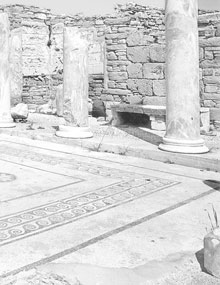
The House of the Lake and the House of the Diadoumenos, which are both in the ancient sanctuary of Delos, are expected to be restored and maintained through a project funded by the EU’s Third Community Support Framework and managed by the Central Archaeological Council. The two relics have been ravaged by nature and neglect.

IOTA SYKKA

Two monuments at the archaeological site of Delos in the Cyclades will be restored and maintained with European Union money, after the Greek Central Archaeological Council (KAS) approved two studies for the relics’ upkeep earlier this summer.

Delos, which mythology says is the birthplace of Artemis and Apollo, is considered one of the most important archaeological sites in the Cyclades.

The project will be funded by the EU’s Third Community Support Framework (CSFIII) and will focus on repairing damage caused by bad weather and a lack of maintenance.

The two monuments of the ancient sanctuary, the House of the Diadoumenos and the peristyle of the House of the Lake, date to the 2nd century BC and were destroyed in 88 BC, during the Mithridates Wars. The so-called Diadoumenos House is at the northern end of the site, northwest of the lake. It is an impressive complex which consists of rooms facing a central atrium. The atrium used to have a mosaic floor, under which two cisterns existed - the smaller one was a well.

The studies that were carried out revealed structural problems, including issues with the walls, parts of which have collapsed into one of the two cisterns.

Experts also detected some damage - limited, fortunately - due to the overgrowth of vegetation. Damage has also been caused by archaeological excavations.

Humidity, strong winds and a lack of any upkeep have caused bits of plaster to fall into the structures. KAS approved the initial studies and it is now hoped that experts will seriously tackle Delos, since the two monuments are now on UNESCO’s World Cultural Heritage list.

Monday, September 04, 2006

Plea to keep the universe Greek

Source: The Australian

September 02, 2006

GREEK astronomers had appealed to the world's top astronomical body to maintain a tradition of naming planets after Greek mythological figures, the Athens Observatory said today.

The Greeks were riled when a new planet-sized object discovered in 2003 was unofficially called Xena in homage to the main character of the American fantasy television series Xena: Warrior Princess.

"This provisional name ... is at the origin of this initiative taken by the observatory," the institute's astronomy department director Christos Goudis said.

Observatory chairman Christos Zerefos wrote a letter to the International Astronomical Union on August 20 proposing the names of a number of Greek mythological figures to replace Xena, Mr Goudis said.

"The last five years have seen a new interpretation of the solar system and we have to avoid giving off-hand names to newly-discovered stars," Mr Goudis said.

"Astronomy has deep roots ... we must preserve this historic tradition," he said.

A team led by US astronomer Mike Brown of the California Institute of Technology discovered Xena, a frozen object some 15 billion km from Earth, in 2003.

A fan of the popular television series, Mr Brown has nine years to think of a permanent name for the orb, originally designated as 2003 UB313.

Friday, September 01, 2006

Greece to the Final!!!!

Greece won USA 101-95 in the 2006 FIBA World Championship semifinals!


The European champions, who trailed by as many as 12 points in the first half but fought back to take a 45-41 lead at the interval, prevailed 101-95 to advance to the final in Japan.

Greece, which is now 8-0, will play Spain in the finals on Sunday.

Tuesday, August 29, 2006

Marbles with an Attitude!

...so, the Marbles are scattered and fragmented and ok fine, we believe that they deserve to be reunited and returned to the Acropolis, but hey... what do the marbles think? (Source: marbles@Apokrisi).

Well, let's see a sample!


If you want to see more, take a look at marbles@Apokrisi.

Iran: Discovery of 4000-Year-Old Ridged Graves in Lama

Source: Payvand's Iran News

Discovery of some ridged graves in which humans and animals were buried together in Lama Cemetery has raised new hopes for archeologists to find residential settlements in this area.

Tehran, 27 August 2006 (CHN) -- Second season of archeological excavations in the pre-historic cemetery of Lama in Kohkilouyeh-va-Boyer Ahmad province resulted in discovery of several ridged graves. The designs carved on the burial gifts unearthed in this cemetery are very similar to the New-Elamite designs which had already been found in Fars and Khuzestan provinces. Archeologists believe that most probably these graves date back to the second millennium BC.

In an interview with CHN, Hassan Rezvani, head of excavation team in Lama historical cemetery talked about new discoveries in the area and said: "We have not yet exhumed the graves, but we believe that the graves must entail some unique characteristics like the previous ones which had been unearthed during the first season of excavation. Human beings and animals were buried together in the graves. Based on archeological studies, this burial method was practiced during the ancient times to supply the dead with food!"

According to Rezvani, some studies have been undertaken on the historical relics which were unearthed during the previous season of archeological excavations that are now being kept in museum of Yasouj. "All the cultural evidence including clays, metal and bronze articles, different dishes, and the samples bones belonging to both human beings and animals were studied during 20 days of continual work in the museum of Yasouj. The designs which were engraved on the objects are very similar to the New Elamite designs already discovered in Fars and Khuzestan provinces. With continuation of excavations, we are hoping to identify some unknown residential settlements in this area," added Rezvani.

Lama Cemetery is located in Chal Shahin area in the township of Dena in Kohkilouyeh-va-Boyer Ahmad province. Some 53 graves were identified during archeological excavations in year 2000 in this cemetery. Initial studies on the findings revealed that the graves must have belonged to 3500-3000 years ago.

In this cemetery, rubbles and rocks were used in the construction of the graves and large pieces of stone were used to cover them. Different burial methods can be seen in some of the graves of this cemetery which belong to different periods of time. The remains of animal bones (mostly goat and sheep) have been discovered in most of the graves as burial offerings to the dead.

Sunday, August 27, 2006

2006 FIBA World Championship

Nothing to do with archaeology but I just couldn't help it! *S*

Greece have just achieved their sixth consecutive win in the 2006 World Basketball Championship, this time against China (final score 95-64).


Next game (quarter-final) is against France.

Results so far:
19.08.2006 vs Qatar 84-64
20.08.2006 vs Lithuania 81-76
22.08.2006 vs Australia 72-69
23.08.2006 vs Brazil 91-80
24.08.2006 vs Turkey 76-69
27.08.2006 vs China 95-64

Greece qualified to the World Cup after winning the 2005 FIBA European Champhionship.