Despotiko Excavation
Dispilio Excavations
Kallithea Archaeological Project
Mt. Lykaion Excavation and Survey Project
The Zominthos Project 2004-2009
Thursday, August 31, 2006


Greece to the semifinals
The reigning European champions booked their place in the semifinals of the FIBA World Championship 2006 with a convincing victory over France, 73-56.

Greece will now play USA, which knocked off Germany, 85-65.

Greece will now play USA, which knocked off Germany, 85-65.
Tuesday, August 29, 2006
Marbles with an Attitude!
...so, the Marbles are scattered and fragmented and ok fine, we believe that they deserve to be reunited and returned to the Acropolis, but hey... what do the marbles think? (Source: marbles@Apokrisi).
Well, let's see a sample!

If you want to see more, take a look at marbles@Apokrisi.
Well, let's see a sample!

If you want to see more, take a look at marbles@Apokrisi.
Iran: Discovery of 4000-Year-Old Ridged Graves in Lama
Source: Payvand's Iran News
Discovery of some ridged graves in which humans and animals were buried together in Lama Cemetery has raised new hopes for archeologists to find residential settlements in this area.
Tehran, 27 August 2006 (CHN) -- Second season of archeological excavations in the pre-historic cemetery of Lama in Kohkilouyeh-va-Boyer Ahmad province resulted in discovery of several ridged graves. The designs carved on the burial gifts unearthed in this cemetery are very similar to the New-Elamite designs which had already been found in Fars and Khuzestan provinces. Archeologists believe that most probably these graves date back to the second millennium BC.
In an interview with CHN, Hassan Rezvani, head of excavation team in Lama historical cemetery talked about new discoveries in the area and said: "We have not yet exhumed the graves, but we believe that the graves must entail some unique characteristics like the previous ones which had been unearthed during the first season of excavation. Human beings and animals were buried together in the graves. Based on archeological studies, this burial method was practiced during the ancient times to supply the dead with food!"
According to Rezvani, some studies have been undertaken on the historical relics which were unearthed during the previous season of archeological excavations that are now being kept in museum of Yasouj. "All the cultural evidence including clays, metal and bronze articles, different dishes, and the samples bones belonging to both human beings and animals were studied during 20 days of continual work in the museum of Yasouj. The designs which were engraved on the objects are very similar to the New Elamite designs already discovered in Fars and Khuzestan provinces. With continuation of excavations, we are hoping to identify some unknown residential settlements in this area," added Rezvani.
Lama Cemetery is located in Chal Shahin area in the township of Dena in Kohkilouyeh-va-Boyer Ahmad province. Some 53 graves were identified during archeological excavations in year 2000 in this cemetery. Initial studies on the findings revealed that the graves must have belonged to 3500-3000 years ago.
In this cemetery, rubbles and rocks were used in the construction of the graves and large pieces of stone were used to cover them. Different burial methods can be seen in some of the graves of this cemetery which belong to different periods of time. The remains of animal bones (mostly goat and sheep) have been discovered in most of the graves as burial offerings to the dead.
Discovery of some ridged graves in which humans and animals were buried together in Lama Cemetery has raised new hopes for archeologists to find residential settlements in this area.
Tehran, 27 August 2006 (CHN) -- Second season of archeological excavations in the pre-historic cemetery of Lama in Kohkilouyeh-va-Boyer Ahmad province resulted in discovery of several ridged graves. The designs carved on the burial gifts unearthed in this cemetery are very similar to the New-Elamite designs which had already been found in Fars and Khuzestan provinces. Archeologists believe that most probably these graves date back to the second millennium BC.
In an interview with CHN, Hassan Rezvani, head of excavation team in Lama historical cemetery talked about new discoveries in the area and said: "We have not yet exhumed the graves, but we believe that the graves must entail some unique characteristics like the previous ones which had been unearthed during the first season of excavation. Human beings and animals were buried together in the graves. Based on archeological studies, this burial method was practiced during the ancient times to supply the dead with food!"
According to Rezvani, some studies have been undertaken on the historical relics which were unearthed during the previous season of archeological excavations that are now being kept in museum of Yasouj. "All the cultural evidence including clays, metal and bronze articles, different dishes, and the samples bones belonging to both human beings and animals were studied during 20 days of continual work in the museum of Yasouj. The designs which were engraved on the objects are very similar to the New Elamite designs already discovered in Fars and Khuzestan provinces. With continuation of excavations, we are hoping to identify some unknown residential settlements in this area," added Rezvani.
Lama Cemetery is located in Chal Shahin area in the township of Dena in Kohkilouyeh-va-Boyer Ahmad province. Some 53 graves were identified during archeological excavations in year 2000 in this cemetery. Initial studies on the findings revealed that the graves must have belonged to 3500-3000 years ago.
In this cemetery, rubbles and rocks were used in the construction of the graves and large pieces of stone were used to cover them. Different burial methods can be seen in some of the graves of this cemetery which belong to different periods of time. The remains of animal bones (mostly goat and sheep) have been discovered in most of the graves as burial offerings to the dead.
Sunday, August 27, 2006
2006 FIBA World Championship
Nothing to do with archaeology but I just couldn't help it! *S*
Greece have just achieved their sixth consecutive win in the 2006 World Basketball Championship, this time against China (final score 95-64).

Next game (quarter-final) is against France.
Results so far:
19.08.2006 vs Qatar 84-64
20.08.2006 vs Lithuania 81-76
22.08.2006 vs Australia 72-69
23.08.2006 vs Brazil 91-80
24.08.2006 vs Turkey 76-69
27.08.2006 vs China 95-64
Greece qualified to the World Cup after winning the 2005 FIBA European Champhionship.
Greece have just achieved their sixth consecutive win in the 2006 World Basketball Championship, this time against China (final score 95-64).

Next game (quarter-final) is against France.
Results so far:
19.08.2006 vs Qatar 84-64
20.08.2006 vs Lithuania 81-76
22.08.2006 vs Australia 72-69
23.08.2006 vs Brazil 91-80
24.08.2006 vs Turkey 76-69
27.08.2006 vs China 95-64
Greece qualified to the World Cup after winning the 2005 FIBA European Champhionship.
Friday, August 25, 2006
Parthenon piece to be returned
Source: ekathimerini
German university agrees to give up relief sculpture next month; gov’t sees move as symbolic
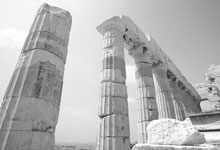
ANA
A view of the Parthenon as seen from the inside of the structure in June. The government hopes a decision by a German university to return a small piece of the Parthenon sculptures will set a precedent for other institutions.
A German university will be the first foreign institution to return part of the 2,500-year-old Parthenon sculptures to Greece, the government said late on Wednesday.
The small piece will be handed over by University of Heidelberg officials in early September, Greece’s Culture Minister Giorgos Voulgarakis said.
Measuring 8 by 12 centimeters (3 by nearly 5 inches), the relief sculpture of a man’s foot is far less significant than the British Museum’s collection of Parthenon masterpieces - also known as the Elgin Marbles - which Greece has fought for decades to reclaim.
But its return is a highly symbolic act which officials in Athens hope will lead to further the repatriations of the thousands of Greek antiquities in foreign museums and collections.
“This is very encouraging, and part of a series of things that are at last being put in order,” Voulgarakis said. “Our systematic efforts are leading to results.”
The Parthenon temple on the Acropolis, dedicated to Athena, goddess of wisdom, was built between 447 and 432 BC and is considered the crowning piece of ancient Greek architecture and art.
Large sections of its sculptured decoration were removed by Britain’s Lord Elgin in the early 19th century and since then have been displayed in the British Museum in London.
Greece claims these works were illegally removed and should be returned to Athens to be displayed alongside its own Parthenon sculptures.
Wednesday’s announcement came a day after the J. Paul Getty Museum said it had signed over to Greece the ownership of two ancient sculptures in its collections, following intense pressure from Athens. The pieces will be returned to Greece next week.
The private museum in Los Angeles is discussing the return of another two antiquities that Greece says were illegally excavated and spirited out of the country.
The Heidelberg sculpture belongs to the north section of the Parthenon frieze, a 160-meter (525-foot) strip of marble slabs decorated in relief with figures from a religious procession. It joins other parts of the frieze in Greece.
A Culture Ministry official said Greece would be offering an ancient artifact in return for the fragment - but did not offer further details.
The piece is expected to be displayed in a new 129-million-euro ($165 million) museum under construction in Athens to house finds from the Acropolis. The building is set for completion in March 2007.
Parts of the Parthenon sculptures are also held in the Louvre in Paris, and in museums in the Vatican, Vienna, Munich, Copenhagen and Palermo. (AP)
German university agrees to give up relief sculpture next month; gov’t sees move as symbolic

ANA
A view of the Parthenon as seen from the inside of the structure in June. The government hopes a decision by a German university to return a small piece of the Parthenon sculptures will set a precedent for other institutions.
A German university will be the first foreign institution to return part of the 2,500-year-old Parthenon sculptures to Greece, the government said late on Wednesday.
The small piece will be handed over by University of Heidelberg officials in early September, Greece’s Culture Minister Giorgos Voulgarakis said.
Measuring 8 by 12 centimeters (3 by nearly 5 inches), the relief sculpture of a man’s foot is far less significant than the British Museum’s collection of Parthenon masterpieces - also known as the Elgin Marbles - which Greece has fought for decades to reclaim.
But its return is a highly symbolic act which officials in Athens hope will lead to further the repatriations of the thousands of Greek antiquities in foreign museums and collections.
“This is very encouraging, and part of a series of things that are at last being put in order,” Voulgarakis said. “Our systematic efforts are leading to results.”
The Parthenon temple on the Acropolis, dedicated to Athena, goddess of wisdom, was built between 447 and 432 BC and is considered the crowning piece of ancient Greek architecture and art.
Large sections of its sculptured decoration were removed by Britain’s Lord Elgin in the early 19th century and since then have been displayed in the British Museum in London.
Greece claims these works were illegally removed and should be returned to Athens to be displayed alongside its own Parthenon sculptures.
Wednesday’s announcement came a day after the J. Paul Getty Museum said it had signed over to Greece the ownership of two ancient sculptures in its collections, following intense pressure from Athens. The pieces will be returned to Greece next week.
The private museum in Los Angeles is discussing the return of another two antiquities that Greece says were illegally excavated and spirited out of the country.
The Heidelberg sculpture belongs to the north section of the Parthenon frieze, a 160-meter (525-foot) strip of marble slabs decorated in relief with figures from a religious procession. It joins other parts of the frieze in Greece.
A Culture Ministry official said Greece would be offering an ancient artifact in return for the fragment - but did not offer further details.
The piece is expected to be displayed in a new 129-million-euro ($165 million) museum under construction in Athens to house finds from the Acropolis. The building is set for completion in March 2007.
Parts of the Parthenon sculptures are also held in the Louvre in Paris, and in museums in the Vatican, Vienna, Munich, Copenhagen and Palermo. (AP)
Bad Science!!!!
No comment!
Source: Reality Macedonia
Second Text of the Rosetta Stone Deciphered
The second text of the Rosetta Stone is written in the script and language of the then-masters of Egypt – the Ancient Macedonians.
By Nevena Popovska
The results of the research from the project "Decyphering the second text of the Rosetta Stone" were presented in the Macedonian Academy of Arts and Sciences (MANU) Thursday.
Academic Tome Boshevski and prof. Aristotel Tentov conducted the project was conducted under MANU auspices.
The Rosseta Stone, the researchers stressed, was discovered in 1799 in Egypt. Made of granite, 1.44 m tall, 0.72 m wide and weighting 762 kg. Text's contents is a decree by Ptolemy V Epiphanes written in three scripts: hierogliphic, "demotic" and ancient Greek in the year 196 before Christ. Currently the stone is stored in the British Museum in London.
"Contemporary science has mainly adopted the stance that there are no traces remaining from the script and the language of the Ancient Macedonians," Boshevski said. "Thus, the Rossetta Stone is considered as written with three scripts in two languages, in the following order: Hieroglyphic in Ancient Egyptian, Demotic in Ancient Egyptian, and Ancient Greek in Ancient Greek [Ionian]. Our starting premise was that it is unlikely that there's not a single complete sentance in the language and the script of the Ancient Macedonians preserved. Based on this, we hypothesized that the text on the Rosetta Stone is written in three languages, in the following order: Hieroglyphic in Ancient Egyptian, with a syllabic alphabet in Ancient Macedonian, and with a phoenetic alphabet in Ancient Greek." FULL STORY
Source: Reality Macedonia
Second Text of the Rosetta Stone Deciphered
The second text of the Rosetta Stone is written in the script and language of the then-masters of Egypt – the Ancient Macedonians.
By Nevena Popovska
The results of the research from the project "Decyphering the second text of the Rosetta Stone" were presented in the Macedonian Academy of Arts and Sciences (MANU) Thursday.
Academic Tome Boshevski and prof. Aristotel Tentov conducted the project was conducted under MANU auspices.
The Rosseta Stone, the researchers stressed, was discovered in 1799 in Egypt. Made of granite, 1.44 m tall, 0.72 m wide and weighting 762 kg. Text's contents is a decree by Ptolemy V Epiphanes written in three scripts: hierogliphic, "demotic" and ancient Greek in the year 196 before Christ. Currently the stone is stored in the British Museum in London.
"Contemporary science has mainly adopted the stance that there are no traces remaining from the script and the language of the Ancient Macedonians," Boshevski said. "Thus, the Rossetta Stone is considered as written with three scripts in two languages, in the following order: Hieroglyphic in Ancient Egyptian, Demotic in Ancient Egyptian, and Ancient Greek in Ancient Greek [Ionian]. Our starting premise was that it is unlikely that there's not a single complete sentance in the language and the script of the Ancient Macedonians preserved. Based on this, we hypothesized that the text on the Rosetta Stone is written in three languages, in the following order: Hieroglyphic in Ancient Egyptian, with a syllabic alphabet in Ancient Macedonian, and with a phoenetic alphabet in Ancient Greek." FULL STORY
Thursday, August 24, 2006
The Thera eruption revisited
Source: National Geographic News
"Atlantis" Eruption Twice as Big as Previously Believed, Study Suggests
Richard A. Lovett
for National Geographic News
August 23, 2006
A volcanic eruption that may have inspired the myth of Atlantis was up to twice as large as previously believed, according to an international team of scientists.
The eruption occurred 3,600 years ago on the Santorini archipelago, whose largest island is Thera. Santorini is located in the Aegean Sea about 125 miles (200 kilometers) southeast of modern-day Greece.
"In a very similar setting, [the milder] Krakatau produced 100-foot [30-meter] tsunami waves," Sigurdsson said.
Other pyroclastic flows would have been comprised of pumice—a frothy rock so light it floats.
These flows, known as overwater flows, would have zoomed across the sea in scalding waves of debris, eventually hitting land many miles away.
An overwater flow from Krakatau killed more than a thousand people on the coast of Sumatra, 25 miles away from the site of the eruption.
The devastation caused by Santorini—once a single island—would have been far worse.
"We have to scale the effects of both the tsunami and overwater pyroclastic flows to the Santorini eruption," Sigurdsson said.
His team, he adds, will soon begin studies in Crete and western Turkey looking for the remnants from such flows.
Jelle Zeilinga de Boer, an emeritus professor of geology at Wesleyan University in Middletown, Connecticut, notes that the strength of the eruption also depends on its duration.
"We don't know whether this came out in one flow or a number," he said.
There is some archaeological evidence, he adds, that people returned to the devastated area and started rebuilding, only to be blasted anew by the next round of activity.
Massive Destruction
Whether it occurred in one large blast or in a series of smaller events, the eruption produced massive devastation.
In his book Volcanoes in Human History, de Boer links the eruption to the demise of the Minoan civilization.
The seafaring Minoan culture was based on Crete, which is only a few dozen miles from Thera. At the time of the eruption, they dominated that part of the ancient Mediterranean.
When Thera erupted, the Minoans would have been clobbered by tsunamis, overwater pyroclastic flows, and fires from oil lamps knocked over by the eruption's shockwave.
Famine, plague, and a destruction of the Minoans' shipping economy would also have followed, de Boer says.
The eruption may also have had an enormous impact on Mediterranean mythology.
"I have no doubt that every myth is based on some event, and so is the myth of Atlantis," the University of Rhode Island's Sigurdsson said. "An event of this magnitude must have left its imprint."
Sigurdsson also sees traces of Santorini in a Greek poem called the Theogony, composed by Hesiod about 800 years after the eruption.
The poem describes an epic battle between giants and the Greek gods and includes imagery of a great battle far out at sea.
Hesiod must have picked up the story as folklore handed down from survivors close enough to see the event but not close enough to know what happened, Siggurdsson says.
"He uses all the terminology one would use in describing an eruption," he said. "The people who lived close enough to see that it was a volcano were all killed. [The rest] could only describe it in supernatural terms."
"Atlantis" Eruption Twice as Big as Previously Believed, Study Suggests
Richard A. Lovett
for National Geographic News
August 23, 2006
A volcanic eruption that may have inspired the myth of Atlantis was up to twice as large as previously believed, according to an international team of scientists.
The eruption occurred 3,600 years ago on the Santorini archipelago, whose largest island is Thera. Santorini is located in the Aegean Sea about 125 miles (200 kilometers) southeast of modern-day Greece.
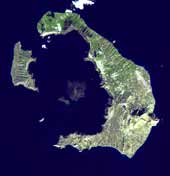
The massive explosion may have destroyed the Minoan civilization based on nearby Crete.
Writing in this week's issue of the journal Eos, a team of Greek and U.S. researchers estimate that the volcano released 14 cubic miles (60 cubic kilometers) of magma—six times more than the infamous 1883 eruption of Krakatau (Krakatoa).
Only one eruption in human history is believed to have been larger: an 1815 explosion of Tambora, in Indonesia, which released 24 cubic miles (100 cubic kilometers) of magma.
(Related story: "'Lost Kingdom' Discovered on Volcanic Island in Indonesia [February 27, 2006].)
The researchers, partially funded by the National Geographic Society, obtained the new data by conducting the first seismic survey of the seabed near Santorini.
Previously, scientists had been forced to guess the size of the eruption based on ash deposits found in Turkey, Crete, Egypt, and the Black Sea.
A Hundred Feet Thick
Using techniques similar to those employed by oil companies to search for offshore deposits, the research team found a ring of volcanic deposits extending all the way around the Santorini archipelago.
The deposits averaged 100 feet (30 meters) thick and extended about 19 miles (30 kilometers) in all directions, says Haraldur Sigurdsson, a volcanologist at the University of Rhode Island in Kingston, who led the research.
During the eruption, the material that formed the deposits would have plunged into the sea as pyroclastic flows—hot, fast-moving mixtures of gas, ash, and molten rock. As these hit the water, they would have kicked up massive tsunamis.
"In a very similar setting, [the milder] Krakatau produced 100-foot [30-meter] tsunami waves," Sigurdsson said.
Other pyroclastic flows would have been comprised of pumice—a frothy rock so light it floats.
These flows, known as overwater flows, would have zoomed across the sea in scalding waves of debris, eventually hitting land many miles away.
An overwater flow from Krakatau killed more than a thousand people on the coast of Sumatra, 25 miles away from the site of the eruption.
The devastation caused by Santorini—once a single island—would have been far worse.
"We have to scale the effects of both the tsunami and overwater pyroclastic flows to the Santorini eruption," Sigurdsson said.
His team, he adds, will soon begin studies in Crete and western Turkey looking for the remnants from such flows.
Jelle Zeilinga de Boer, an emeritus professor of geology at Wesleyan University in Middletown, Connecticut, notes that the strength of the eruption also depends on its duration.
"We don't know whether this came out in one flow or a number," he said.
There is some archaeological evidence, he adds, that people returned to the devastated area and started rebuilding, only to be blasted anew by the next round of activity.
Massive Destruction
Whether it occurred in one large blast or in a series of smaller events, the eruption produced massive devastation.
In his book Volcanoes in Human History, de Boer links the eruption to the demise of the Minoan civilization.
The seafaring Minoan culture was based on Crete, which is only a few dozen miles from Thera. At the time of the eruption, they dominated that part of the ancient Mediterranean.
When Thera erupted, the Minoans would have been clobbered by tsunamis, overwater pyroclastic flows, and fires from oil lamps knocked over by the eruption's shockwave.
Famine, plague, and a destruction of the Minoans' shipping economy would also have followed, de Boer says.
The eruption may also have had an enormous impact on Mediterranean mythology.
"I have no doubt that every myth is based on some event, and so is the myth of Atlantis," the University of Rhode Island's Sigurdsson said. "An event of this magnitude must have left its imprint."
Sigurdsson also sees traces of Santorini in a Greek poem called the Theogony, composed by Hesiod about 800 years after the eruption.
The poem describes an epic battle between giants and the Greek gods and includes imagery of a great battle far out at sea.
Hesiod must have picked up the story as folklore handed down from survivors close enough to see the event but not close enough to know what happened, Siggurdsson says.
"He uses all the terminology one would use in describing an eruption," he said. "The people who lived close enough to see that it was a volcano were all killed. [The rest] could only describe it in supernatural terms."
Phoenician tombs found in Sicily
Source: ANSA
Marsala (Trapani), August 23
Archaeologists have unearthed 40 sarcophagi in what was once the sacred Phoenician burial grounds of Birgi, near the ancient colony of Motya .
The tombs were discovered by chance by a group of construction workers excavating the foundations of a house close to the westernmost tip of Sicily near Marsala, culture officials said .
Archaeologists said the sarcophagi were made of simple stone slabs and resembled those found on display outside the museum on the neighbouring island of Motya (present-day Mozia), site of a prosperous Phoenician colony .
"The tombs were of different dimensions, including several used to bury children, and spread apart in irregular order," archaeologists said .
Although they failed to find objects inside the sarcophigi, archaeologists unearthed several vases of different sizes and shapes in the field .
"The vases were most likely used during propitiatory rites just before the burial took place," the experts said .
According to the experts, the tombs had clearly been ransacked by tomb raiders or perhaps by Joseph Whitaker, an archaeologist related to a noble British family that produced and exported Marsala wines from Sicily in the 19th Century . Whitaker, who was responsible for the rediscovery of Motya, built a house on the island and moved all his finds there in 1908 . His house now serves as the archaeological museum .
Motya - whose name means "wool-spinning centre" was founded in the 8th century BC, about a century after the foundation of the most famous Phoenician colony in the ancient world, Carthage in Tunisia .
Greeks also began to colonise Sicily at the same time as Motya's foundation and conflicts broke out between Greek and Phoenician settlements . The Greek tyrant ruler of Siracusa, Dionysius I, destroyed Motya in 397 BC . Half a century later, Rome's intervention in the Greek-Carthaginian conflicts led to the Roman conquest of Sicily, which became Rome's first province .
The Phoenicians were a trading people who formed a massive commercial empire across the Mediterranean from their bases in modern-day Lebanon . Among the Italian cities they founded is today's capital of Sicily, Palermo . Other colonies included Cadiz and Malaga in Spain, Tangiers in Morocco and Tripoli in Libya .
Late last year, archaeologists announced they had found the remains of an ancient Phoenician temple off Motya, saying it was "unique" in the West . "You have to go all the way to Amrit in Syria to find a similar one," said Lorenzo Nigro of the Rome University team, who headed the digs . The temple came to light after a portion of a lagoon surrounding Motya was drained . The pool began to fill up again and a fresh-water spring was found - a fact Nigro believes proves it was used as a holy place .
Marsala (Trapani), August 23
Archaeologists have unearthed 40 sarcophagi in what was once the sacred Phoenician burial grounds of Birgi, near the ancient colony of Motya .
The tombs were discovered by chance by a group of construction workers excavating the foundations of a house close to the westernmost tip of Sicily near Marsala, culture officials said .
Archaeologists said the sarcophagi were made of simple stone slabs and resembled those found on display outside the museum on the neighbouring island of Motya (present-day Mozia), site of a prosperous Phoenician colony .
"The tombs were of different dimensions, including several used to bury children, and spread apart in irregular order," archaeologists said .
Although they failed to find objects inside the sarcophigi, archaeologists unearthed several vases of different sizes and shapes in the field .
"The vases were most likely used during propitiatory rites just before the burial took place," the experts said .
According to the experts, the tombs had clearly been ransacked by tomb raiders or perhaps by Joseph Whitaker, an archaeologist related to a noble British family that produced and exported Marsala wines from Sicily in the 19th Century . Whitaker, who was responsible for the rediscovery of Motya, built a house on the island and moved all his finds there in 1908 . His house now serves as the archaeological museum .
Motya - whose name means "wool-spinning centre" was founded in the 8th century BC, about a century after the foundation of the most famous Phoenician colony in the ancient world, Carthage in Tunisia .
Greeks also began to colonise Sicily at the same time as Motya's foundation and conflicts broke out between Greek and Phoenician settlements . The Greek tyrant ruler of Siracusa, Dionysius I, destroyed Motya in 397 BC . Half a century later, Rome's intervention in the Greek-Carthaginian conflicts led to the Roman conquest of Sicily, which became Rome's first province .
The Phoenicians were a trading people who formed a massive commercial empire across the Mediterranean from their bases in modern-day Lebanon . Among the Italian cities they founded is today's capital of Sicily, Palermo . Other colonies included Cadiz and Malaga in Spain, Tangiers in Morocco and Tripoli in Libya .
Late last year, archaeologists announced they had found the remains of an ancient Phoenician temple off Motya, saying it was "unique" in the West . "You have to go all the way to Amrit in Syria to find a similar one," said Lorenzo Nigro of the Rome University team, who headed the digs . The temple came to light after a portion of a lagoon surrounding Motya was drained . The pool began to fill up again and a fresh-water spring was found - a fact Nigro believes proves it was used as a holy place .
Wednesday, August 23, 2006
Another Greek name for NASA
Source: NASA
NASA Names New Crew Exploration Vehicle Orion
08.22.06
NASA announced Tuesday that its new crew exploration vehicle will be named Orion.
Orion is the vehicle NASA’s Constellation Program is developing to carry a new generation of explorers back to the moon and later to Mars. Orion will succeed the space shuttle as NASA's primary vehicle for human space exploration.
Orion's first flight with astronauts onboard is planned for no later than 2014 to the International Space Station. Its first flight to the moon is planned for no later than 2020.

Image to left: NASA's Constellation Program is getting to work on the new spacecraft that will return humans to the moon and blaze a trail to Mars and beyond. This artist's rendering represents a concept of a crew exploration vehicle (CEV) and service module. Image credit: NASA
Orion is named for one of the brightest, most familiar and easily identifiable constellations.
"Many of its stars have been used for navigation and guided explorers to new worlds for centuries," said Orion Project Manager Skip Hatfield. "Our team, and all of NASA - and, I believe, our country - grows more excited with every step forward this program takes. The future for space exploration is coming quickly."
In June, NASA announced the launch vehicles under development by the Constellation Program have been named Ares, a synonym for Mars. The booster that will launch Orion will be called Ares I, and a larger heavy-lift launch vehicle will be known as Ares V.
Orion will be capable of transporting cargo and up to six crew members to and from the International Space Station. It can carry four crewmembers for lunar missions. Later, it can support crew transfers for Mars missions.
Orion borrows its shape from space capsules of the past, but takes advantage of the latest technology in computers, electronics, life support, propulsion and heat protection systems. The capsule's conical shape is the safest and most reliable for re-entering the Earth’s atmosphere, especially at the velocities required for a direct return from the moon.
Orion will be 16.5 feet in diameter and have a mass of about 25 tons. Inside, it will have more than 2.5 times the volume of an Apollo capsule. The spacecraft will return humans to the moon to stay for long periods as a testing ground for the longer journey to Mars.
NASA's Johnson Space Center, Houston, manages the Constellation Program and the agency's Marshall Space Flight Center, Huntsville, Ala., manages the Exploration Launch Projects' office for the Exploration Systems Mission Directorate, Washington.
NASA Names New Crew Exploration Vehicle Orion
08.22.06
NASA announced Tuesday that its new crew exploration vehicle will be named Orion.
Orion is the vehicle NASA’s Constellation Program is developing to carry a new generation of explorers back to the moon and later to Mars. Orion will succeed the space shuttle as NASA's primary vehicle for human space exploration.
Orion's first flight with astronauts onboard is planned for no later than 2014 to the International Space Station. Its first flight to the moon is planned for no later than 2020.

Image to left: NASA's Constellation Program is getting to work on the new spacecraft that will return humans to the moon and blaze a trail to Mars and beyond. This artist's rendering represents a concept of a crew exploration vehicle (CEV) and service module. Image credit: NASA
Orion is named for one of the brightest, most familiar and easily identifiable constellations.
"Many of its stars have been used for navigation and guided explorers to new worlds for centuries," said Orion Project Manager Skip Hatfield. "Our team, and all of NASA - and, I believe, our country - grows more excited with every step forward this program takes. The future for space exploration is coming quickly."
In June, NASA announced the launch vehicles under development by the Constellation Program have been named Ares, a synonym for Mars. The booster that will launch Orion will be called Ares I, and a larger heavy-lift launch vehicle will be known as Ares V.
Orion will be capable of transporting cargo and up to six crew members to and from the International Space Station. It can carry four crewmembers for lunar missions. Later, it can support crew transfers for Mars missions.
Orion borrows its shape from space capsules of the past, but takes advantage of the latest technology in computers, electronics, life support, propulsion and heat protection systems. The capsule's conical shape is the safest and most reliable for re-entering the Earth’s atmosphere, especially at the velocities required for a direct return from the moon.
Orion will be 16.5 feet in diameter and have a mass of about 25 tons. Inside, it will have more than 2.5 times the volume of an Apollo capsule. The spacecraft will return humans to the moon to stay for long periods as a testing ground for the longer journey to Mars.
NASA's Johnson Space Center, Houston, manages the Constellation Program and the agency's Marshall Space Flight Center, Huntsville, Ala., manages the Exploration Launch Projects' office for the Exploration Systems Mission Directorate, Washington.
Getty update
Source: ekathimerini
Getty to hand back artifacts
Two ancient Greek artifacts, including one that dates as far back as the 6th century BC, will be returned to Greece by the end of the month from the J. Paul Getty Museum, the Culture Ministry said yesterday.
The private museum in Los Angeles signed over the two sculptures following pressure from Greece which says that they were illegally taken from the country.
The 6th century BC marble relief depicts two women offering gifts to a seated goddess while the 4th century BC tombstone bears the figure of a young warrior.
The two sides agreed to hold further talks in Athens on the possible return of other antiquities, according to the ministry. Talks are also expected to focus on matters on which the two parties can work together in the future.
The news comes after the museum agreed in July to return four antiquities which Greece had been contesting.
Getty to hand back artifacts
Two ancient Greek artifacts, including one that dates as far back as the 6th century BC, will be returned to Greece by the end of the month from the J. Paul Getty Museum, the Culture Ministry said yesterday.
The private museum in Los Angeles signed over the two sculptures following pressure from Greece which says that they were illegally taken from the country.
The 6th century BC marble relief depicts two women offering gifts to a seated goddess while the 4th century BC tombstone bears the figure of a young warrior.
The two sides agreed to hold further talks in Athens on the possible return of other antiquities, according to the ministry. Talks are also expected to focus on matters on which the two parties can work together in the future.
The news comes after the museum agreed in July to return four antiquities which Greece had been contesting.
Tuesday, August 22, 2006
More on the 'Hobbit'
This time from the Independent.
The hobbit: was it a work of fiction?
The three-foot tall creature was hailed as a new species of human. Now research casts doubt on the claim.
By Steve Connor
Published: 22 August 2006
It is either the most important discovery in human evolution for decades, or one of the biggest blunders of modern science - and there's not much room for anything in between.
She was either a new species of miniature "Hobbit-like" human, just three feet tall, who lived 18,000 years ago on a remote Indonesian island among giant rats, pygmy elephants and massive, dragon-like reptiles. Or she was just another member of our own species - Homo sapiens - who was unfortunate enough to suffer from a severe congenital disorder that meant she developed an unusually small braincase, stunted body and shortened limbs.
If the latter is ever proved to be the case, it will come as a huge embarrassment to the scientists behind a study published in the journal Nature in 2004, claiming that Homo floresiensis truly represents a new species of miniature human being.
The latest salvo in the dispute over the bones has come in a study published in the current issue of the journal Proceedings of the National Academy of Science, which backs up claims that the "hobbit" is nothing more than a small-brained member of our own species.
The authors of the study claim that the original assessment of the remains was wrong, and that there is no evidence for the existence of a miniature species of human who hunted pygmy rats and who was in turn hunted by giant Komodo dragons.
FULL STORY
The hobbit: was it a work of fiction?
The three-foot tall creature was hailed as a new species of human. Now research casts doubt on the claim.
By Steve Connor
Published: 22 August 2006
It is either the most important discovery in human evolution for decades, or one of the biggest blunders of modern science - and there's not much room for anything in between.
She was either a new species of miniature "Hobbit-like" human, just three feet tall, who lived 18,000 years ago on a remote Indonesian island among giant rats, pygmy elephants and massive, dragon-like reptiles. Or she was just another member of our own species - Homo sapiens - who was unfortunate enough to suffer from a severe congenital disorder that meant she developed an unusually small braincase, stunted body and shortened limbs.
If the latter is ever proved to be the case, it will come as a huge embarrassment to the scientists behind a study published in the journal Nature in 2004, claiming that Homo floresiensis truly represents a new species of miniature human being.
The latest salvo in the dispute over the bones has come in a study published in the current issue of the journal Proceedings of the National Academy of Science, which backs up claims that the "hobbit" is nothing more than a small-brained member of our own species.
The authors of the study claim that the original assessment of the remains was wrong, and that there is no evidence for the existence of a miniature species of human who hunted pygmy rats and who was in turn hunted by giant Komodo dragons.
FULL STORY
Aegean’s ritual prehistory - Keros
The Times August 21, 2006
Notebook: Archaeology
Aegean’s ritual prehistory
By Norman Hammond, Archaeology Correspondent
THE prehistoric marble sculptures of the Cyclades are noted for their spare, elegant lines: they are also notorious for being in large part looted, with few having a known archaeological provenance, and for attracting the attentions of fakers. Recent discoveries on the island of Keros have shown that these enigmatic figurines, and the stone bowls made from the same marble, arguably by the same artists, were deposited in rituals equally puzzling.
Cycladic art dates to the third millennium BC, a product of the society which arose in the Aegean islands not long before Minoan Crete and then Mycenaean Greece emerged as Europe’s first literate civilisations. Originally thought rather crude, its figurines — ranging from hand-sized to more than a metre in height — gained stature in the eyes of collectors as the taste for simplicity in modern sculpture developed in the last century.
Their role in Ancient Cycladic society remained a mystery; research this summer on the island of Keros by a team led by Professor Colin Renfrew, of Cambridge University, has provided a wealth of quite literally hard evidence, although its significance is as yet unclear.
In 1963 Professor Renfrew, then a student, visited the island and “was staggered to pick up on the surface numerous fragments of marble bowls and figurines”. Looters moved in on Keros, and in the 1970s the “Keros Hoard” was cited as the origin of many unprovenanced pieces sold on the art market.
The “Keros Enigma” was that, while many scholars felt that the looted pieces had come from an ancient cemetery, none had ever been discovered: one grave was known, together with settlement remains on the neighbouring islet of Daskalio. A massive deposit, thought to have contained thousands of figurine and bowl fragments, was also known to have been looted in the 1960s.
Some ascribed the fragmentary condition of most pieces to looters, but Professor Renfrew, noting the lack of joinable fragments and the apparently ancient and weathered nature of the fracture surfaces, believed that they had been deposited already broken. Excavations this year at the site of Daskalio Kavos confirmed his thesis.
The team reported to the Greek authorities that “the discovery of a further, undisturbed, special deposit followed by its careful excavation shows that all the material found was already broken in fragments before it became buried in Ancient times.”
“The rarity of joining pieces, as well as the different degrees of weathering, make clear that they were broken elsewhere and brought, already in fragmentary form, to the exceptionally rich deposit.”
The cemetery interpretation is excluded by the lack of human remains. Pottery, such as the spouted “sauce boats”, was brought in from islands including Naxos, Syros and Amorgos, and possibly from the Greek mainland. Professor Renfrew believes that the figurines and bowls had equally diverse origins. The overall quantity of fine pottery and marble objects found at Daskalio Kavos “rivals the total from all the known Cycladic cemeteries.”
The site can therefore be recognised as “the first major ritual centre of Aegean prehistory”, antedating the Mycenaean shrine on the island of Milos excavated by Professor Renfrew some years ago.
Notebook: Archaeology
Aegean’s ritual prehistory
By Norman Hammond, Archaeology Correspondent
THE prehistoric marble sculptures of the Cyclades are noted for their spare, elegant lines: they are also notorious for being in large part looted, with few having a known archaeological provenance, and for attracting the attentions of fakers. Recent discoveries on the island of Keros have shown that these enigmatic figurines, and the stone bowls made from the same marble, arguably by the same artists, were deposited in rituals equally puzzling.
Cycladic art dates to the third millennium BC, a product of the society which arose in the Aegean islands not long before Minoan Crete and then Mycenaean Greece emerged as Europe’s first literate civilisations. Originally thought rather crude, its figurines — ranging from hand-sized to more than a metre in height — gained stature in the eyes of collectors as the taste for simplicity in modern sculpture developed in the last century.
Their role in Ancient Cycladic society remained a mystery; research this summer on the island of Keros by a team led by Professor Colin Renfrew, of Cambridge University, has provided a wealth of quite literally hard evidence, although its significance is as yet unclear.
In 1963 Professor Renfrew, then a student, visited the island and “was staggered to pick up on the surface numerous fragments of marble bowls and figurines”. Looters moved in on Keros, and in the 1970s the “Keros Hoard” was cited as the origin of many unprovenanced pieces sold on the art market.
The “Keros Enigma” was that, while many scholars felt that the looted pieces had come from an ancient cemetery, none had ever been discovered: one grave was known, together with settlement remains on the neighbouring islet of Daskalio. A massive deposit, thought to have contained thousands of figurine and bowl fragments, was also known to have been looted in the 1960s.
Some ascribed the fragmentary condition of most pieces to looters, but Professor Renfrew, noting the lack of joinable fragments and the apparently ancient and weathered nature of the fracture surfaces, believed that they had been deposited already broken. Excavations this year at the site of Daskalio Kavos confirmed his thesis.
The team reported to the Greek authorities that “the discovery of a further, undisturbed, special deposit followed by its careful excavation shows that all the material found was already broken in fragments before it became buried in Ancient times.”
“The rarity of joining pieces, as well as the different degrees of weathering, make clear that they were broken elsewhere and brought, already in fragmentary form, to the exceptionally rich deposit.”
The cemetery interpretation is excluded by the lack of human remains. Pottery, such as the spouted “sauce boats”, was brought in from islands including Naxos, Syros and Amorgos, and possibly from the Greek mainland. Professor Renfrew believes that the figurines and bowls had equally diverse origins. The overall quantity of fine pottery and marble objects found at Daskalio Kavos “rivals the total from all the known Cycladic cemeteries.”
The site can therefore be recognised as “the first major ritual centre of Aegean prehistory”, antedating the Mycenaean shrine on the island of Milos excavated by Professor Renfrew some years ago.
Monday, August 21, 2006
‘Hobbit’ was a disabled caveman
No comment...
Jonathan Leake and Tom Baird (The Sunday Times)
The remains of a fossilised stone age pygmy, hailed as a new species of human when it was found two years ago, probably belonged to a disabled but otherwise normal caveman, researchers have claimed.
The discovery of the 18,000-year-old “homo floresiensis” on the Indonesian island of Flores was thought to be a major development in tracing human evolution when it was announced in 2004.
However, a new analysis of the 3ft skeleton, nicknamed the “hobbit”, along with other remains found at the site, has indicated they probably belonged to an early human suffering from microcephaly, a condition that causes an abnormally small head and other deformities.
“The skeletal remains do not represent a new species, but some of the ancestors of modern human pygmies who live on the island today,” concludes a report in the Proceedings of the National Academy of Sciences, one of America’s most respected scientific institutions. “The individual exhibits a combination of characteristics that are not primitive but instead regional and not unique but found in other modern human populations.”
The controversy began in October 2004 when Nature, a leading British science journal, published what appeared to be a groundbreaking paper about a new species of human.
The original team, co-directed by Michael Morwood from the University of New England in Australia and Professor Radien Soejono of the Indonesian Research Centre for Archeology, made the discovery in the Liang Bua cave.
The creature was found with fossils of animals including a snake, frog, monkey, deer and pig. “Here we have a creature that is substantially different from modern humans, a totally new species of our genus, that lived almost into historical times. This has a number of startling implications,” said Henry Gee, Nature’s senior editor for biological science, at the time.
Nature has confirmed that it subjected the manuscript to the normal scientific review process in which it was scrutinised by outside experts who approved its contents.
The new study suggests, however, that the initial evaluation of the remains was flawed.
Robert Eckhardt, professor of developmental genetics and evolutionary morphology at Pennsylvania State University, who was part of the new team, criticises the original study for comparing the skeleton with those of homo sapiens primarily from Europe.
A more accurate understanding of the “hobbit”, he says, emerges when comparing the bones against humans from the same region.
Some researchers had already expressed doubts over the original findings. Earlier this year Robert Martin, a primatologist at the Field museum in Chicago, said: “If you plot a graph of all of the data we have on brain sizes of hominids against time, [floresiensis] is the only one that falls right off the curve. It’s an anomaly.”
Jonathan Leake and Tom Baird (The Sunday Times)
The remains of a fossilised stone age pygmy, hailed as a new species of human when it was found two years ago, probably belonged to a disabled but otherwise normal caveman, researchers have claimed.
The discovery of the 18,000-year-old “homo floresiensis” on the Indonesian island of Flores was thought to be a major development in tracing human evolution when it was announced in 2004.
However, a new analysis of the 3ft skeleton, nicknamed the “hobbit”, along with other remains found at the site, has indicated they probably belonged to an early human suffering from microcephaly, a condition that causes an abnormally small head and other deformities.
“The skeletal remains do not represent a new species, but some of the ancestors of modern human pygmies who live on the island today,” concludes a report in the Proceedings of the National Academy of Sciences, one of America’s most respected scientific institutions. “The individual exhibits a combination of characteristics that are not primitive but instead regional and not unique but found in other modern human populations.”
The controversy began in October 2004 when Nature, a leading British science journal, published what appeared to be a groundbreaking paper about a new species of human.
The original team, co-directed by Michael Morwood from the University of New England in Australia and Professor Radien Soejono of the Indonesian Research Centre for Archeology, made the discovery in the Liang Bua cave.
The creature was found with fossils of animals including a snake, frog, monkey, deer and pig. “Here we have a creature that is substantially different from modern humans, a totally new species of our genus, that lived almost into historical times. This has a number of startling implications,” said Henry Gee, Nature’s senior editor for biological science, at the time.
Nature has confirmed that it subjected the manuscript to the normal scientific review process in which it was scrutinised by outside experts who approved its contents.
The new study suggests, however, that the initial evaluation of the remains was flawed.
Robert Eckhardt, professor of developmental genetics and evolutionary morphology at Pennsylvania State University, who was part of the new team, criticises the original study for comparing the skeleton with those of homo sapiens primarily from Europe.
A more accurate understanding of the “hobbit”, he says, emerges when comparing the bones against humans from the same region.
Some researchers had already expressed doubts over the original findings. Earlier this year Robert Martin, a primatologist at the Field museum in Chicago, said: “If you plot a graph of all of the data we have on brain sizes of hominids against time, [floresiensis] is the only one that falls right off the curve. It’s an anomaly.”
The Antikythera Mechanism
Revealed: world's oldest computer
Helena Smith
Sunday August 20, 2006
The Observer
It looks like a heap of rubbish, feels like flaky pastry and has been linked to aliens. For decades, scientists have puzzled over the complex collection of cogs, wheels and dials seen as the most sophisticated object from antiquity, writes Helena Smith. But 102 years after the discovery of the calcium-encrusted bronze mechanism on the ocean floor, hidden inscriptions show that it is the world's oldest computer, used to map the motions of the sun, moon and planets.
'We're very close to unlocking the secrets,' says Xenophon Moussas,an astrophysicist with a Anglo-Greek team researching the device. 'It's like a puzzle concerning astronomical and mathematical knowledge.'
Known as the Antikythera mechanism and made before the birth of Christ, the instrument was found by sponge divers amid the wreckage of a cargo ship that sunk off the tiny island of Antikythera in 80BC. To date, no other appears to have survived.
'Bronze objects like these would have been recycled, but being in deep water it was out of reach of the scrap-man and we had the luck to discover it,' said Michael Wright, a former curator at London's Science Museum. He said the apparatus was the best proof yet of how technologically advanced the ancients were. 'The skill with which it was made shows a level of instrument-making not surpassed until the Renaissance. It really is the first hard evidence of their interest in mechanical gadgets, ability to make them and the preparedness of somebody to pay for them.'
For years scholars had surmised that the object was an astronomical showpiece, navigational instrument or rich man's toy. The Roman Cicero described the device as being for 'after-dinner entertainment'.
But many experts say it could change how the history of science is written. 'In many ways, it was the first analogue computer,' said Professor Theodosios Tassios of the National Technical University of Athens. 'It will change the way we look at the ancients' technological achievements.'
Helena Smith
Sunday August 20, 2006
The Observer
It looks like a heap of rubbish, feels like flaky pastry and has been linked to aliens. For decades, scientists have puzzled over the complex collection of cogs, wheels and dials seen as the most sophisticated object from antiquity, writes Helena Smith. But 102 years after the discovery of the calcium-encrusted bronze mechanism on the ocean floor, hidden inscriptions show that it is the world's oldest computer, used to map the motions of the sun, moon and planets.
'We're very close to unlocking the secrets,' says Xenophon Moussas,an astrophysicist with a Anglo-Greek team researching the device. 'It's like a puzzle concerning astronomical and mathematical knowledge.'
Known as the Antikythera mechanism and made before the birth of Christ, the instrument was found by sponge divers amid the wreckage of a cargo ship that sunk off the tiny island of Antikythera in 80BC. To date, no other appears to have survived.
'Bronze objects like these would have been recycled, but being in deep water it was out of reach of the scrap-man and we had the luck to discover it,' said Michael Wright, a former curator at London's Science Museum. He said the apparatus was the best proof yet of how technologically advanced the ancients were. 'The skill with which it was made shows a level of instrument-making not surpassed until the Renaissance. It really is the first hard evidence of their interest in mechanical gadgets, ability to make them and the preparedness of somebody to pay for them.'
For years scholars had surmised that the object was an astronomical showpiece, navigational instrument or rich man's toy. The Roman Cicero described the device as being for 'after-dinner entertainment'.
But many experts say it could change how the history of science is written. 'In many ways, it was the first analogue computer,' said Professor Theodosios Tassios of the National Technical University of Athens. 'It will change the way we look at the ancients' technological achievements.'
Friday, August 18, 2006
Russian Centaur?
This sounds really interesting.
Source: InfoCentre
During archeological diggings in Velikiy Novgorod Russian scientists have found a figure they named "ancient Russian centaur". The figure was found in layers dated back to the end of XI century in the Troitsky dig near the Novgorod Kremlin.
Unknown craftsman had cut a wooden bearded man with a hat on his head and a bow behind his back. The figure has hooves instead of feet and is covered with a golden coating. It is broken in that very part, where human body transforms to the body of a horse. The other part is lost. Scientists report that such figures have never been found before.
Experts suppose the centaur to be the child toy, but at the same time they mark that toys in Ancient Russian had never had such coatings. The centaur is now heading for the expertise to find out its real age and the wood it was cut from.
The same report more or less can also be found here.
Source: InfoCentre
During archeological diggings in Velikiy Novgorod Russian scientists have found a figure they named "ancient Russian centaur". The figure was found in layers dated back to the end of XI century in the Troitsky dig near the Novgorod Kremlin.
Unknown craftsman had cut a wooden bearded man with a hat on his head and a bow behind his back. The figure has hooves instead of feet and is covered with a golden coating. It is broken in that very part, where human body transforms to the body of a horse. The other part is lost. Scientists report that such figures have never been found before.
Experts suppose the centaur to be the child toy, but at the same time they mark that toys in Ancient Russian had never had such coatings. The centaur is now heading for the expertise to find out its real age and the wood it was cut from.
The same report more or less can also be found here.
Wednesday, August 16, 2006
Archaeologists Challenge Link Between Dead Sea Scrolls and Ancient Sect
Source: The New York Times
By JOHN NOBLE WILFORD
Published: August 15, 2006
New archaeological evidence is raising more questions about the conventional interpretation linking the desolate ruins of an ancient settlement known as Qumran with the Dead Sea Scrolls, which were found in nearby caves in one of the sensational discoveries of the last century.
After early excavations at the site, on a promontory above the western shore of the Dead Sea, scholars concluded that members of a strict Jewish sect, the Essenes, had lived there in a monastery and presumably wrote the scrolls in the first centuries B.C. and A.D.
Many of the texts describe religious practices and doctrine in ancient Israel.
But two Israeli archaeologists who have excavated the site on and off for more than 10 years now assert that Qumran had nothing to do with the Essenes or a monastery or the scrolls. It had been a pottery factory.
The archaeologists, Yizhak Magen and Yuval Peleg of the Israel Antiquities Authority, reported in a book and a related magazine article that their extensive excavations turned up pottery kilns, whole vessels, production rejects and thousands of clay fragments. Derelict water reservoirs held thick deposits of fine potters’ clay.
Dr. Magen and Dr. Peleg said that, indeed, the elaborate water system at Qumran appeared to be designed to bring the clay-laced water into the site for the purposes of the pottery industry. No other site in the region has been found to have such a water system.
By the time the Romans destroyed Qumran in A.D. 68 in the Jewish revolt, the archaeologists concluded, the settlement had been a center of the pottery industry for at least a century. Before that, the site apparently was an outpost in a chain of fortresses along the Israelites’ eastern frontier.
“The association between Qumran, the caves and the scrolls is, thus, a hypothesis lacking any factual archaeological basis,” Dr. Magen said in an article in the current issue of Biblical Archaeology Review.
He and Dr. Peleg wrote a more detailed report of their research in “The Site of the Dead Sea Scrolls: Archaeological Interpretations and Debates,” published this year. The book was edited by Katharina Galor of Brown, Jean-Baptiste Humbert of the French Biblical and Archaeological School of Jerusalem, and J?rgen Zangenberg of the University of Wuppertal in Germany.
This is by no means the first challenge to the Essene hypothesis originally advanced by Roland de Vaux, a French priest and archaeologist who was an early interpreter of the scrolls after their discovery almost 60 years ago. Other scholars have suggested that Qumran was a fortified manor house or a villa, possibly an agricultural community or a commercial entrep?t.
Norman Golb, a professor of Near Eastern languages and civilization at the University of Chicago who is a longtime critic of the Essene link, said he was impressed by the new findings and the pottery-factory interpretation.
“Magen’s a very seasoned archaeologist and scholar, and many of his views are cogent,” Dr. Golb said in a telephone interview. “A pottery factory? That could well be the case.”
Dr. Golb said that, of course, Qumran could have been both a monastery and a pottery factory. Yet, he added: “There is not an iota of evidence that it was a monastery. We have come to see it as a secular site, not one of pronounced religious orientation.”
For years, Dr. Golb has argued that the multiplicity of Jewish religious ideas and practices recorded in the scrolls made it unlikely that they were the work of a single sect like the Essenes. He noted that few of the texts dealt with specific Essene traditions. Not one, he said, espoused celibacy, which the sect practiced.
The scrolls in the caves were probably written by many different groups, Dr. Golb surmised, and were removed from Jerusalem libraries by refugees in the Roman war. Fleeing to the east, the refugees may well have deposited the scrolls for safekeeping in the many caves near Qumran.
The new research appears to support this view. As Dr. Magen noted, Qumran in those days was at a major crossroads of traffic to and from Jerusalem and along the Dead Sea. Similar scrolls have been found at Masada, the site south of Qumran of the suicidal hold-out against the Romans.
Dr. Magen also cited documents showing that refugees in another revolt against the Romans in the next century had fled to the same caves. He said they were “the last spot they could hide the scrolls before descending to the shore” of the Dead Sea.
In the magazine article, Dr. Magen said the jars in which most of the scrolls were stored had probably come from the pottery factory. If so, this may prove to be the only established connection between the Qumran settlement and the scrolls.
Despite the rising tide of revisionist thinking, other scholars of the Dead Sea scrolls continue to defend the Essene hypothesis, though with some modifications and diminishing conviction.
By JOHN NOBLE WILFORD
Published: August 15, 2006
New archaeological evidence is raising more questions about the conventional interpretation linking the desolate ruins of an ancient settlement known as Qumran with the Dead Sea Scrolls, which were found in nearby caves in one of the sensational discoveries of the last century.
After early excavations at the site, on a promontory above the western shore of the Dead Sea, scholars concluded that members of a strict Jewish sect, the Essenes, had lived there in a monastery and presumably wrote the scrolls in the first centuries B.C. and A.D.
Many of the texts describe religious practices and doctrine in ancient Israel.
But two Israeli archaeologists who have excavated the site on and off for more than 10 years now assert that Qumran had nothing to do with the Essenes or a monastery or the scrolls. It had been a pottery factory.
The archaeologists, Yizhak Magen and Yuval Peleg of the Israel Antiquities Authority, reported in a book and a related magazine article that their extensive excavations turned up pottery kilns, whole vessels, production rejects and thousands of clay fragments. Derelict water reservoirs held thick deposits of fine potters’ clay.
Dr. Magen and Dr. Peleg said that, indeed, the elaborate water system at Qumran appeared to be designed to bring the clay-laced water into the site for the purposes of the pottery industry. No other site in the region has been found to have such a water system.
By the time the Romans destroyed Qumran in A.D. 68 in the Jewish revolt, the archaeologists concluded, the settlement had been a center of the pottery industry for at least a century. Before that, the site apparently was an outpost in a chain of fortresses along the Israelites’ eastern frontier.
“The association between Qumran, the caves and the scrolls is, thus, a hypothesis lacking any factual archaeological basis,” Dr. Magen said in an article in the current issue of Biblical Archaeology Review.
He and Dr. Peleg wrote a more detailed report of their research in “The Site of the Dead Sea Scrolls: Archaeological Interpretations and Debates,” published this year. The book was edited by Katharina Galor of Brown, Jean-Baptiste Humbert of the French Biblical and Archaeological School of Jerusalem, and J?rgen Zangenberg of the University of Wuppertal in Germany.
This is by no means the first challenge to the Essene hypothesis originally advanced by Roland de Vaux, a French priest and archaeologist who was an early interpreter of the scrolls after their discovery almost 60 years ago. Other scholars have suggested that Qumran was a fortified manor house or a villa, possibly an agricultural community or a commercial entrep?t.
Norman Golb, a professor of Near Eastern languages and civilization at the University of Chicago who is a longtime critic of the Essene link, said he was impressed by the new findings and the pottery-factory interpretation.
“Magen’s a very seasoned archaeologist and scholar, and many of his views are cogent,” Dr. Golb said in a telephone interview. “A pottery factory? That could well be the case.”
Dr. Golb said that, of course, Qumran could have been both a monastery and a pottery factory. Yet, he added: “There is not an iota of evidence that it was a monastery. We have come to see it as a secular site, not one of pronounced religious orientation.”
For years, Dr. Golb has argued that the multiplicity of Jewish religious ideas and practices recorded in the scrolls made it unlikely that they were the work of a single sect like the Essenes. He noted that few of the texts dealt with specific Essene traditions. Not one, he said, espoused celibacy, which the sect practiced.
The scrolls in the caves were probably written by many different groups, Dr. Golb surmised, and were removed from Jerusalem libraries by refugees in the Roman war. Fleeing to the east, the refugees may well have deposited the scrolls for safekeeping in the many caves near Qumran.
The new research appears to support this view. As Dr. Magen noted, Qumran in those days was at a major crossroads of traffic to and from Jerusalem and along the Dead Sea. Similar scrolls have been found at Masada, the site south of Qumran of the suicidal hold-out against the Romans.
Dr. Magen also cited documents showing that refugees in another revolt against the Romans in the next century had fled to the same caves. He said they were “the last spot they could hide the scrolls before descending to the shore” of the Dead Sea.
In the magazine article, Dr. Magen said the jars in which most of the scrolls were stored had probably come from the pottery factory. If so, this may prove to be the only established connection between the Qumran settlement and the scrolls.
Despite the rising tide of revisionist thinking, other scholars of the Dead Sea scrolls continue to defend the Essene hypothesis, though with some modifications and diminishing conviction.
Monday, August 14, 2006
Nicosia’s past reflected in its monuments
Medieval fortifications, churches, mosques and baths have been restored in the divided city with United Nations funds

Only the name Saman-Bahce, or Saman Orchard, remains of the old market gardens. The 68 houses form nine small residential complexes around a small square with a hexagonal fountain (left), where children play and neighbors meet. Visitors to the northern part of Nicosia eventually end up at Buyuk Khan. Built in 1572, it is now a venue for entertainment and cultural events.
By Olga Sella - Kathimerini
NICOSIA - This major city in Cyprus is the last divided capital in Europe. It is also a city with a long history and a wealth of monuments recording its eventful past. Until recently, Greeks could only view the traces of its history in half of the city, though in 1979 the mayors of both sides began jointly implementing a master plan to restore the city’s most significant monuments with the help of UN funds.
Though a series of delays affected the work of archaeologists, conservators and architects, the results are now apparent on the Venetian walls, city gates, churches, baths, mosques and Gothic and Ottoman monuments scattered around both sides of the divided capital. In 2003, the opportunity to visit the occupied side of Nicosia for a few hours enabled visitors to get an overview of this many layered city. At the Ledra Palace checkpoint, where Greek and Turkish Cypriots cross to the other side of the city, are the master plan offices, staffed alternately by Greek and Turkish Cypriots. A stroll through both the well-known and not-so-well-known monuments of Nicosia is the best way to piece together a mosaic of the invaders, conquerors and foreigners who left traces of their culture in Cyprus.
Venetian engineer Julio Savorgnano began work on the medieval fortifications of Nicosia in 1567. The walls encircle the city, reinforced by 11 heart-shaped bastions.
For some years now the Ammohostos Gate has been used as a venue for cultural events.
The restored Kyrenia Gate, also known as the Porta del Proveditore, is in northern Nicosia. On the avenue leading to the Kyrenia Gate, the Tekes Mevlevi, which was used by the Dervishes, is now home to the Turkish Museum of Folk Art.
Public buildings
In the center of the northern part, next to the market, is Buyuk Khan, restored in 2003. A large, two-story building with porticos around a square courtyard with a small mosque in its center, it is now used for restaurants, art galleries and tourist stores.
Two large historic baths, the baths of Omeriye and Buyuk Hamam, have been restored and are still in operation. The Baths of Omeriye, a late 16th-century stone edifice, was built in 1570 by Lala Mustafa Pasha to celebrate the Ottoman conquest of Nicosia. Buyuk Hamam, in the market, was a Catholic church built during the time of the Lusignans. It was turned into a bathhouse when Nicosia was taken by the Ottoman Turks. Currently under restoration is the Kumarcilar Khan, dating from the late 17th century.
Aghia Sophia, the cathedral of the Lusignans, where the rulers of the Franks were crowned, was made into a mosque with 49-meter minarets by Lala Mustafa in 1570. It is one of the city’s most important monuments.
Right next to Aghia Sophia is the 14th-century church of Panaghia Hodigitria, which was the Orthodox cathedral during the Venetian period. It later became a covered market or bedestan.
The 13th-century Lusignan-era Armenian church in Arabhnet, the Byzantine and Gothic Cross of Misirikou, the churches of Aghios Antonios (17th century), Chrysaliniotissa (early 18th century), the restored mosque of Omeriye, and the church of Panaghia Faneromeni (early 19th century) are just a few of the places of worship within the walls of Nicosia.
A short walk through the city reveals a wealth of monuments that reflect the storied past of this historic capital.
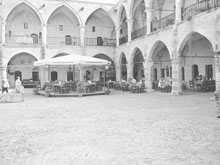
Only the name Saman-Bahce, or Saman Orchard, remains of the old market gardens. The 68 houses form nine small residential complexes around a small square with a hexagonal fountain (left), where children play and neighbors meet. Visitors to the northern part of Nicosia eventually end up at Buyuk Khan. Built in 1572, it is now a venue for entertainment and cultural events.
By Olga Sella - Kathimerini
NICOSIA - This major city in Cyprus is the last divided capital in Europe. It is also a city with a long history and a wealth of monuments recording its eventful past. Until recently, Greeks could only view the traces of its history in half of the city, though in 1979 the mayors of both sides began jointly implementing a master plan to restore the city’s most significant monuments with the help of UN funds.
Though a series of delays affected the work of archaeologists, conservators and architects, the results are now apparent on the Venetian walls, city gates, churches, baths, mosques and Gothic and Ottoman monuments scattered around both sides of the divided capital. In 2003, the opportunity to visit the occupied side of Nicosia for a few hours enabled visitors to get an overview of this many layered city. At the Ledra Palace checkpoint, where Greek and Turkish Cypriots cross to the other side of the city, are the master plan offices, staffed alternately by Greek and Turkish Cypriots. A stroll through both the well-known and not-so-well-known monuments of Nicosia is the best way to piece together a mosaic of the invaders, conquerors and foreigners who left traces of their culture in Cyprus.
Venetian engineer Julio Savorgnano began work on the medieval fortifications of Nicosia in 1567. The walls encircle the city, reinforced by 11 heart-shaped bastions.
For some years now the Ammohostos Gate has been used as a venue for cultural events.
The restored Kyrenia Gate, also known as the Porta del Proveditore, is in northern Nicosia. On the avenue leading to the Kyrenia Gate, the Tekes Mevlevi, which was used by the Dervishes, is now home to the Turkish Museum of Folk Art.
Public buildings
In the center of the northern part, next to the market, is Buyuk Khan, restored in 2003. A large, two-story building with porticos around a square courtyard with a small mosque in its center, it is now used for restaurants, art galleries and tourist stores.
Two large historic baths, the baths of Omeriye and Buyuk Hamam, have been restored and are still in operation. The Baths of Omeriye, a late 16th-century stone edifice, was built in 1570 by Lala Mustafa Pasha to celebrate the Ottoman conquest of Nicosia. Buyuk Hamam, in the market, was a Catholic church built during the time of the Lusignans. It was turned into a bathhouse when Nicosia was taken by the Ottoman Turks. Currently under restoration is the Kumarcilar Khan, dating from the late 17th century.
Aghia Sophia, the cathedral of the Lusignans, where the rulers of the Franks were crowned, was made into a mosque with 49-meter minarets by Lala Mustafa in 1570. It is one of the city’s most important monuments.
Right next to Aghia Sophia is the 14th-century church of Panaghia Hodigitria, which was the Orthodox cathedral during the Venetian period. It later became a covered market or bedestan.
The 13th-century Lusignan-era Armenian church in Arabhnet, the Byzantine and Gothic Cross of Misirikou, the churches of Aghios Antonios (17th century), Chrysaliniotissa (early 18th century), the restored mosque of Omeriye, and the church of Panaghia Faneromeni (early 19th century) are just a few of the places of worship within the walls of Nicosia.
A short walk through the city reveals a wealth of monuments that reflect the storied past of this historic capital.
Sunday, August 13, 2006
New museum on Kalymnos
Source: ekathimerini
Kalymnos, the small Dodecanese island known for its significant archaeological finds, will welcome another archaeological museum in 2008.
Officials who confirmed the opening added that it has not been decided whether the new museum’s displays will include the celebrated Lady of Kalymnos kore, which was dragged from the sea in 1994. The Central Archaeological Council (KAS) has postponed discussion on the fate of the statue, which is seen as one of the most important archaeological discoveries in recent years in Greece. Its size, good condition and rarity have earned it pride of place at the National Archaeological Museum in Athens, which hopes to hang on to the artifact even though the Kalymnos museum wants it.
With or without the Lady of Kalymnos, the museum is expected to contain an array of impressive displays dating from the 5th century AD to the Christian period. Plans include an area to display a magnificent statue of Asclepius, god of health, which has been reassembled.
The museum will be housed in a new, two-story building of 386 square meters in Aghia Triada in the town of Pothia, near the Vouvali mansion, which has been used to exhibit a number of archaeological finds.
The museum project is funded by the Third Community Support Framework and KAS has already approved the museological study. Current plans outline that the first hall will be dedicated to prehistoric finds made mostly in Kalymnos’s numerous caves. The same hall will also contain luxurious vessels of the local and imported ceramic crafts of the Minoan and Mycenaean civilizations, among other displays.
The second hall will contain finds from a Hellenistic settlement located in a gorge during a recent excavation at Damos that brought to light numerous finds that allude to the daily life of residents at the time. Should the Lady of Kalymnos be returned to her island, she too will go on display here.
Kalymnos, the small Dodecanese island known for its significant archaeological finds, will welcome another archaeological museum in 2008.
Officials who confirmed the opening added that it has not been decided whether the new museum’s displays will include the celebrated Lady of Kalymnos kore, which was dragged from the sea in 1994. The Central Archaeological Council (KAS) has postponed discussion on the fate of the statue, which is seen as one of the most important archaeological discoveries in recent years in Greece. Its size, good condition and rarity have earned it pride of place at the National Archaeological Museum in Athens, which hopes to hang on to the artifact even though the Kalymnos museum wants it.
With or without the Lady of Kalymnos, the museum is expected to contain an array of impressive displays dating from the 5th century AD to the Christian period. Plans include an area to display a magnificent statue of Asclepius, god of health, which has been reassembled.
The museum will be housed in a new, two-story building of 386 square meters in Aghia Triada in the town of Pothia, near the Vouvali mansion, which has been used to exhibit a number of archaeological finds.
The museum project is funded by the Third Community Support Framework and KAS has already approved the museological study. Current plans outline that the first hall will be dedicated to prehistoric finds made mostly in Kalymnos’s numerous caves. The same hall will also contain luxurious vessels of the local and imported ceramic crafts of the Minoan and Mycenaean civilizations, among other displays.
The second hall will contain finds from a Hellenistic settlement located in a gorge during a recent excavation at Damos that brought to light numerous finds that allude to the daily life of residents at the time. Should the Lady of Kalymnos be returned to her island, she too will go on display here.
Friday, August 11, 2006
Police find antiquities in bar on Koufonissi
Source: ekathimerini
Police confiscated more than 100 ancient vases and marble fragments during a raid on a Lesser Cyclades island restaurant, authorities said yesterday.
Officers from the special antiquities squad seized dozens of complete pots - including 10 large vases used to transport wine and food - as well as a rare bronze double ax and four marble column bases, police said.
The raid took place on Wednesday on the small island of Koufonissi.
Several of the antiquities had been on public display, built into the bar’s walls, police said. They did not provide dating for the artifacts, but said most appeared to have been fished out of the sea.
The bar owner was not arrested as archaeologists tried to establish whether certain of the antiquities had been declared to authorities, police said. (AP)
Police confiscated more than 100 ancient vases and marble fragments during a raid on a Lesser Cyclades island restaurant, authorities said yesterday.
Officers from the special antiquities squad seized dozens of complete pots - including 10 large vases used to transport wine and food - as well as a rare bronze double ax and four marble column bases, police said.
The raid took place on Wednesday on the small island of Koufonissi.
Several of the antiquities had been on public display, built into the bar’s walls, police said. They did not provide dating for the artifacts, but said most appeared to have been fished out of the sea.
The bar owner was not arrested as archaeologists tried to establish whether certain of the antiquities had been declared to authorities, police said. (AP)
Thursday, August 10, 2006
New museum on Crete
A new archaeological museum opens in the area of Kissamos on September 3, 2006. The museum will exhibit artifacts that have been retrieved from excavations in the area which is part of the Chania prefecture. Most of the artifacts are said to date to the Roman period. The construction of this new museum costed 586,000 euros.
Wednesday, August 09, 2006
A pivotal foreign institution
Excavators with drive. The American School of Classical Studies began excavations at the Ancient Agora in Athens in 1931. This is a photo of the west side of the Agora at the start of excavations. It is taken from the north toward the hill of Kolonos Agoraios and the Hephaesteion.
By Alexandra Koroxenidis - Kathimerini English Edition
When the American School of Classical Studies at Athens (ASCSA) was founded 125 years ago, it had only seven members and 12 collaborating universities and its location was a small building on Amalias Street. Today, the school accepts the most distinguished students in archaeology and classical studies from its 168 affiliated universities in North America and is a vital part of cultural life in Greece, both through the important excavations that it conducts on ancient sites, its specialized publications and the Gennadius Library.
Recently, ASCSA which is also known as the American Archaeological School, organized a symposium to celebrate its 125th and the 75th anniversary of the Athens Agora excavations. On that occasion, Stephen V. Tracy, a professor of classical studies (he has taught at Berkeley, Brown, Harvard and the State University of Ohio, among others) and the school's director for the past four years (he will hold the post until June 2007), spoke to Kathimerini English Edition about the school's aims, its excavations and its contribution to the diffusion of classical studies and archaeology at the universities of North America.
«I think that when compared with other foreign institutions in Greece, what we are unusual in doing is that we are a school in the true sense of the word, we have a teaching program year-round which is open to students that are doing PhD research or entering an academic career. There is not a program of ancient Greek studies in North America that does not have at least one alumnus of the school on its faculty. We do not want to train only archaeologists but also people studying art history, Greek literature, Greek history, Ancient Greek and philosophy to come here and learn about the country's culture and visit the archaeological sites,» Professor Tracy said. «We are a school, and Greece is our classroom.»
But how great is the demand for archaeology as a field of study at US universities?
«Many of my colleagues in the US, or other parts of the world, worry that fewer people are studying Greek or Latin than before. But the fact is that I see a healthy continuation to which I feel that the American School of Classical Studies contributes greatly. Greek and Latin and any serious study of the ancient world is never going to be something that appeals to the masses but only to a small group of pretty smart people,» Tracy said.
Besides the ancient world, the curriculum of the school also extends to the Byzantine era; the Gennadius Library provides access to the study of modern Greek history, literature and civilization. Its unique collection includes the archives of George Seferis and Odysseus Elytis.
«I think that interest in the Byzantine and medieval periods are growing in the States. To be honest, I think that Modern Greek appeals more to people of Greek descent,» said Tracy.
Besides its contribution to education, the ASCSA conducts important work in the field of archaeology. The excavations at the Agora, which began in 1931, and the excavations at Ancient Corinth, which began in 1896 and are the oldest continuing excavations by the school, are among the most important.
«At Corinth, I think we have done something unique. Of course, we wanted to find the classical city and we have not found it but what we have discovered is the Roman city and the Roman remains and we have some Hellenistic finds. In the past two decades, Professor Charles Williams, former director of the excavation, has been working on the Frankish period and the current director, Dr Guy Sanders, has been working on late Roman and Byzantine and early modern, so this is the one site in Greece where people have been showing for the first time serious attention to those periods, and have done so for quite a long time. We are now in a position to write a history of Corinth from 146 BC to the early modern period,» Tracy said. «In the Agora, we have unearthed some 500,000 finds, among them 7,000 inscriptions through the study of which we are in a position to know exactly how the civic center of Athens, the most important city in the ancient world, operated.»
Back in the mid-60s, when Professor Tracy was a student at ASCSA, he conducted major research on the Greek inscriptions of the Agora. A PhD student at the time (he is an alumnus of Harvard), he came up with a method of dating Attic inscriptions by studying the lettering on them as a style of handwriting. His method enabled him to piece together fragments and revise the dating of several inscriptions.
Besides the continuing Agora excavations, excavations by ASCSA in recent years include William McDonald's work in Messenia and John Cherry and Jack Davis's work in Pylos.
The school
The man who envisioned ASCSA was Charles Eliot Norton, professor of art history at Harvard and the first president, in 1879, of the Archaeological Institute of America of which ASCSA was intended as a branch.
Designed as a non-governmental institution, the school was a cooperative effort between different American universities which in the school's early days included Brown, Amherst, Columbia, Cornell, Harvard, Princeton, Yale, Virginia, Wesleyan, California, the College of the City of New York and Johns Hopkins.
The school was founded in 1882 and immediately began excavating in the area of the Pnyx. Excavations of the ancient theaters of Thorikos, Sikyon, Icaria and Eretria followed a few years later. At the same time, the ASCSA conducted important studies on the monuments of the Acropolis which were then being excavated by the Greek Archaeological Service and Panayiotis Kavvadias. In 1922, Ioannis Gennadius donated an important collection of 24,000 volumes to the school. A library was built with funding by the Carnegie Foundation. Today the Gennadius owns more than 120,000 volumes that cover the entire range of Greek history and civilization.
In 1931, private institutions such as the Rockefeller Foundation funded the excavations at the Athens Agora. After the war, the ASCSA reconstructed the Stoa of Attalos and turned it to a museum of the finds discovered in the Agora. It also restored the Church of the Holy Apostles that is on the same site.
«Agora: Excavations 1931-2006,» by Craig A. Mauzy, has been published on the occasion of the 75th anniversary of the Agora excavations. Two separate publications on «Marble-Workers in the Athenian Agora» and «Women in the Athenian Agora» were also published recently.
An exhibition that includes photographs from the Agora excavations from 1931 to the present is being held at the Stoa of Attalos through September 15.
Tuesday, August 08, 2006
Archimedes’ script revealed with particle accelerator
Source: ekathimerini
SAN FRANCISCO (AP) - Previously hidden writings of the ancient Greek mathematician Archimedes are being uncovered with powerful X-ray beams nearly 800 years after a Christian monk scrubbed off the text and wrote over it with prayers.
Over the past week, researchers at Stanford University’s Linear Accelerator Center in Menlo Park have been using X-rays to decipher a fragile 10th century manuscript that contains the only copies of some of Archimedes’ most important works.
The X-rays, generated by a particle accelerator, cause tiny amounts of iron left by the original ink to glow without harming the delicate goatskin parchment.
“We are gaining new insights into one of the founding fathers of Western science,” said William Noel, curator of manuscripts at Baltimore’s Walters Art Museum, which organized the effort. “It is the most difficult imaging challenge on any medieval document because the book is in such terrible condition.”
Following a successful trial run last year, Stanford researchers invited X-ray scientists, rare document collectors and classics scholars to take part in the 11-day project.
It takes about 12 hours to scan one page using an X-ray beam about the size of a human hair, and researchers expect to decipher up to 15 pages that resisted modern imaging techniques. After each new page is decoded, it is posted online for the public to see.
“We are focusing on the most difficult pages where the scholars haven’t been able to read the texts,” said Uwe Bergmann, the Stanford physicist heading the project. Born in the 3rd century BC, Archimedes is one of ancient Greece’s greatest mathematicians and discovered the principle of buoyancy while taking a bath.
SAN FRANCISCO (AP) - Previously hidden writings of the ancient Greek mathematician Archimedes are being uncovered with powerful X-ray beams nearly 800 years after a Christian monk scrubbed off the text and wrote over it with prayers.
Over the past week, researchers at Stanford University’s Linear Accelerator Center in Menlo Park have been using X-rays to decipher a fragile 10th century manuscript that contains the only copies of some of Archimedes’ most important works.
The X-rays, generated by a particle accelerator, cause tiny amounts of iron left by the original ink to glow without harming the delicate goatskin parchment.
“We are gaining new insights into one of the founding fathers of Western science,” said William Noel, curator of manuscripts at Baltimore’s Walters Art Museum, which organized the effort. “It is the most difficult imaging challenge on any medieval document because the book is in such terrible condition.”
Following a successful trial run last year, Stanford researchers invited X-ray scientists, rare document collectors and classics scholars to take part in the 11-day project.
It takes about 12 hours to scan one page using an X-ray beam about the size of a human hair, and researchers expect to decipher up to 15 pages that resisted modern imaging techniques. After each new page is decoded, it is posted online for the public to see.
“We are focusing on the most difficult pages where the scholars haven’t been able to read the texts,” said Uwe Bergmann, the Stanford physicist heading the project. Born in the 3rd century BC, Archimedes is one of ancient Greece’s greatest mathematicians and discovered the principle of buoyancy while taking a bath.
Monday, August 07, 2006
Turkey launches controversial Tigris dam project
Source: Yahoo! News
DIYARBAKIR, Turkey (AFP) - Turkey began building a major dam on the Tigris river, overriding fierce criticism that the project will devastate a millennia-old historic site and displace thousands of Kurds.
Prime Minister Recep Tayyip Erdogan joined a ground-breaking ceremony for the Ilisu Dam outside Dargecit town, 45 kilometers (28 miles) from the Syrian border, marking the start of a project that was first mooted in the late 1970s and has ever since remained controversial.
At the core of opposition to the dam is nearby Hasankeyf, a small poverty-stricken town on the banks of the Tigris, once a mighty city in ancient Mesopotamia, part of which will be submerged by the dam's giant reservoir.
The many critics of the project argue that the dam, to be completed with a hydroelectric power plant, will destroy Hasankeyf's unique heritage which includes Assyrian, Roman and Ottoman monuments and ruin the traditional way of life of its population of ethnic Kurds and Arabs.
In a bid to halt the project, activists have petitioned the Strasbourg-based European Court of Human Rights and urged foreign creditors to withhold loans for the international consortium building the facility.
Supporters counter that the dam, part of a large decade-old plan to boost economic development in the poor, mainly Kurdish southeast, will create up to 10,000 jobs, pave the way for fisheries, irrigate vast areas of farmland and provide vital energy for Turkey's flourishing economy.
The southeast has been the theater of a 22-year conflict between separatist Kurdish rebels and the army, which has claimed some 37,000 lives, ravaged the meager infrastructure and the mainstays of farming and forced thousands to migrate into urban slum areas.
Erdogan hailed the project as a proof of Ankara's determination to raise the living standards of its Kurdish minority.
"The step that we are taking today demonstrates that the southeast is no longer neglected... This dam will bring big gains to the local people," he said at the televised ceremony.
Scheduled to become operational in 2013, the 1.2-billion-euro (1.55-billion-dollar) Ilisu Dam will become Turkey's second largest reservoir and fourth largest hydroelectricpower plant, generating 3.8 billion kWh of electricity annually.
Officials say 80 percent of Hasankeyf's archaelogical sites -- including tombs and hundreds of cave houses, already damaged by nature's impact and years of negligence -- will remain above the planned waterline.
The monuments that would be flooded -- including mosques, a hammam (Turkish bath) and the remains of an ancient bridge over the Tigris -- will be relocated to a would-be open-air museum nearby, which Erdogan pledged would turn the region into a "tourist center."
The government is determined to salvage Hasankeyf's heritage, Erdogan said, adding that 66 million euros (85 million dollars) had been allocated for the archaeological work, already under way.
Opponents argue that even if the monuments are safely relocated, the integrity of the site and the original landscape will be destroyed for good.
The government will also compensate people from nearly 200 villages who will lose their homes, estimated to number at least 50,000, and is planning to build a new town for Hasankeyf residents.
"This dam will destroy a history of 12,000 years," grumbled Hasankeyf Mayor Abdulvahap Kusen, part of a vocal civic coalition battling the project.
"Neither I nor anyone else will go to the new settlement. We will all migrate to big cities if Hasankeyf is flooded," he told the Anatolia news agency.
The Ilisu dam is a key element of the Southeastern Anatolian Project (GAP) that envisages a total of 22 dams and 19 hydroelectric plants across the region, most of them on the Tigris and the Euphrates.
The project has triggered protests from neighboring
Iraq and Syria that Turkey is monopolizing the waters of the two rivers, which flow on south to their drought-plagued territories.
DIYARBAKIR, Turkey (AFP) - Turkey began building a major dam on the Tigris river, overriding fierce criticism that the project will devastate a millennia-old historic site and displace thousands of Kurds.
Prime Minister Recep Tayyip Erdogan joined a ground-breaking ceremony for the Ilisu Dam outside Dargecit town, 45 kilometers (28 miles) from the Syrian border, marking the start of a project that was first mooted in the late 1970s and has ever since remained controversial.
At the core of opposition to the dam is nearby Hasankeyf, a small poverty-stricken town on the banks of the Tigris, once a mighty city in ancient Mesopotamia, part of which will be submerged by the dam's giant reservoir.
The many critics of the project argue that the dam, to be completed with a hydroelectric power plant, will destroy Hasankeyf's unique heritage which includes Assyrian, Roman and Ottoman monuments and ruin the traditional way of life of its population of ethnic Kurds and Arabs.
In a bid to halt the project, activists have petitioned the Strasbourg-based European Court of Human Rights and urged foreign creditors to withhold loans for the international consortium building the facility.
Supporters counter that the dam, part of a large decade-old plan to boost economic development in the poor, mainly Kurdish southeast, will create up to 10,000 jobs, pave the way for fisheries, irrigate vast areas of farmland and provide vital energy for Turkey's flourishing economy.
The southeast has been the theater of a 22-year conflict between separatist Kurdish rebels and the army, which has claimed some 37,000 lives, ravaged the meager infrastructure and the mainstays of farming and forced thousands to migrate into urban slum areas.
Erdogan hailed the project as a proof of Ankara's determination to raise the living standards of its Kurdish minority.
"The step that we are taking today demonstrates that the southeast is no longer neglected... This dam will bring big gains to the local people," he said at the televised ceremony.
Scheduled to become operational in 2013, the 1.2-billion-euro (1.55-billion-dollar) Ilisu Dam will become Turkey's second largest reservoir and fourth largest hydroelectricpower plant, generating 3.8 billion kWh of electricity annually.
Officials say 80 percent of Hasankeyf's archaelogical sites -- including tombs and hundreds of cave houses, already damaged by nature's impact and years of negligence -- will remain above the planned waterline.
The monuments that would be flooded -- including mosques, a hammam (Turkish bath) and the remains of an ancient bridge over the Tigris -- will be relocated to a would-be open-air museum nearby, which Erdogan pledged would turn the region into a "tourist center."
The government is determined to salvage Hasankeyf's heritage, Erdogan said, adding that 66 million euros (85 million dollars) had been allocated for the archaeological work, already under way.
Opponents argue that even if the monuments are safely relocated, the integrity of the site and the original landscape will be destroyed for good.
The government will also compensate people from nearly 200 villages who will lose their homes, estimated to number at least 50,000, and is planning to build a new town for Hasankeyf residents.
"This dam will destroy a history of 12,000 years," grumbled Hasankeyf Mayor Abdulvahap Kusen, part of a vocal civic coalition battling the project.
"Neither I nor anyone else will go to the new settlement. We will all migrate to big cities if Hasankeyf is flooded," he told the Anatolia news agency.
The Ilisu dam is a key element of the Southeastern Anatolian Project (GAP) that envisages a total of 22 dams and 19 hydroelectric plants across the region, most of them on the Tigris and the Euphrates.
The project has triggered protests from neighboring
Iraq and Syria that Turkey is monopolizing the waters of the two rivers, which flow on south to their drought-plagued territories.
Friday, August 04, 2006
Greek politicians ‘linked’ to illicit antiquities?
Source: ekathimerini
Greek politicians are involved in the illegal trade of ancient artifacts, a man claiming to be a former middleman in the international antiquity-smuggling network said in a radio program aired yesterday by the British Broadcasting Corporation (BBC).
The former looter, who became a police informer, did not name any politicians. However, the man who identified himself as “Yiannis” said he was adamant that political figures are involved in antiquities smuggling.
“It starts at the top, from politicians down to ordinary people and the motivation is always money,” he told the BBC Radio 4’s Crossing Continents program.
“Everybody knows it’s illegal. There’s dirt on all layers of Greek society. I repeat: a lot of dirt,” he added.
Yiannis said that some artifacts such as Cycladic figurines can be sold for millions of euros.
The illegal trade in antiquities became a major issue earlier this year, when the Illegal Antiquities Department of the Attica Police raided the Paros home of Marion True, the former curator of the J. Paul Getty Museum in Los Angeles, and seized unregistered antiquities.
True is currently on trial in Rome for allegedly receiving stolen antiquities from Italy. She denies the charges.
In April, officers seized hundreds of unregistered artifacts at a villa on the tiny island of Schinoussa, near Naxos, which was owned by the late Christos Michailidis, an antiquities dealer and a member of a wealthy shipping family.
The probe is being led by Giorgos Gligoris, the head of the Illegal Antiquities Department. He told the BBC that he would like more resources at his disposal.
“We have a total of 27 police. It is not enough and there should be more,” said Gligoris, who works undercover and does not appear in public. “I’d like more police obviously, and more cars, a helicopter perhaps and everything that modern technology provides.”
“They have all that in Italy an it shows in their success,” he added.
Greek politicians are involved in the illegal trade of ancient artifacts, a man claiming to be a former middleman in the international antiquity-smuggling network said in a radio program aired yesterday by the British Broadcasting Corporation (BBC).
The former looter, who became a police informer, did not name any politicians. However, the man who identified himself as “Yiannis” said he was adamant that political figures are involved in antiquities smuggling.
“It starts at the top, from politicians down to ordinary people and the motivation is always money,” he told the BBC Radio 4’s Crossing Continents program.
“Everybody knows it’s illegal. There’s dirt on all layers of Greek society. I repeat: a lot of dirt,” he added.
Yiannis said that some artifacts such as Cycladic figurines can be sold for millions of euros.
The illegal trade in antiquities became a major issue earlier this year, when the Illegal Antiquities Department of the Attica Police raided the Paros home of Marion True, the former curator of the J. Paul Getty Museum in Los Angeles, and seized unregistered antiquities.
True is currently on trial in Rome for allegedly receiving stolen antiquities from Italy. She denies the charges.
In April, officers seized hundreds of unregistered artifacts at a villa on the tiny island of Schinoussa, near Naxos, which was owned by the late Christos Michailidis, an antiquities dealer and a member of a wealthy shipping family.
The probe is being led by Giorgos Gligoris, the head of the Illegal Antiquities Department. He told the BBC that he would like more resources at his disposal.
“We have a total of 27 police. It is not enough and there should be more,” said Gligoris, who works undercover and does not appear in public. “I’d like more police obviously, and more cars, a helicopter perhaps and everything that modern technology provides.”
“They have all that in Italy an it shows in their success,” he added.
Spy pics reveal ancient settlements
Source: The Courier Mail
AUSTRALIAN researchers studying declassified spy satellite images have found widespread remains of ancient human settlements dating back 130,000 years in Syria.
The photographs were taken by United States military surveillance satellites operating under the CIA and defence-led Corona program in the late 1960s.
The team of researchers travelled to the Euphrates River Valley in April and June and searched sites they had painstakingly identified using the images, which were only declassified in the late 1990s.
Group leader Mandy Mottram, a PhD student at the Australian National University's School of Archaeology and Anthropology, said the evidence of human life found in the area included a hilltop Byzantine basilica, a 24 hectare fortified town dating to the Early Bronze Age, Early Islamic pottery factories and a hilltop complex of megalithic tombs.
Ms Mottram said the researchers' trained eyes could spot small changes in the landscape, such as a different soil colour, that could indicate a former human settlement.
The images are particularly valuable because they show the landscape prior to its present rapid agricultural development.
"It's the guide for us to go out and have a look in that specific area," she said.
"It's been actually really brilliantly helpful for us. We've had a really, really high strike rate, I would say about 95 per cent."
Some of the artefacts found could dramatically change the way historians think of the area's early inhabitants, Ms Mottram said.
For example, contrary to a common belief that rural civilisations were experiencing economic and social decline from the mid-6th century, the team found evidence of widespread prosperity including many settlements and large quantities of pottery.
The researchers hope to establish the first complete record of human occupation in the area, beginning with the arrival from Africa of early human groups up to one million years ago.
They have already found tools from the Middle Palaeolithic period that are between 130,000 and 40,000 years old, and could have been made by either Neanderthals or early modern humans, as well as a few Acheulian tools that could date back several hundred thousand years.
Ms Mottram said the group was still analysing images of the items and structures they found and hoped to return to Syria next April if they secured funding.
AUSTRALIAN researchers studying declassified spy satellite images have found widespread remains of ancient human settlements dating back 130,000 years in Syria.
The photographs were taken by United States military surveillance satellites operating under the CIA and defence-led Corona program in the late 1960s.
The team of researchers travelled to the Euphrates River Valley in April and June and searched sites they had painstakingly identified using the images, which were only declassified in the late 1990s.
Group leader Mandy Mottram, a PhD student at the Australian National University's School of Archaeology and Anthropology, said the evidence of human life found in the area included a hilltop Byzantine basilica, a 24 hectare fortified town dating to the Early Bronze Age, Early Islamic pottery factories and a hilltop complex of megalithic tombs.
Ms Mottram said the researchers' trained eyes could spot small changes in the landscape, such as a different soil colour, that could indicate a former human settlement.
The images are particularly valuable because they show the landscape prior to its present rapid agricultural development.
"It's the guide for us to go out and have a look in that specific area," she said.
"It's been actually really brilliantly helpful for us. We've had a really, really high strike rate, I would say about 95 per cent."
Some of the artefacts found could dramatically change the way historians think of the area's early inhabitants, Ms Mottram said.
For example, contrary to a common belief that rural civilisations were experiencing economic and social decline from the mid-6th century, the team found evidence of widespread prosperity including many settlements and large quantities of pottery.
The researchers hope to establish the first complete record of human occupation in the area, beginning with the arrival from Africa of early human groups up to one million years ago.
They have already found tools from the Middle Palaeolithic period that are between 130,000 and 40,000 years old, and could have been made by either Neanderthals or early modern humans, as well as a few Acheulian tools that could date back several hundred thousand years.
Ms Mottram said the group was still analysing images of the items and structures they found and hoped to return to Syria next April if they secured funding.
Thursday, August 03, 2006

Wednesday, August 02, 2006
The "Theseus Ring": An Update
It's final! The "Theseus Ring" is genuine.
According to the final report by the Democritus Laboratory, the so called "Theseus Ring" is authentic. Based both on the ring's chemical composition and manufacturing technique, the scientists and archaeologists responsible gave the green light for the purchase to the National Archaeological Museum.
The ring was bought from the Museum for 75,000 Euros, half of its estimated value.
For more info (in Greek), take a look here.
According to the final report by the Democritus Laboratory, the so called "Theseus Ring" is authentic. Based both on the ring's chemical composition and manufacturing technique, the scientists and archaeologists responsible gave the green light for the purchase to the National Archaeological Museum.
The ring was bought from the Museum for 75,000 Euros, half of its estimated value.
For more info (in Greek), take a look here.
Tuesday, August 01, 2006
New tombs in the Valley of the Kings
For more information, take a look at the official site of the Valley of the Kings Foundation.
Sunday, July 30, 2006
Metro excavation could illuminate Hellenistic and Roman periods in Thessaloniki
Source: ekathimerini
By Iota Myrtsioti
THESSALONIKI - Archaeologists are ready to begin work on the largest-ever excavation site in this city's historic center using the so-called «metro-mouse,» the giant drill already used to dig tunnels under the city of Athens.
As the drill moves ahead, it is expected to help unearth finds that will illuminate the history and topography of the city's Hellenistic and Roman periods.
The greatest archaeological interest lies in the site of the six metro stations along the ancient Via Egnatia, where monuments and archaeological exploration point to the existence of a rich store of artifacts.
Potential sites were mapped as part of Attiko Metro's plan for the tunnels, and the Culture Ministry signed a memorandum of cooperation with the construction firm this week.
«The metro will not only improve life for the city's residents but will shed light on its history,» said the ministry's secretary-general Christos Zachopoulos.
The 15 articles in the memorandum offer ways for how findings should be preserved, stored, protected, transported, restored, documented and displayed at the six stations along the route. These displays will be under the exclusive jurisdiction of the archaeological ephorates.
«We have an excellent working relationship with the archaeological services,» said Attiko Metro's board chairman Giorgos Yiannis. «The goal is to respect and highlight the city's rich heritage.»
Focal points
New Railway Station. This area is the site of the city's extensive cemetery dating from the Hellenistic and Roman periods, as well as layers of Early Christian and Byzantine periods. Finds so far include Hellenistic and Roman graves dating from the 2nd-8th century AD.
Dimokratias Square Station. Sections of the ancient western wall have been found here, and over a wider area, about 40 archaeological digs have unearthed buildings with mosaic floors, mostly from the Roman period, among other monuments.
Venizelos Station. A central area with many monuments, this could be the site of a Byzantine monastery, and Roman and Late Roman buildings and public buildings.
Aghia Sophia Station. Another potential source of artifacts, 50 digs in the wider area have pinpointed buildings dating from the Hellenistic to the Byzantine periods.
Sintrivani Square and Panemistimiou Stations. Sections of the eastern cemetery and perhaps architectural remains of various buildings such as Roman baths and ancient wells are here.
Findings at other stations are not expected to produce many antiquities, apart from a few Hellenistic funereal monuments.
By Iota Myrtsioti
THESSALONIKI - Archaeologists are ready to begin work on the largest-ever excavation site in this city's historic center using the so-called «metro-mouse,» the giant drill already used to dig tunnels under the city of Athens.
As the drill moves ahead, it is expected to help unearth finds that will illuminate the history and topography of the city's Hellenistic and Roman periods.
The greatest archaeological interest lies in the site of the six metro stations along the ancient Via Egnatia, where monuments and archaeological exploration point to the existence of a rich store of artifacts.
Potential sites were mapped as part of Attiko Metro's plan for the tunnels, and the Culture Ministry signed a memorandum of cooperation with the construction firm this week.
«The metro will not only improve life for the city's residents but will shed light on its history,» said the ministry's secretary-general Christos Zachopoulos.
The 15 articles in the memorandum offer ways for how findings should be preserved, stored, protected, transported, restored, documented and displayed at the six stations along the route. These displays will be under the exclusive jurisdiction of the archaeological ephorates.
«We have an excellent working relationship with the archaeological services,» said Attiko Metro's board chairman Giorgos Yiannis. «The goal is to respect and highlight the city's rich heritage.»
Focal points
New Railway Station. This area is the site of the city's extensive cemetery dating from the Hellenistic and Roman periods, as well as layers of Early Christian and Byzantine periods. Finds so far include Hellenistic and Roman graves dating from the 2nd-8th century AD.
Dimokratias Square Station. Sections of the ancient western wall have been found here, and over a wider area, about 40 archaeological digs have unearthed buildings with mosaic floors, mostly from the Roman period, among other monuments.
Venizelos Station. A central area with many monuments, this could be the site of a Byzantine monastery, and Roman and Late Roman buildings and public buildings.
Aghia Sophia Station. Another potential source of artifacts, 50 digs in the wider area have pinpointed buildings dating from the Hellenistic to the Byzantine periods.
Sintrivani Square and Panemistimiou Stations. Sections of the eastern cemetery and perhaps architectural remains of various buildings such as Roman baths and ancient wells are here.
Findings at other stations are not expected to produce many antiquities, apart from a few Hellenistic funereal monuments.
Thursday, July 27, 2006
Greek researchers discover prehistoric primate skull
Source: CBS News
(AP) Greek researchers said Wednesday they had discovered a well-preserved skull of 5 million-year-old primate.

The remains of the Mesopithecus Pentelicus _ a monkey-like animal, a little more than 3 feet long _ were found in the northern Halkidiki peninsula, outside the city of Thessaloniki.
"It's an important find because it's in such good condition," Evangelia Tsoukala, a professor of geology at Thessaloniki University who is heading the excavation, told state-run NET television.
"It had a tail ... it was herbivorous, and the skull is intact as well as the teeth," she said.
Local officials said they hope to build a museum in the area to put the skull and other prehistoric animal remains found at the site on display.
(AP) Greek researchers said Wednesday they had discovered a well-preserved skull of 5 million-year-old primate.

The remains of the Mesopithecus Pentelicus _ a monkey-like animal, a little more than 3 feet long _ were found in the northern Halkidiki peninsula, outside the city of Thessaloniki.
"It's an important find because it's in such good condition," Evangelia Tsoukala, a professor of geology at Thessaloniki University who is heading the excavation, told state-run NET television.
"It had a tail ... it was herbivorous, and the skull is intact as well as the teeth," she said.
Local officials said they hope to build a museum in the area to put the skull and other prehistoric animal remains found at the site on display.
Wednesday, July 26, 2006
Ramses statue finds serene home in Cairo
Source: iol
By Anna Johnson
Cairo - The giant statue of Pharaoh Ramses II will be moved next month from a congested downtown square to a more serene home near the Great Pyramids, in a bid to save it from damaging pollution and traffic gridlock, Egypt's antiquities chief said on Monday.
Exhaust fumes from trains, cars and buses and subway vibrations are eating away at the more than 3 200-year-old granite statue at Ramses Square, its home since the early 1950s when it was taken from a temple at the site of the ancient Egyptian capital of Memphis.
To try to prevent further deterioration, the 125 ton statue - a popular feature on postcards and guide books - will be part of the new Grand Museum of Egypt, to be located about two kilometres from the pyramids, Hawass said.
'I don't think people will miss it here'
"The statue in that square now has pollution and therefore there is no way (to keep it downtown), we have to move that statue," antiquities chief Zahi Hawass said.
Contractors plan to test the move when they transport a replica statue next week. If all goes well, Ramses will make its way through the sprawling city on August 25.
"Statues are not made to be in squares, they are made to be in temples or in museums," Hawass said.
Officials have been talking about moving the statue for more than a decade as experts bickered over where it should be. But Hawass said the Grand Museum location was recently agreed upon and engineers began investigating how to move the statue.
Ramses II was a warrior king who is credited with bringing Egypt unprecedented power and splendour during his 67-year reign. He died in 1225 B.C.
'I don't see tourists coming down here to see it'
Engineers plan to construct a steel cage around the statue and connect the cage to steel beams. Two flatbed trucks will carry the statue through the city, a move that will take several hours, said Ibrahim Mahlab, the chairperson of Arab Contractors, the company in charge of moving the statue.
Once the statue is moved, it will be renovated and wait for its new home to be built. The museum, which also will house King Tut's mummy and other treasures, is not expected to open for at least five years, officials said.
With crews already preparing the statue to be moved, some Egyptians said they thought Ramses was better off near the pyramids and away from the non-stop traffic and pollution.
"I don't think people will miss it here," said Muhammad Said, 26, a computer engineer. "I don't see tourists coming down here to see it. But if they move it to a better place, perhaps more people will value it."
Medical student Marco Gobran, 23, also said he didn't mind if they moved Ramses, especially if it aided with what he saw as one of Cairo's biggest dilemmas.
"Egypt has problems with traffic jams, and moving this will help," Gobran said. - Sapa-AP
By Anna Johnson
Cairo - The giant statue of Pharaoh Ramses II will be moved next month from a congested downtown square to a more serene home near the Great Pyramids, in a bid to save it from damaging pollution and traffic gridlock, Egypt's antiquities chief said on Monday.
Exhaust fumes from trains, cars and buses and subway vibrations are eating away at the more than 3 200-year-old granite statue at Ramses Square, its home since the early 1950s when it was taken from a temple at the site of the ancient Egyptian capital of Memphis.
To try to prevent further deterioration, the 125 ton statue - a popular feature on postcards and guide books - will be part of the new Grand Museum of Egypt, to be located about two kilometres from the pyramids, Hawass said.
'I don't think people will miss it here'
"The statue in that square now has pollution and therefore there is no way (to keep it downtown), we have to move that statue," antiquities chief Zahi Hawass said.
Contractors plan to test the move when they transport a replica statue next week. If all goes well, Ramses will make its way through the sprawling city on August 25.
"Statues are not made to be in squares, they are made to be in temples or in museums," Hawass said.
Officials have been talking about moving the statue for more than a decade as experts bickered over where it should be. But Hawass said the Grand Museum location was recently agreed upon and engineers began investigating how to move the statue.
Ramses II was a warrior king who is credited with bringing Egypt unprecedented power and splendour during his 67-year reign. He died in 1225 B.C.
'I don't see tourists coming down here to see it'
Engineers plan to construct a steel cage around the statue and connect the cage to steel beams. Two flatbed trucks will carry the statue through the city, a move that will take several hours, said Ibrahim Mahlab, the chairperson of Arab Contractors, the company in charge of moving the statue.
Once the statue is moved, it will be renovated and wait for its new home to be built. The museum, which also will house King Tut's mummy and other treasures, is not expected to open for at least five years, officials said.
With crews already preparing the statue to be moved, some Egyptians said they thought Ramses was better off near the pyramids and away from the non-stop traffic and pollution.
"I don't think people will miss it here," said Muhammad Said, 26, a computer engineer. "I don't see tourists coming down here to see it. But if they move it to a better place, perhaps more people will value it."
Medical student Marco Gobran, 23, also said he didn't mind if they moved Ramses, especially if it aided with what he saw as one of Cairo's biggest dilemmas.
"Egypt has problems with traffic jams, and moving this will help," Gobran said. - Sapa-AP
War Criminals
I just can't understand how the "civilised" world allows Israel to continue its military action against Lebanon. Hundrends of innocent civilians have been killed and wounded and thousands have been forced to flee their country.
WHY?
Where's the U.N. when you need it?
WHY?
Where's the U.N. when you need it?
Monday, July 24, 2006
AIA/ASOR Call on Mid-East Combatants To Honor Hague Convention of 1954
The Archaeological Institute of America (AIA) and the American Schools of Oriental Research (ASOR) deplore the loss of innocent life in northern Israel and Lebanon and profoundly wish for a quick resolution of the armed hostilities in the area.
We also urge all parties to the conflict to honor the terms of the 1954 Hague Convention on the Protection of Cultural Property in the Event of Armed Conflict and the principles of customary international law to protect the region's rich archaeological, cultural and historic heritage. The Hague Convention calls on parties to armed conflict to avoid targeting of, and to minimize damage of, such cultural artifacts as monuments, sites and antiquities.
The region of the Levant, encompassing the modern states of Israel and Lebanon, is rich in cultural remains of many time periods, including occupation sites of early man, sites of the Biblical period, Phoenician, Hellenistic and Roman eras, and sites of the Crusader, Byzantine, Islamic and Ottoman Turkish periods. This region embodies much of the early history of the three great religions of Christianity, Judaism and Islam, and contributed significantly to the development of the ancient cultures of the Eastern Mediterranean. Numerous sites in northern Israel and Lebanon have been inscribed on the World Heritage List and thus have been recognized for their contribution to human religious, historical and cultural values. Their preservation is an international priority. World Heritage sites include the Biblical sites of Megiddo and Hazor and the Crusader Old City of Acre in northern Israel. In Lebanon, the Roman cities of Baalbek and Tyre, the Phoenician site of Byblos and the Umayyad city of Anjar are also inscribed on the World Heritage List. These sites are all located within the area of military conflict and are therefore at great risk.
Both Israel and Lebanon are parties to the 1954 Hague Convention. While the AIA and ASOR realize that not all parties to this conflict are nation-states and therefore not parties to the Hague Convention, we nonetheless urge all parties to the conflict to work within the terms of the Hague Convention and customary international law to minimize damage and destruction of these cultural sites, which are of great value to all of humankind.
Eric Meyers, President, American Schools of Oriental Research
Jane C. Waldbaum, President, Archaeological Institute of America
Source: AIA website
We also urge all parties to the conflict to honor the terms of the 1954 Hague Convention on the Protection of Cultural Property in the Event of Armed Conflict and the principles of customary international law to protect the region's rich archaeological, cultural and historic heritage. The Hague Convention calls on parties to armed conflict to avoid targeting of, and to minimize damage of, such cultural artifacts as monuments, sites and antiquities.
The region of the Levant, encompassing the modern states of Israel and Lebanon, is rich in cultural remains of many time periods, including occupation sites of early man, sites of the Biblical period, Phoenician, Hellenistic and Roman eras, and sites of the Crusader, Byzantine, Islamic and Ottoman Turkish periods. This region embodies much of the early history of the three great religions of Christianity, Judaism and Islam, and contributed significantly to the development of the ancient cultures of the Eastern Mediterranean. Numerous sites in northern Israel and Lebanon have been inscribed on the World Heritage List and thus have been recognized for their contribution to human religious, historical and cultural values. Their preservation is an international priority. World Heritage sites include the Biblical sites of Megiddo and Hazor and the Crusader Old City of Acre in northern Israel. In Lebanon, the Roman cities of Baalbek and Tyre, the Phoenician site of Byblos and the Umayyad city of Anjar are also inscribed on the World Heritage List. These sites are all located within the area of military conflict and are therefore at great risk.
Both Israel and Lebanon are parties to the 1954 Hague Convention. While the AIA and ASOR realize that not all parties to this conflict are nation-states and therefore not parties to the Hague Convention, we nonetheless urge all parties to the conflict to work within the terms of the Hague Convention and customary international law to minimize damage and destruction of these cultural sites, which are of great value to all of humankind.
Eric Meyers, President, American Schools of Oriental Research
Jane C. Waldbaum, President, Archaeological Institute of America
Source: AIA website
Friday, July 21, 2006
Augustus' birthplace believed found
Source: Yahoo News
ROME - A team of archaeologists announced Wednesday they have uncovered part of what they believe is the birthplace of Rome's first emperor Augustus.
Leading archaeologist Clementina Panella said the team has dug up part of a corridor and other fragments under Rome's Palatine Hill, which she described as "a very ancient aristocratic house."
Panella said that she could not yet be certain that the house was where Augustus was born in 63 B.C., but added that historical cross-checks and other findings nearby have showed that the emperor was particularly fond of the area, she said.
Excavations on the Palatine in recent decades have turned up wonders such as another renewed Augustus' house, including two rooms with stunning frescoes of masked figures and pine branches.
Panella said there are at least two houses on the Palatine where the emperor was known to have lived. Much has yet to be uncovered, hidden in underground passageways.
ROME - A team of archaeologists announced Wednesday they have uncovered part of what they believe is the birthplace of Rome's first emperor Augustus.
Leading archaeologist Clementina Panella said the team has dug up part of a corridor and other fragments under Rome's Palatine Hill, which she described as "a very ancient aristocratic house."
Panella said that she could not yet be certain that the house was where Augustus was born in 63 B.C., but added that historical cross-checks and other findings nearby have showed that the emperor was particularly fond of the area, she said.
Excavations on the Palatine in recent decades have turned up wonders such as another renewed Augustus' house, including two rooms with stunning frescoes of masked figures and pine branches.
Panella said there are at least two houses on the Palatine where the emperor was known to have lived. Much has yet to be uncovered, hidden in underground passageways.
Wednesday, July 19, 2006
Appeal by the International Observatory for the Protection of Cultural Heritages in Areas of Crisis
Naples, 15 July 2006
To the President of Israel, H.E. Moshe KATZAV
To the Prime Minister of Israel, H.E. Ehud OLMERT
To the President of Lebanon, H.E. Emile LAHUD
To the Prime Minister of Lebanon, H.E.Fuad SINIORA
Copy to: the General Secretary of UNESCO
the Head of Governments parties to The Hague Convention of 1954
U.N. General Secretary
Appeal
The undersigned Dr. Prof. Fabio Maniscalco, as Director of the
"International Observatory for the Protection of Cultural Heritages in Areas
of Crisis", and on behalf of all those who wish to sign this appeal,
Considering that
- Following the various armed conflicts of the last century, after a hard and sometimes contradictory process, the International Community has recognized some juridical instruments finalized to safeguarding cultural heritage in conflict areas. We refer, in particular, to the 1954 Hague Convention for the Protection of Cultural Property in the Event of Armed Conflict;
- In the Preamble of the Hague Convention of 1954, States parties recognize that ".damage to cultural property belonging to any people whatsoever means damage to the cultural heritage of all mankind, since each people makes its contribution to the culture of the world" and that ".the preservation of the cultural heritage is of great importance for all peoples of the world and that it is important that this heritage should receive international protection";
- During the long-lasting and endless crisis in the Middle East, a huge amount of cultural and religious heritage have been destroyed, damaged or stolen by conflicting factions;
- Israel and Lebanon have signed the 1954 Hague Convention (in 1957 and in 1960).
Calls upon the Government of Israel and of Lebanon
- To make aware Israeli and Lebanese Defense Forces for the respect of its and others historical and cultural identity and to adopt any useful measure to observe the provision of the 1954 Hague Convention, for the Protection of Cultural Property in the Event of Armed Conflict, in the territories of Lebanon and of Israel.
Fabio Maniscalco
If you are interested in signing, please contact Dr. Maniscalco: isform@libero.it
To the President of Israel, H.E. Moshe KATZAV
To the Prime Minister of Israel, H.E. Ehud OLMERT
To the President of Lebanon, H.E. Emile LAHUD
To the Prime Minister of Lebanon, H.E.Fuad SINIORA
Copy to: the General Secretary of UNESCO
the Head of Governments parties to The Hague Convention of 1954
U.N. General Secretary
Appeal
The undersigned Dr. Prof. Fabio Maniscalco, as Director of the
"International Observatory for the Protection of Cultural Heritages in Areas
of Crisis", and on behalf of all those who wish to sign this appeal,
Considering that
- Following the various armed conflicts of the last century, after a hard and sometimes contradictory process, the International Community has recognized some juridical instruments finalized to safeguarding cultural heritage in conflict areas. We refer, in particular, to the 1954 Hague Convention for the Protection of Cultural Property in the Event of Armed Conflict;
- In the Preamble of the Hague Convention of 1954, States parties recognize that ".damage to cultural property belonging to any people whatsoever means damage to the cultural heritage of all mankind, since each people makes its contribution to the culture of the world" and that ".the preservation of the cultural heritage is of great importance for all peoples of the world and that it is important that this heritage should receive international protection";
- During the long-lasting and endless crisis in the Middle East, a huge amount of cultural and religious heritage have been destroyed, damaged or stolen by conflicting factions;
- Israel and Lebanon have signed the 1954 Hague Convention (in 1957 and in 1960).
Calls upon the Government of Israel and of Lebanon
- To make aware Israeli and Lebanese Defense Forces for the respect of its and others historical and cultural identity and to adopt any useful measure to observe the provision of the 1954 Hague Convention, for the Protection of Cultural Property in the Event of Armed Conflict, in the territories of Lebanon and of Israel.
Fabio Maniscalco
If you are interested in signing, please contact Dr. Maniscalco: isform@libero.it
Saturday, July 15, 2006
Underwater museum to be built in Alexandria?
Source: Al-Ahram Weekly
Will Egypt build the first offshore underwater museum? Nevine El-Aref investigates
Setting up an offshore, submarine archaeological site anywhere is not an easy task, let alone in a city with the water pollution problems of Alexandria. Yet the remarkable discoveries made by underwater archaeologists over the last decade justify further serious efforts for what would be Egypt's first ever offshore underwater museum.
The site and form gives cause for conjecture. Should it be in Alexandria's Eastern Harbour, the Sisila area, or Abu Qir Bay? What will it look like? Should it resemble the Australian National Maritime Museum in Sydney or the Bodrum Museum of Underwater Archaeology at the spectacular Uluburun Wreck in Turkey, or the Mus?e de Marine in Paris? All these display a collection of sunken ship wrecks, flora and fauna.
These questions and more were raised at an international workshop held last week in Alexandria to discuss the feasibility of constructing such a museum. On the table were a projected ground plan, an architectural design and a programme to study the environmental conditions of Alexandria's Mediterranean Sea and its state of marine pollution, the socio- economic problems related to the success of the underwater archaeological museum project and urban impacts. The workshop was held under the umbrella of UNESCO and the Ministry of Culture at the Alexandria Art Creativity Centre, where a multidisciplinary team of 28 international and Egyptian experts were gathered.
Full Story
Will Egypt build the first offshore underwater museum? Nevine El-Aref investigates
Setting up an offshore, submarine archaeological site anywhere is not an easy task, let alone in a city with the water pollution problems of Alexandria. Yet the remarkable discoveries made by underwater archaeologists over the last decade justify further serious efforts for what would be Egypt's first ever offshore underwater museum.
The site and form gives cause for conjecture. Should it be in Alexandria's Eastern Harbour, the Sisila area, or Abu Qir Bay? What will it look like? Should it resemble the Australian National Maritime Museum in Sydney or the Bodrum Museum of Underwater Archaeology at the spectacular Uluburun Wreck in Turkey, or the Mus?e de Marine in Paris? All these display a collection of sunken ship wrecks, flora and fauna.
These questions and more were raised at an international workshop held last week in Alexandria to discuss the feasibility of constructing such a museum. On the table were a projected ground plan, an architectural design and a programme to study the environmental conditions of Alexandria's Mediterranean Sea and its state of marine pollution, the socio- economic problems related to the success of the underwater archaeological museum project and urban impacts. The workshop was held under the umbrella of UNESCO and the Ministry of Culture at the Alexandria Art Creativity Centre, where a multidisciplinary team of 28 international and Egyptian experts were gathered.
Full Story
Wednesday, July 12, 2006
Egyptian archaeologists discover ancient Greek insciption
Source: Middle East Times
CAIRO -- Egyptian archaeologists have discovered carvings with Greek inscriptions dating back to the era of the second century Roman Emperor Marcus Aurelius, the Supreme Council of Antiquities announced on Tuesday.
The carvings, believed to form part of the altar of a temple, were unearthed while archaeologists were excavating in the area around Pompey's Pillar in the Mediterranean city of Alexandria.
"This carving is composed of six lines of writing in the Greek language on a stone which is 50 centimeters [20 inches] by 36 centimeters long," said Zahi Hawass, the secretary-general of the council.
Hawass believes that the writing dates back to the ninth year of Aurelius' rule that lasted from AD 161 to 180.
It appears to be an exaltation to the God Serapis, a composite of Egyptian and Hellenistic deities, including Zeus and Helios, as part of efforts to integrate Egyptian religion with that of their Hellenic rulers.
The council also announced that works were currently underway to restore the area around Pompey's pillar, the tallest ancient monument in Alexandria.
"The project to develop the area of Pompey's pillar at a cost of E£10 million [about $1.8 million] will be finished within the next year," said Mohammed Abdel Maqsud, a senior official of the council.
The 27-meter-high (90-foot) granite column is located on Alexandria's ancient acropolis and was originally part of the temple of Serapis.
CAIRO -- Egyptian archaeologists have discovered carvings with Greek inscriptions dating back to the era of the second century Roman Emperor Marcus Aurelius, the Supreme Council of Antiquities announced on Tuesday.
The carvings, believed to form part of the altar of a temple, were unearthed while archaeologists were excavating in the area around Pompey's Pillar in the Mediterranean city of Alexandria.
"This carving is composed of six lines of writing in the Greek language on a stone which is 50 centimeters [20 inches] by 36 centimeters long," said Zahi Hawass, the secretary-general of the council.
Hawass believes that the writing dates back to the ninth year of Aurelius' rule that lasted from AD 161 to 180.
It appears to be an exaltation to the God Serapis, a composite of Egyptian and Hellenistic deities, including Zeus and Helios, as part of efforts to integrate Egyptian religion with that of their Hellenic rulers.
The council also announced that works were currently underway to restore the area around Pompey's pillar, the tallest ancient monument in Alexandria.
"The project to develop the area of Pompey's pillar at a cost of E£10 million [about $1.8 million] will be finished within the next year," said Mohammed Abdel Maqsud, a senior official of the council.
The 27-meter-high (90-foot) granite column is located on Alexandria's ancient acropolis and was originally part of the temple of Serapis.
More on Artemis...

(AP) A 2,000-year-old marble statue of a goddess has been discovered among dozens of broken columns and inscriptions during excavation at an ancient theater in central Greece, archaeologists said on Monday.
The headless statue of hunting goddess Artemis dates from the middle of the first century B.C., archaeologist Athanassios Tziafalias said.
Full Story
Monday, July 10, 2006
Getty Museum to return sculptures to Greece
The Associated Press
The J. Paul Getty Museum has agreed to return two ancient sculptures at the center of a major cultural heritage dispute with Greece, officials said Monday.
Greek Culture Minister Giorgos Voulgarakis said he was "extremely satisfied" with the decision, and voiced optimism similar moves would follow from the Getty and other international museums.
"This is just the beginning," Voulgarakis said. "I believe that in the future we will have very good results concerning other antiquities whose return we are seeking."
Full Story
The J. Paul Getty Museum has agreed to return two ancient sculptures at the center of a major cultural heritage dispute with Greece, officials said Monday.
Greek Culture Minister Giorgos Voulgarakis said he was "extremely satisfied" with the decision, and voiced optimism similar moves would follow from the Getty and other international museums.
"This is just the beginning," Voulgarakis said. "I believe that in the future we will have very good results concerning other antiquities whose return we are seeking."
Full Story
Saturday, July 08, 2006
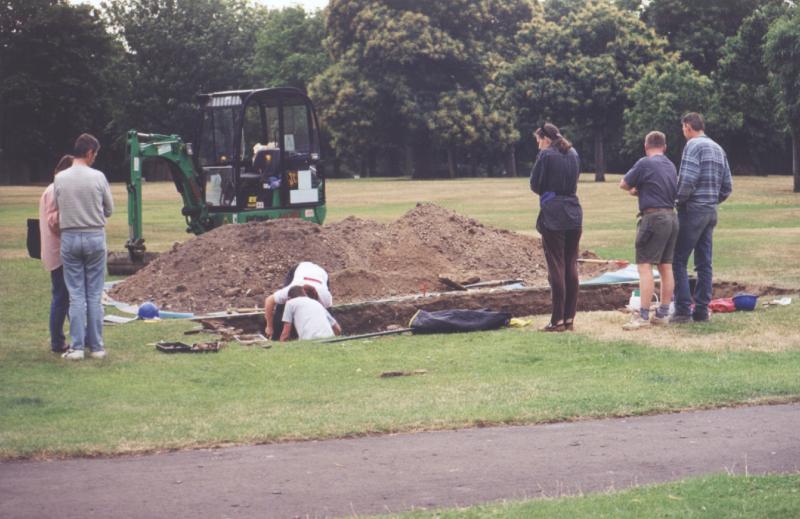
Thursday, July 06, 2006
The "Theseus Ring" Debate

Last November, the Greek press reported the (re) discovery of a gold signet ring (2.7 x 1.8 cm) dated to the late 15th-early 14th century BC and conventionally named "The Theseus Ring". The ring, which depicts a bull-leaping scene, is said to come from the area of Anafiotika at Plaka, Athens. The scene also includes a lion on the left and a tree (?) on the right.
Today, the National Museum at Athens wishes to buy the ring but there is a huge debate about its authenticity. Although preliminary archaeometric analyses from the "Democritus Institute" are said to verify its authenticity, some archaeologists, including Yannis Sakellarakis, are still sceptical.
For more info (in Greek), take a look here.
Tuesday, July 04, 2006
Hitch in Acropolis restoration
From ekathimerini
Restoration work on the Acropolis monuments has hit “another small delay” but this should not hinder the overall course of the project, Culture Minister Giorgos Voulgarakis said yesterday after touring the ancient site.
The ministry will release further funding, if necessary, to tackle the latest glitches, which have arisen in the Temple of Athena Nike and the Parthenon’s vestibule, Voulgarakis said. Since 1999, more than 28 million euros has been spent on restoring the Acropolis, the minister said, noting that 86 percent of these funds came from the European Union. Voulgarakis said cutting-edge technology would be used to analyze the condition of the Acropolis’s peripheral walls, which will also be restored.
Voulgarakis also expressed his satisfaction with the progress in construction of the New Acropolis Museum, which he said was ready for the return of the Parthenon Marbles (currently in the British Museum) and other fragments in other foreign museums. “Greece now has the infrastructure to accommodate all the missing parts of the Parthenon,” he said.
The minister also heralded planned features for the new museum, including a virtual-reality theater which will project three-dimensional movies about the history of the Acropolis monuments.
As for the old Acropolis museum, its possible demolition is being debated. “The building is no architectural monument,” the president of the Committee for the Conservation of Acropolis Monuments (YSMA), Haralambos Bouras, said.
A few hours after Voulgarakis’s visit to the Acropolis, Culture Ministry staff on short-term contracts blocked access to the site for two hours in an unexpected protest over job security.
Restoration work on the Acropolis monuments has hit “another small delay” but this should not hinder the overall course of the project, Culture Minister Giorgos Voulgarakis said yesterday after touring the ancient site.
The ministry will release further funding, if necessary, to tackle the latest glitches, which have arisen in the Temple of Athena Nike and the Parthenon’s vestibule, Voulgarakis said. Since 1999, more than 28 million euros has been spent on restoring the Acropolis, the minister said, noting that 86 percent of these funds came from the European Union. Voulgarakis said cutting-edge technology would be used to analyze the condition of the Acropolis’s peripheral walls, which will also be restored.
Voulgarakis also expressed his satisfaction with the progress in construction of the New Acropolis Museum, which he said was ready for the return of the Parthenon Marbles (currently in the British Museum) and other fragments in other foreign museums. “Greece now has the infrastructure to accommodate all the missing parts of the Parthenon,” he said.
The minister also heralded planned features for the new museum, including a virtual-reality theater which will project three-dimensional movies about the history of the Acropolis monuments.
As for the old Acropolis museum, its possible demolition is being debated. “The building is no architectural monument,” the president of the Committee for the Conservation of Acropolis Monuments (YSMA), Haralambos Bouras, said.
A few hours after Voulgarakis’s visit to the Acropolis, Culture Ministry staff on short-term contracts blocked access to the site for two hours in an unexpected protest over job security.
Wednesday, May 24, 2006
On a personal note...
I'll be out of town for over a month for fieldwork. That means I'll have minimal internet access.
I hope eveybody has a nice (and even productive) summer!
Cheers!
I hope eveybody has a nice (and even productive) summer!
Cheers!
Arrest on Paros over artifacts
From ekathimerini
Police on the Cycladic island of Paros said yesterday that they had arrested a 56-year-old woman for allegedly possessing a number of illegal antiquities, including nine sections of ancient columns.
Officers from the Attica police antiquities department had been on the island to chase up leads from the discovery of a huge stash of illegal artifacts on the nearby island of Schinoussa.
Policemen searched the house of an archaeologist who had allegedly worked in the past with Marion True, the former director of the J. Paul Getty Museum in Los Angeles. Illegal artifacts were confiscated from True’s villa on Paros last month. But officers did not find anything suspicious at the unnamed archeologist’s house.
During their investigation, however, they found a total of 11 illegal antiquities in the possession of the unnamed 56-year-old woman after searching her home and the hotel owned by her husband. The find is not thought to be connected with the Schinoussa case.
Police on the Cycladic island of Paros said yesterday that they had arrested a 56-year-old woman for allegedly possessing a number of illegal antiquities, including nine sections of ancient columns.
Officers from the Attica police antiquities department had been on the island to chase up leads from the discovery of a huge stash of illegal artifacts on the nearby island of Schinoussa.
Policemen searched the house of an archaeologist who had allegedly worked in the past with Marion True, the former director of the J. Paul Getty Museum in Los Angeles. Illegal artifacts were confiscated from True’s villa on Paros last month. But officers did not find anything suspicious at the unnamed archeologist’s house.
During their investigation, however, they found a total of 11 illegal antiquities in the possession of the unnamed 56-year-old woman after searching her home and the hotel owned by her husband. The find is not thought to be connected with the Schinoussa case.
Thursday, May 18, 2006
Minoan civilization survived tsunami
From ekathimerini
The tsunami that hit the islands of the southern Aegean and the southern shores of Asia Minor was created in two phases.
The second mechanism causing the final phase of the eruption was the collapse of the volcano’s cone.
“It is believed that after a large percentage of volcanic material was ejected, the volcano’s cone emptied and that’s why it collapsed, simultaneously creating the large caldera” — or crater — “which today can be seen on Thera (Santorini),” Papadopoulos says.
“The collapse of the cone into the sea drove out a large amount of water, which then receded back into the sea and crashed upon the walls of the caldera, creating a tsunami.”
According to data derived from scientific research, the height of the tsunami waves ranged between 15 and 30 meters on Santorini and in northern Crete, based on the offshore geomorphology.
“It was probably a very harsh and violent tsunami,” Papadopoulos says. “It is estimated that the waves reached northern Crete 30 to 45 minutes after they were created [by the eruption]. The large height of the waves likely provoked a vast array of catastrophes at coastal Minoan sites. However, we don’t believe that [the tsunami] provoked the collapse of the Minoan civilization, which should be attributed to another era.”
Scientists came to this conclusion in part because they examined similar events in modern history, such as the recent tsunami in Indonesia.
“This tsunami provoked great catastrophes in one lengthy zone which included several countries in Southeast Asia and also caused the death of hundreds of thousands of people,” Papadopoulos says.
“However, several kilometers further inland, in the interior of the countries that were damaged, life went on as normal. We believe something similar happened in northern Crete, in the neighboring islands and on the southern shores of Asia Minor.”
Also see: Scientists probe the most famous volcanic eruption ever to take place in Greece
The tsunami that hit the islands of the southern Aegean and the southern shores of Asia Minor was created in two phases.
The second mechanism causing the final phase of the eruption was the collapse of the volcano’s cone.
“It is believed that after a large percentage of volcanic material was ejected, the volcano’s cone emptied and that’s why it collapsed, simultaneously creating the large caldera” — or crater — “which today can be seen on Thera (Santorini),” Papadopoulos says.
“The collapse of the cone into the sea drove out a large amount of water, which then receded back into the sea and crashed upon the walls of the caldera, creating a tsunami.”
According to data derived from scientific research, the height of the tsunami waves ranged between 15 and 30 meters on Santorini and in northern Crete, based on the offshore geomorphology.
“It was probably a very harsh and violent tsunami,” Papadopoulos says. “It is estimated that the waves reached northern Crete 30 to 45 minutes after they were created [by the eruption]. The large height of the waves likely provoked a vast array of catastrophes at coastal Minoan sites. However, we don’t believe that [the tsunami] provoked the collapse of the Minoan civilization, which should be attributed to another era.”
Scientists came to this conclusion in part because they examined similar events in modern history, such as the recent tsunami in Indonesia.
“This tsunami provoked great catastrophes in one lengthy zone which included several countries in Southeast Asia and also caused the death of hundreds of thousands of people,” Papadopoulos says.
“However, several kilometers further inland, in the interior of the countries that were damaged, life went on as normal. We believe something similar happened in northern Crete, in the neighboring islands and on the southern shores of Asia Minor.”
Also see: Scientists probe the most famous volcanic eruption ever to take place in Greece
Thursday, May 11, 2006
Ancient Greek and Roman Jokes
Tuesday, May 09, 2006
Monday, May 08, 2006
What on Earth? Survey of Geographic Literacy
Half of young Americans can't find New York on a map.
This is just one of the results of the 2006 Survey of Geographic Literacy undertaken by Roper on behalf of the National Geographic Society.
According to the research:
- Only 37% of young Americans can find Iraq on a map—though U.S. troops have been there since 2003.
- 6 in 10 young Americans don't speak a foreign language fluently.
- 20% of young Americans think Sudan is in Asia. (It's the largest country in Africa.)
- 48% of young Americans believe the majority population in India is Muslim. (It's Hindu—by a landslide.)
For more info, visit the official website.
This is just one of the results of the 2006 Survey of Geographic Literacy undertaken by Roper on behalf of the National Geographic Society.
According to the research:
- Only 37% of young Americans can find Iraq on a map—though U.S. troops have been there since 2003.
- 6 in 10 young Americans don't speak a foreign language fluently.
- 20% of young Americans think Sudan is in Asia. (It's the largest country in Africa.)
- 48% of young Americans believe the majority population in India is Muslim. (It's Hindu—by a landslide.)
For more info, visit the official website.
Saturday, May 06, 2006
DAIDALIKA / DA-DA-LE-JO
DAIDALIKA is a website dedicated to the study of the Aegean scripts (Cretan "hieroglyphics", the Phaistos Disk, Linear A and Linear B).
The site, created by Dr. Gareth Owens of the Technological Educational Institute of Crete, offers a valuable introduction to the subject, including small biographies of all the scholars involved in the discovery and decipherment (e.g. Sir Arthur Evans, Michael Ventris, John Chadwick and James Hooker).
A must see for all those interested in the study of ancient languages.
The site, created by Dr. Gareth Owens of the Technological Educational Institute of Crete, offers a valuable introduction to the subject, including small biographies of all the scholars involved in the discovery and decipherment (e.g. Sir Arthur Evans, Michael Ventris, John Chadwick and James Hooker).
A must see for all those interested in the study of ancient languages.
Thursday, May 04, 2006
Getty Director on his way to Athens
From ekathimerini:
Culture Minister Giorgos Voulgarakis said yesterday that he was due to receive the director of New York’s Getty Museum, Michael Brand, for talks in Athens on May 16 as police announced the discovery of a fresh cache of ancient artifacts at a villa on Paros belonging to the museum’s former curator.
“We are engaging in open dialogue as regards the museum’s Greek exhibits and issues of broader interest to Greece,” Voulgarakis told reporters yesterday, adding, “We are particularly interested in the return of Greek antiquities.”
Meanwhile, police said that 12 “illegally held” ancient artifacts — including two marble sarcophagi and a marble olive press — had been confiscated from a villa belonging to the Getty’s former curator, Marion True, who faces trial in Italy on charges of conspiring to trade in stolen antiquities. A raid on True’s villa last month yielded 17 ancient artifacts and led to a subsequent raid on a villa in Schinoussa, near Naxos — belonging to the late antiquities dealer Christos Michailidis — which yielded hundreds more illegal antiquities.
Culture Minister Giorgos Voulgarakis said yesterday that he was due to receive the director of New York’s Getty Museum, Michael Brand, for talks in Athens on May 16 as police announced the discovery of a fresh cache of ancient artifacts at a villa on Paros belonging to the museum’s former curator.
“We are engaging in open dialogue as regards the museum’s Greek exhibits and issues of broader interest to Greece,” Voulgarakis told reporters yesterday, adding, “We are particularly interested in the return of Greek antiquities.”
Meanwhile, police said that 12 “illegally held” ancient artifacts — including two marble sarcophagi and a marble olive press — had been confiscated from a villa belonging to the Getty’s former curator, Marion True, who faces trial in Italy on charges of conspiring to trade in stolen antiquities. A raid on True’s villa last month yielded 17 ancient artifacts and led to a subsequent raid on a villa in Schinoussa, near Naxos — belonging to the late antiquities dealer Christos Michailidis — which yielded hundreds more illegal antiquities.
Tuesday, May 02, 2006
Monday, May 01, 2006
Replica of Pergamon Altar to be Erected...
The Turkish Culture Ministry will erect a replica of the Bergama (ancient Pergamum or Pergamon) Zeus Altar, which is now on display in the Berlin Pergamon Museum, and attach a sign indicating the original is held in Berlin.
Full Story
Full Story
Subscribe to:
Posts (Atom)